"She's Spanish," said the American, Kenner; "you can bet your bottom dollar on it—and look at her daughter."
The other man, a clean-shaven, long-faced, dark-haired Englishman, sitting before a well-chosen déjeûner on the terrace of the great hotel at Monaco, did not betray any desire to contradict the assertion.
"I've been looking at her daughter for half-an-hour," said he, "and if she'll be pleased to go on breakfasting, I'll make it an hour."
The American laughed cheerily, with a great boyish laugh at the rejoinder, and took a cigar from a lizard-skin case.
"Wal," he remarked, "I've seen worse on canvas than the little girl with the straw hat and the streamers; but fix your eye on the maternal property, and I guess you'll shout glory! Why, man, she must be a hundred and four, and young at that!"
"They made her out fifty in the smoking-room last night," remarked the other, "so she's got the benefit of the doubt, any way. It's a case of Beauty and the Beast, and both of them of the feminine gender. The proprietor here will spin yarns about the pair until you wink with listening. He kept me up on cheroots and bad whiskey until three this morning, and if I hadn't got a head like a warming-pan, I'd pass the tale on."
"Does he know where the old girl hoists her flag when she's at home?"
"Broadly—that is, just enough to trouble the post-office. He says she's four walls and a precipice which she calls a castle somewhere in the north-west of Spain. Her profession, occupation, calling, or business, as they style it on the parish census, seems to be equally solitary—she's a wrecker, and she lives on the vitals of ships. What do you think of that?"
"I think he's a handsome liar!"
"But he believes it; and he gave me a list as long as your arm of the properties she has acquired by what the policies call peril of the sea. Look at her now: she's eating oysters with her fingers, you'll observe, and swearing at the waiter in two languages. Isn't there a prima facie case for the assumption?"
The American, who, like the other, was a man of some thirty years of age, fell to stroking his wavy yellow moustache thoughtfully. He did not seem able to look away from the table, luxuriously shadowed by many palms, whereat the Spanish woman and her daughter were sitting. Of these the mother demanded the more immediate notice. She was a woman gaunt and hag-like when your eyes fell upon her face, but of prodigious stature when she rose to walk, having the stride of a man and a gait which would have won applause upon a recreation ground. But age had worn furrows in the brown, hide-like skin of her ferocious countenance, until nothing but her features was discernible at the first; and these, which once had given ornament to a remarkable face, now stood out upon it to disfigurement.
As for her daughter—the little Inez, they called her in the hotel—then eating fruit with youthful recklessness, while the woman at her side was breakfasting off oysters and champagne, she was the contrast which gave to the picture its relief of welcome light. Her hair was dark with the rich sheen of Southern strength; her eyes were black and vivacious; and her face was piquant and beautiful, even after Northern traditions. Those who knew anything of her said that she was eighteen; and in this she had cheated the quick maturity of the land of Alcaldes and of garlic, for she did not look a day more, while her manner had all the childish unrest and the vivacity of an English boarding-school Miss. In truth a stranger family never sought the hospitality of Monaco, or brought yacht over the unsurpassably blue waters of the tideless sea; and the interest of the American, Kenner, and of the listless Englishman, Arnold Messenger—commonly known as "The Prince"—was entirely justified, even to the assumption that the crone-like woman had a past, and that her history was not to be told in the market-place.
Some of these thoughts were alive in Kenner's mind as he sat devouring his cigar and continuing to watch the woman and her daughter. The morning was glorious, for the sun danced with sparkling light upon the still Mediterranean, and shone from the white villas and the rocky promontory as it shines in the Riviera at the nod of spring, bearing full beams upon palm and aloe, and the glorious crannies of flowers which blossom with the salt spray upon them. Men in dazzling "blazers" moved in and out upon the terraces; the breeze, of exulting freshness, bore the strains of dreamy music upon its breath; a few yachts rode without motion under the shelter of the height of towers; tropic luxuriousness of nature seemed to have pushed winter from her hold, and to have come with a rich store from the very heart of Africa. It was not a morning to think of gloom; but the immovable touch of depression suddenly held the American, and he could not shake it off.
"I tell you what. Prince," said he, breaking his chain of silence after many minutes, "if I sit here watching that hag eat oysters—she's had three dozen already—I shall go to sleep and dream she's sticking pins into my figger. She makes me think I've been out on Bad-Lands."
The Prince looked up in astonishment.
"You'd better turn witch-finder!" he exclaimed: "the new Mat Hopkins and the crone of Monaco! I can see a deputation to put her through the water-cure."
"You've the laugh of me right along, but that's not it. Did you ever know that I'd worked the second-sight trade and made a hundred dollars a week in a barn-storming tour through the States?"
"You're clever enough," replied the other, "but I didn't know you'd ever done any thing so honest."
"Wal, a man must have his recreation, and I took mine with mediums; you try it when you're down to a dime."
"That's about my point now, though I don't see what it's got to do with the woman and the oysters."
"Every thing, Prince; and look here: I'm cleaned out if ever I had a clearer reading"
"Of what?"
"Of the hag and of ourselves."
The Prince lighted a cigar, the smoke hiding the jeer upon his lips.
"Go on," said he.
Kenner gave his answer with great deliberation, but he wore the air of the most serious man alive.
"That's exactly what I'm going to do," he remarked; "and in five years' time you can remind me of what's been said. In the first place, I've met that woman before; in the second, I've got to meet her again; and at the next meeting she will best me or I shall best her; but there'll be smart work, and lives lost."
The man was woefully earnest, and his eyes, shining with some excitement, were still fixed upon the crone at the table. But Messenger listened, and laughed aloud.
"Kenner," said he, "you'd have made a better comedian than ever you were table-turner. Don't you think you've fooled around enough?"
The answer was never given, for the Spanish woman had paid her bill and was leaving the terrace. In another hour she had quitted Monaco in her steam yacht, and nothing but the memory of a grotesque and singular personality remained behind her.
When Arnold Messenger gave me the bundle of papers from which in the more part this narrative of an episode has been put together, he forgot, at the same time, to present me with any facts in his past which would help the biographer of a very singular man to do him complete justice. I knew him in Montevideo as one who had played for a very great stake at no distant date, but had lost nigh all he had in the throw, even to the unquestioning friendship of the young man, by name Hal Fisher, who then accompanied him. Under such circumstances the making of crooked paths straight and the removal of stumbling-blocks was a task which I could accomplish but partially, and with no measure of complete satisfaction. Of the man's youth or boyhood I could learn little, save that he had been sent down from Magdalen College at Cambridge, and had left the university without taking a degree. The after years of his coming to manhood seem to have been spent in indolent luxury; and even in exploits which, but for the financial advocacy of his uncle, a rich rubber factor in Grantham, would have led to his acquaintance with the criminal law. Such a fate passed him by, and that it failed to overwhelm him may be set down both to his remarkable, if misdirected, intelligence, and to this succour of which I have spoken.
During his wanderings in London two years after he left Cambridge he had met the lad who, when I first encountered him, passed as his brother. The boy had befriended him in a street brawl, and, mutual confidences being exchanged, a very strange and inexplicable intimacy had come about. Hal Fisher was the son of a coffee merchant in Liverpool. He had suffered much—his mother dying at his birth—from a brutal interpretation of paternal duty which his father expounded to him; and at the age of fourteen he had quitted the private school in Edgbaston, Birmingham, where the aforesaid apocalypse was developed fruitfully, and had come to the city, as many have come, hoping, fearing, with no friends, no knowledge, no plan, no prospect. On the very evening of his arrival a chance curiosity led him to press into the heart of a crowd which had gathered—as British crowds will —to see one man set upon by five; and, being led instinctively to the defence of the minority, he joined heartily in the fray, and found himself shortly after in the rooms of Arnold Messenger, where he told the grave, thoughtful, sympathetic stranger the whole history of his life.
The result was a friendship which endured unbroken for nearly forty months. Fisher had much learning for his years; he wrote a capital letter, he had read many books. And here you will note a strange freak of fortune, which placed so fine a lad in the company of one of the most plausible and most accomplished chevaliers d'industrie in London. Arnold Messenger at that time—and after, as I fear—got meat and drink only by unfailing trickery. He found it mighty convenient to use the powers of one who never questioned him, who gave him faithful service, who had no plaguing curiosity—above all, one who deemed him in some part a hero, and betrayed for him an ardent boyish affection. The man, who had never evinced a regard unto that time even for a dog, was led to reciprocate the attachment in a generous way. He found himself acting the part of an elder brother. He shielded the boy from any participation in his dangerous ventures; he had pride in the thought that Fisher believed him to be honest; and he spent his money for the lad's good with a generosity which proved that he had two sides to his character.
This, then, is the somewhat reserved and priestly-looking man whom we find a loiterer at Monaco in the company of Kenner. His friend, the American, wore the reputation of riches, and had brought his yacht to the Mediterranean solely in search of pigeons to pluck, and schemes—honest or otherwise—to pursue. But fortune had not smiled either upon him or upon Messenger. They lost heavily at the tables, they were banned by the elect, they could not run down a single fool who would give heed to their multifarious schemes. For the Englishman the immediate future was so dark that he contemplated a thousand and one schemes by which he might delude trusting hotel-keepers, and quit Italy for a new campaign. Yet the spring of his knavish inspiration remained dry; the waters of roguery refused to flow.
This diminuendo of hope had just been struck when the pair encountered the Spanish woman and her daughter Inez. They watched her leave the town in her yacht, her ostensible destination being Genoa; after which they loitered for an hour about the quaint little harbour, and then returned, at Messenger's request, to hunt up the boys. Of these I have spoken sufficiently of Fisher, now a lad of seventeen; but of the other, Sydney Capel, a young fellow of twenty-four, I learned but little. Fisher had met him at Monaco; in his account of himself he said that he was a clerk in the firm of Capel, Martingale & Co., the financiers, of Bishopsgate Street, his uncle being head of the house, and reckoned a man of much substance. He was quite a boy still in habit and achievement, and the lads rowed and sailed together every day to their mutual satisfaction. When Messenger and the American found them on the morning I am writing of, they were in spurs and breeches, hot from a gallop, and already reducing the abundance of fish, flesh, and fowl which served them for déjeûner. And while they talked, which they did unceasingly, they never for a moment relaxed the grip of knife and fork, or gave the waiters a "stand-easy."
"I tell you what, Prince," said Fisher, attacking a dish of wild strawberries and cream with particular relish, "that road to Mentone is about the grandest bit I've yet done in explorations. I never saw any thing like those carouba-trees in my life; and as for cypress and euphorbia, why, you can revel in them! We saw the Corsican snow caps again this morning—grand they were in the sun, just like the mountains in a 'Percy', and as clear as a photograph—eh, Capel?"
Sydney Capel, who admitted with reluctance that beauty could be found four miles from Charing Cross, answered unpoetically, and with full mouth—
"Good old Corsica!"
"That's just where he's such a brute," continued Fisher, quite disregarding the animalism of the observation. "I show him a hill all alive with grey olives and lemon-trees, and he says that it reminds him of Regent's Park! I believe the only thing Capel cares for in the universe is a hansom cab or a theatre ticket."
"He's only chaffing you, Hal," said the Prince, who smoked with a pleasant smile as he listened to the babble; "if you treat him properly, he'll let you give him a whole essay on heliotrope, and a bookful of facts about the prickly pear."
"Will he?" replied Fisher, looking round for yet a further measure of sweet sustenance. "You don't know what an unartistic beggar it is—all facts and figures, like a calculating machine. What do you think, now? He's going back to London to-night to lug Heaven knows how many kegs of gold to St. Petersburg!"
The American had been reading during this talk, but he looked up sharply at the words. The Prince, too, put down the paper he held in his hand.
"What's that?" he asked.
"Just what I want to know," continued Fisher; "I call it rot—why, it only seems yesterday that he came here!"
"Must you really go, Capel?" enquired the Prince with sudden interest.
"I'm afraid so; you see, twice every year our house sends some hundreds of thousands to St. Petersburg in the matter of the loan we got for Russia. My uncle likes me to be one of the two that look after the business, and so I'm going back."
"That's a queer job," remarked Kennel, with a delightfully assumed indifference. "How many of you round up the dollars, did you say?"
"Only two of us," said Capel, lighting a cigarette and lolling back to look away down the coast-line to Bordighera; "you see, there's no danger."
"Of course not," interrupted Messenger suddenly; "I suppose nobody ever knows when the money is going."
"Exactly—we have a special train from Fenchurch Street to Tilbury, a special cabin or tug from Tilbury to Flushing, and then we go right through to the Russian frontier."
"Do they give you a great time out yonder?" asked Kenner.
"By Jove! I should think they do! I was trotted all over St. Petersburg like a grand duke when I went there last winter; I never ate so much in a week that I can remember."
"So I should fancy," said Kenner, sinking suddenly back into his chair and taking up his book.
"By-the-way," said he, as if in after-thought, "I may skirmish a while in your old city after this flower-show here—what's the number of your street, if I'm passing?"
"I've got Capel's address," interposed Fisher suddenly; "we're going to dine together when I get back."
"That's right," said the Prince, looking hard at Kenner as he spoke.
They did not question the lads further, nor even look at them, but had great occupation in the causeries of current French newspapers which lay about on chairs and tables in pictorial profusion. The contaminating example of silence seized upon the others—a musical silence, during which the leaves of the date-bearing palms swayed musically in the sea-breeze, and the melodies which Glück made floated up from terrace to terrace, to be lost in a crescendo of chatter and movement, or to merge with the whispers of the wind to which the multicolored buds were opening. So full of seductive rest was all the environment of lake-like water and olive-capped hills that to survey it in idleness, to draw deep breaths of intoxicating freshness, was sufficient pastime for the restless or the wanderer. Even the boys, given to mad desires to make this bill or that cape, to ensnare the unnameably poor fish of the Mediterranean, to do any thing but vegetate, suffered it for a whole hour before the mood took them to round the Cap d'Ail and inspect the point of Villefranche. The idea was no sooner suggested by Fisher than Sydney Capel gave it an immediate imprimatur; and in the wealth of his self-satisfaction cried with one of the five Italian words he knew: "Andiamo! there's just time for an hour's spin, out and back. I say, Kenner, can we have your boat?"
"Why, certainly," said the American. "I guess the Prince and me don't hanker after sprat-fishing this watch—eh, Prince?"
"Don't consider me," replied the Prince quietly; "I'm going into the hotel to write letters."
"Then you'll want me?" cried Fisher dolefully.
"Not a bit of it. I've only got to tot down one or two things, and you're better out than in. We shall see you at dinner."
"Yes; Capel will have time to bolt something before he sets out on that money-grubbing business of his. We should be back by five."
They went off arm in arm toward the harbor, where the American's steam yacht Semiramis lay, and Fisher took the opportunity on the way to make a somewhat significant remark upon his friend and patron's scholarship.
"Poor old Messenger!" said he; "I fancy him blundering through a dictionary without me. I never knew a man write such a fist or spell so badly in all my life!"
"And yet they sent him down from the 'varsity without a degree," interposed Capel with malice.
"That's true; but he's the best chap alive for all that. He's been more than a brother to me; and there's something else in the world besides spelling."
He always consoled himself with this reflection, which was the growth of an honest friendship; but upon this afternoon the Prince had scant need of his sympathy. He progressed without his amanuensis to his satisfaction; for the truth was that he had no business of letter-writing at all. The moment the boys were out of hearing he had put his paper down, as Kenner had done; and the men, each desiring the other to begin, waited with a slight, but unusual, restraint upon them. This was but the restraint of an instant, neither boasting of any substantial mock modesty; and when once he spoke, the Prince had meaning in his voice.
"Kenner," said he, "I've a fancy to smoke a cigar out past the lower town. Are you that way?"
"I was going to suggest it," replied Kenner, with the frankest air possible; "let's get."
They moved from the terrace, and skirted round the harbour to the Mentone road, walking sedately, and without uttering a single observation, until they had left the effervescence and the voices of those who served tables behind them, and were upon that perfect highway which is one of the continuing glories of the Riviera. There, but for a handful of loiterers coming from the olive-clad promontory of Cap Martin, they had no company; and the sun being almost in the zenith, they made yet a slower measure of progress. Again, as at the hotel, Messenger was the first to speak.
"Kenner," said he of a sudden, as he stopped and began to use his stick upon the hard road as a man uses a burin upon a block—"Kenner, that money could be acquired."
The American blew a great circle of smoke from his lips, and looked at the other full in the face.
"You've made an observation," said he, "for which I've been looking for the last ten minutes."
Messenger ceased to engrave unnecessary hieroglyphics upon the wayside when he had got the answer, and walked on briskly for a while, as a man whose active mind compels activity in his limbs. When he stopped again, it was at a fall of the road where the hedge was all ablaze with a burden of flower and fruit, and a little cascade of crystal water shot out a thousand lights, as of unnumbered jewels. There was a jutting out of the grass bank here which made a natural seat under a canopy of wisteria and laburnum, and the men went to it by a common impulse, and began to talk more freely.
"What I want to ask myself," said the Prince, resuming the broken conversation at the point he had left it—"what I want to ask myself is this: How comes it if these clerks—you can't call them any thing else—are sent twice or three times a year to St. Petersburg with some tons of money, that no one of our friends has ever had the mind to try his luck with them?"
"That's nat'ral," interrupted the American; "but who's going to say that they have heard of it? I've got a head pretty full of items, but this is a cablegram to me. You don't suppose the dude's people are going round to all the newspaper men with the tale: 'Here's five hundred thousand off to St. Petersburg again; come and have a straight talk about it.' They keep it under lock and key; that's their chart of safety, as any mule could see."
"I quite follow you," said Messenger, whose hair was streaming back from his forehead in the fresh breeze, and whose eyes shone queerly, as if reflecting the ardent thought of the keen mind behind them; "yet, when I really think of the matter, I can remember that I have heard the tale before. All these financial houses send bullion in big sums to the Continent at one time or other, and it's rare that they've any other guard than a couple of trusted clerks."
"And why should they?" asked Kenner, to whom reflection brought some disappointment; "why should they? Who could interfere with them? You've got to leave sticking up trains to our boys; it's played out in your country, I reckon. Even Red Rube himself wouldn't have taken it on, passage paid!"
"All that's very true," said Messenger, "but it's premature. At the present moment I am putting a very simple question to myself. Let's suppose that a man of some intelligence came to hear that Capel, Martingale & Co. were sending half-a-million to Russia say in three months' time. We'll presume he's got money behind him, and is a man of big ventures. Naturally it would strike him that there's a weak spot in the arrangement somewhere, and that a clever hand, with time before him, should be able to lay it bare. I'd like to bet a hundred that I'd find it with five minutes' thought."
"Maybe," said Kenner, shaking his head as one who has no belief, "maybe; but I'd like to wager on the other thing. Not that you ain't smart, Prince—I don't know your fellow in the States—but it's just this: I don't believe there is any weak spot. Why, figure it out! They mail the money by a special car, by a special steam-boat, and another special car. Where are you to scoop the jack-pot if—you've got a whole bank behind you?"
"The weak spot," said Messenger with great deliberation, "is the tug. If the man that I have spoken of had the work in hand, he would make it his first business to square the skipper of the tug. After that his course would be easy."
"How do you make that out? What could they do with a tug full of money between Harwich and the Scheldt? By gosh! you've the quickest head for bad conclusions that I've tapped yet! Don't you see that the packet would be cabled as missing to every port in the Channel, and stopped away this side of Ushant light? It's as plain to me as the hilltop yonder."
"Because you haven't brought any grip on it. The further I go into it the easier it seems. Let me give you the whole business in a few words. The man I have mentioned would, to begin with, leave this place to-night, and follow this Sydney Capel to London. There he would associate with him closely (taking rooms in his house, if possible) for the next three months. He would use what mind he had to the making of a friendship; and the leisure from this occupation would be given to the promotion of a good understanding (bought at any price) with the skipper of the tug who generally crosses with the money. It is no great strain to imagine that this man might find important business in St. Petersburg at the very moment when Sydney Capel next left with the bullion. For him to get a permit to go through by the special and the tug would be no unreasonable thing. I can imagine, too, that if he had a friend with a fast steam yacht, and if this friend met the tug by agreement in the North Sea, the way would be clearer. Do you follow me thus far?"
"In a bee-line!" replied the American, who smoked with a fury begotten of excitement.
"Well, we can see all the rest without a long bill on thought. The skipper of the tug has men to depend on aboard with him; the clerks, if they are not bought, get a couple of raps from a revolver-butt; the tug is scuttled, the money is shipped upon the yacht, and she steams north to reach the Atlantic. After that it's a mere pleasure trip."
He ceased to speak, the quick glow of interest passing from the face it had lighted as the sun passes from a cloud. But Kenner rose quickly from the grass bank, and with blanched face and dancing eyes cried—
"Prince, you're a genius, by thunder!"
"Do you think so?" asked Messenger. "But I was only giving a suppositional case. You'd want a cast-iron man to take the business on, and money behind him."
Kenner answered the suggestion with his customary and simple exclamation: "Let's get!"
The afternoon was passing, the west being already touched with that arc of deeper crimson which is the herald of twilight, and there were few wayfarers upon the road to Monaco. For some part of the way the men walked, as they had come, in a meditative silence, but upon the threshold of the town the American stopped of a sudden, and asked his companion the abrupt question—
"Can you leave here to-night?"
Messenger displayed no shadow of surprise that it was put to him. He had been waiting for it since they had left the alcove of the orchids; and he answered it with another interrogation—
"If I could get five hundred and the promise of a couple of thousand in a month, I'd see my way."
"It's a big sum, Prince," urged Kenner laconically.
"And a big thing. I don't know that the figure isn't below the mark. Of course it would be share and share whatever's got as between man and man, and this money I want can go against the account when the time comes. You would bring the Semiramis to London directly I wire for you."
"That's fair-sounding," replied Kenner, "and I don't know that I've got any thing against it. I'll chew it in my mind for half-an-hour, any way."
"Take all the time you like," said the Prince; "to-morrow will do as well as to-day, though something might be got if a man followed this youngster to London to-night. By the way, if I go, you'll have Fisher with you for a couple of months' cruise—that's understood?"
"Why, certainly; but he'll be ashore later on?"
"Ashore—I fancy not! Would you be having him shout my history in the streets when my back's turned? If we go, he goes; that's as certain as the sun is sinking."
They entered the garden as they spoke, and went to Kenner's room. Two hours later Sydney Capel left for London; and Arnold Messenger, commonly known as "The Prince," went with him.
At one bell in the first dog—the day being Wednesday, and the month July—the steam yacht Semiramis rounded the South Foreland, and dropped anchor among a fleet of wind-bound vessels which lay off the white town of Deal. She had taken a pilot from the Solent, for her skipper, Roger Burke, a huge man from San Francisco, knew nothing of English waters, and the main part of the crew was made up of niggers and of lascars. She had for mate a slim, quiet man, named Parker; and her chief engineer was a Frenchman, whom she had picked up during a long cruise in the Pacific. Yet she had been built in the Thames for the American, Jake Kenner; and in the matter of speed, or, indeed, of design, she had few equals among pleasure boats. I have heard it said that she was one of the first yachts to be equipped with a tubular boiler and with twin screws; but her owner had gone to Thorneycroft's to buy one of the fastest vessels floating, and the firm had built for him a craft with all the rakish beauty of a cruiser combined with the speed and hull of a torpedo-catcher.
Not that she was by any means an enormous yacht, judging her by later-day standards. Her comparatively large engines allowed but restricted accommodation aft; and while her whole length was nearly two hundred feet, much of it was given to boilers and bunkers, and little to solid comfort. Yet she was a ship-shape-looking craft, with a crew of twenty men; and those on board had the satisfaction of knowing that she could hold her own with most things afloat if the need were that she should show her heels. Unhappily, I have nothing but a photograph of her to use in this account, for she was a wreck within a few weeks of the date when I first see her in my mind in the Downs; and of her idle, easygoing crew but few lived to carry the remembrance of her.
The anchor being over, and the yacht riding easily upon a glassy sea, Roger Burke, the captain, came down from the spotlessly white bridge, and descended the companion to the gray-and-gold saloon. He found Hal Fisher there, lying his length upon the velvet sofa, and absorbed in a heroic, if antique, story which dealt with the corsairs of Barbary. The lad looked up eagerly at his coming, and asked unnecessarily: "Was that the anchor I heard them letting go?"
"Why, for sure; did you think it was the shooters or the coal?"
"Surly brute!" muttered the boy, as the colossal form of the skipper disappeared through the door which led to the private cabin; and he remembered that at last they must have come to the Downs. He had been following so closely the sufferings of five hundred Christians who had worked under the lashings of the Moors that the whole business of bringing-to had escaped him. Yet he had longed for a sight of the white cliffs of England with that intense nostalgie which young travellers suffer. For three months he had not seen a wooded lane nor a really green field; for three months—and this was the sorer trial—he had not looked upon the one man who was as brother, father, indeed, the whole world of mankind, to him. In the earlier days letters had been frequent; they had received them at Alexandria, at Cairo, and at Gibraltar, where for a few weeks prior to her voyage northward the yacht had been lying. But the Prince no longer wrote, as once he had written in that terrible hand of his, boyish letters, full of gossip and good wishes; stunted and withered messages, half promises, hints at business of exceeding importance—of such had been his communications at the end of it, until Hal began to ask himself with no little dread: Is he tiring of me? Can I be of no more use to him? Has not the time come for us to take different roads in life?
He was not the one to suffer any mere charity. The moment he was sure that Arnold Messenger had wearied of him he would make his own way, he declared. There were intervals when he was almost angry with the Prince for leaving him on Kenner's yacht. How came it that he could not be in London with him? Of what sort were those affairs which could be manipulated by one who spelled "believe" without an "i," and put three "p's" in "proper"? The mystery was more than the lad's seventeen years of worldly knowledge could solve. He could only conclude with a heavy heart that the grip of evil fortune had clutched him once more, and that the road of life ahead of him lay through dark paths.
All this contributed to an inveterate longing to set foot in England. Had he but known what infinite perils awaited him on the shores of his own country his doubts and fears would have been of another mood. But suspicion was as far away from him as the poles, both at that time and until the more part of the evil was written. Indeed, when he came on deck to observe the white buildings and the conventional pier of Deal, with the hills and dales of lovely Kent, all fair and green in the ripe fulness of a generous summer, what gloominess he had passed from him, and gave place to an overwhelming gladness, because he knew that soon he would hear his one friend's voice again, and feel the grip of a hand which had done so much for him.
In this mood he stood upon the poop of the Semiramis when Roger Burke, the skipper, went to the private cabin where Kenner sat. The two men were soon occupied in earnest conversation, the American having a long letter in cipher before him, as well as a telegram, with which he was more immediately concerned.
"Burke," said he, lowering his voice almost to a whisper, "this cablegram says: 'Stop in the Downs until I come.' Now what does he mean by that? Here's the cipher—you can read it as well as I can—putting it plain that we were to be ready for the job by the eleventh of the month, and this is the tenth. What's the delay, and why?—unless he wants to fly the danger signal, and this is his flag."
The great skipper shook his head, and leaned back on the sofa mystified.
"It's a job ez big ez oceans," said he, "and it's one chance in five hundred that he gets the leg of them. Don't you see that they may be on top of him long afore he's weathered London? By thunder! there ain't a man of us in it what hasn't got a rope round his gullet bought and paid for now, at the beginning of it—not a man of us!"
Kenner was not convinced.
"You don't know the Prince," said he; "it's got to be a fire-and-blazes police to go one better than him, any way."
"I ain't contradictin' that," remarked Burke; "he may be as thick in grit as an out-West man, but he's a poor notion of showing it. What's he want this kid aboard for? Let me ask. Is this a game of base-ball, or is it a job for men?"
"That's his business," replied Kenner, "and I guess it'll come out square when there's settling times. The question I've got to ask now is: Where's he laying for?—and when's the money going over?"
"That's it," said Burke, with a shrug; "and how many's got to share when the candy's split?"
Kenner had an answer upon his lips, but it stayed there, as a great sound of hailing was heard above and footsteps thudded upon the deck. In another moment the cabin-door opened, and Arnold Messenger entered. Though three months had passed since the American had seen him, his face was mobile and impassive as of yore, his manner as confident and easy, his self-possession as remarkable. He had a suit of blue serge upon him that had come from a fine tailor, his brown boots shone like reflectors, his linen had an exquisite whiteness. And as he entered the cabin the others greeted him with a word of intense satisfaction, and waited for him to speak, since the whole fortune of the enterprise hung upon his words.
"Kenner," said he, shutting the door behind him, and bolting it, "what I've got to tell must be told by the clock. I'll be wanting to reach London by the 6.55 out of the town."
"You've half-an-hour," said Kenner laconically. "Burke'll keep the gig out."
"That will suit me perfectly," replied the Prince, settling himself with provoking slowness at the table, upon which he laid some paper; "and if you'll get me ink, we shall save talk.
Burke went to a cupboard at the request; but Kenner could not longer tolerate the mystery.
"Prince," said he, "out with it; is the money going, or do you throw the cards?"
"The money is going to-morrow night," answered Messenger, without moving a muscle of his face, "and the tug Admiral takes it from Tilbury to Flushing."
"Did you happen to know—that is, do you learn the amount?" asked the American, with a husky voice.
"One million sterling!" answered the Prince, his face as placid as marble, and his nerves as steady as steel wires.
"By gosh!" said the American.
Messenger permitted to them a moment's silence in which to digest his words, and then continued with somewhat more satisfying detail—
"Kenner, there's been work to do since we parted, more than three months ago, which I never booked in my calculations the day this thing came to us at Monaco—you remember when. But that you've learned of in my letters, and this is not the time to go into it. The first thing I've to ask you now is this: Have you got a man aboard here that you can't trust in the job, and if so, when are you going to send him ashore?"
Kenner did not answer the question himself, but turned to the skipper, Burke, who sat upon the edge of the bunk nursing his chin in his hand.
"Burke," said he, "that's your affair, I guess. What you don't know about them ain't worth the knowing."
The skipper raised his head at the appeal, and answered quietly :
"If I thought ez any of 'em was that way, I'd put bullets in 'em now, if you was to swing me afore two bells."
"That's all I wanted to hear," replied Messenger, "and in that matter I've no sort of doubt. The next thing to ask you is: How much are we going to tell them safely, and when are they to be told?"
"You've got to tell 'em a good deal, I reckon," said the skipper instantly—"a good deal, barrin' what your cargo's worth; the knowledge of that's between us three"
"And the skipper of the tug," interposed Messenger; "a man among a thousand, he is—Kess Robinson by name, and as obstinate as a mule. I had to promise him twenty thousand pounds and a couple of thousand per man for his crew"
"Are they all swore to it?" asked Burke sharply.
"Why should they be—now?" answered Messenger. "Do we want them ladling it all over the town? But they're well chosen; and if there's to be trouble among them, it will come from the mate, Mike Brennan, a big honest fool, that I've talked to for a month, and made no more impression on than if he'd been cast-iron ballast."
"How many of 'em is to come aboard here?" asked Kenner somewhat anxiously. "You see, whatever they have, our lot's got to have the same, if they're going right along smooth with it."
"I've thought of that," replied Messenger; "put down fifty thousand for the men together, and there needn't be a whisper; but you'll get all the arms you have aft, and if they've any pride forward, we'll have to begin the shooting!"
"That's as plain as dough-nuts!" cried Burke, snapping his fingers; "and it rests for us to know what our instructions is—you're mighty quiet about them."
"I am going to write them," said Messenger, taking up the pen and a big sheet of foolscap, and speaking with an easy air of command, as one inheriting it; "I am going to make it so plain that a child of seven could follow it. In the first place, you will weigh the moment I am gone, and get into Sheerness for as much coal as you can carry, stacking decks as well as bunkers. You will lie at the river's mouth until to-morrow night—it may be until ten, it may be until eleven. The money will leave Bishopsgate Street somewhere about seven o'clock, and will be carried in a special train from Fen church Street to Tilbury, where it will be put, in charge of Sydney Capel and Arthur Conyers, the head clerk of the house, upon the tag Admiral, I shall be already upon the tug, which will weigh at once and proceed up river. At Sheerness we shall show a flare, when you, being ready to put out, will follow us as closely as common sense dictates until we stand well in the North Sea, and clear of ships. We shall shape a course full N.E. to be out of the track of steamers, and when we are ready for you, which will not be until we have passed Hull—we shall send up a couple of rockets, and you will answer and make fast alongside, while we come over and bring the money. After that, as I said to you three months ago, it's a question of sea-legs."
The American listened to the clear enunciation of ideas with a close attention and admiration for the man whose brain could generate such a plausible hypothesis. There were yet, however, links missing from the chain as he saw it, and his first question was in a degree proof of his own shrewdness:
"These clerks, or whatever you call 'em," said he—"who's going to lay them out?"
"That depends on themselves, or on one of them, at any rate," answered Messenger, continuing to write. "You've read from my letters that Capel is in with us to his armpits. I bought him for a quarter share—as between you and me, Kenner—a month ago. He owes a matter of fifty thousand in London, and can't draw back—I've seen to that. He flew at the job almost before I'd opened my lips, and I'd trust him to the end of it. The other's a mere dummy, a numskull, who'll either cave in at the first show of fight or go under for his pains. It's the mate, as I said before, that's like to trouble us; the rest's a mere pleasure cruise."
And the destination?" asked the American.
"Montevideo first, and the blessed shades of the Argentine or Urugaay after."
He wrote out fully the directions he had given, marking the hours most plainly in uncouth if legible capitals, the others waiting for him patiently, though their excitement was palpitating and visible. When he had concluded the whole with a fine flourish, he looked at his watch, and said that he had ten minutes, a reflection which drew from the American the desire to "crack a bottle for luck."
"Which you'll need badly," muttered Burke. "I've no fancy for work begun on Fridays."
Messenger listened to him, a mocking sneer upon his lips.
"Burke," said he, "I've had fine accounts of you; and you're in for the biggest venture of your life. Are you going to play the old woman now?"
"By thunder! that's sense to the kernel," added Kenner. "We're afloat, and Heaven knows when we'll see the shore again"
"That depends on us all," said Messenger, rising; "but if any man shows false, let him look to himself."
With this he went on deck, to find the gig waiting, and Fisher leaning moodily upon the taffrail. For a moment he made as though to step into the boat without any notice of the lad; but a sudden impulse arrested him, and he took the boy's hand quickly, and spoke to him in a low voice.
"Hal," said he, "I've much to say to you, but this isn't the time. I shall be aboard here again in three days, and then I'll count upon you."
He was gone almost with his words; and while Fisher was yet thinking of them, the Semiramis had weighed anchor, and was standing in toward the river's mouth.
The rain fell in torrents—pitiless summer rain, which the quivering ground swallowed greedily, and the hurned and seared leaves drank up with unquenchable greed. For a month or more the consuming drought had settled heavily upon the city and the south, leaving to the intolerable sun the green of the earth and the fuller ripeness of the fields; but on that July afternoon the westerly gale had come to lave all things with its refreshing gifts, and to pour upon London that torrent-like draught which alone made life in her streets possible at such a season.
Toward evening the downpour, which had been gathering strength for some hours, burst with a new intensity, sweeping in rivers of water from the higher roofs, and swirling into dust-brown eddies at the choked grating of the sewers. The sky, which had presented a face of leaden cloud since midday, darkened almost as at the touch of night; the air seemed to exude an enervating heaviness; the wind swept from corner to corner, and from nook to nook, bending the younger plants like whips, and scattering the full blossoms from the gardens in showers of perfuming leaves. It was a night, verily, to shame summer—a night breeding thoughts of books and of the blessings of the lemon-tree and the cheapness of ice.
Sydney Capel, standing moodily at his window in the court of Danes Inn, arrived at these reflections, and at more, as the clock struck five, and an aged charwoman condescended to set his tea upon the table, and to make a delightfully vague remark, which served her for all weathers.
"Here's an everning agen," said she; and with that she withdrew as quietly as she had come, and left her special charge to the last meal he would get before setting oat on his long journey—ostensibly to the Russian frontier, in reality to some distant shore of whose situation he was but vaguely conscious.
It has been said by those who saw Capel at this time that he was vastly changed from the man who had taken life so flippantly on the shores of the Mediterranean three months before. His face had lost its colour; his eyes were ringed about with purple hollows; he had a hacking cough, which rarely left him; he had lost much of his old spruceness in dress; he had become blasé and effeminate. Such a change was easy to account for by those who knew the inner pages of his life during those months when Messenger had wound the coils of his rope about him stealthily, until he held him on that day as a vaquero holds quarry in a lasso. It had been a quick fall; but the seeds which breed the tares of life bad been in Capel from his birth, and he proved plastic as clay in the hands of a man who moulded him with all the ready skill of an adventurer and a rogue. On that night the end had come, the parting of the ways—from a career, from friends, from his old world to the paths of danger, of darkness, and of doubt. Had it been possible he would have turned back even then; but the web was too closely woven, the meshes of the net had ensnared him beyond hope.
A clock in the Strand struck the first quarter after five when he turned away from the sight of the relentless rain, and gathered his baggage together with a mechanical effort. He had prepared himself just that outfit which used to serve him on these trips when he took ingots across the Continent, and was fêted in St. Petersburg; but it seemed rather a mockery now to look upon a portmanteau with a dress suit in it, or those other fripperies which were so purely ornamental. Nevertheless they lay there in bulky confusion; and he went to work mechanically, waiting every moment to hear the sound of Messenger's steps upon the stairs and the knock upon bis oak which was the very last he might expect to hear.
As the thing went it was half-past five before Messenger appeared, a smile upon his face and an unusual colour in his cheeks. He was dressed in a short black jacket, with a white vest beneath, and carried no visible equipment, save a light mackintosh, for the long journey before him. But he spoke with an unusual rapidity of utterance, and could not check his uneasiness.
"Well," said he, the moment the door had shut behind him, "you're ready, I see."
"Yes," replied Capel coldly; "I wish to Heaven I were not!"
Messenger looked at him fiercely, but stopped the exclamation upon his lips, and said in a gentler voice:
"I've been young myself; I know the feeling, though I've lost it years since. Have a glass of brandy. Why, man, think of to-morrow!"
"It's just what I'm thinking of," answered Capel. "Tomorrow—and the years after."
Messenger laughed a little harshly, but said no more, and they went together to the Strand, where a cab was waiting for them. In ten minutes' time they were passing down Queen Victoria Street to the Bank; and at the doors of the latter they prepared to separate, the Prince going straight to Tilbury, Capel to the office of his firm, where he was to meet his fellow in the business, and to find the bullion. A very brisk Au revoir was all that came from Messenger's lips as he jumped from the cab to the pavement, but he turned again as Capel was closing the door, and said—
"Oh, by-the-bye, when we get aboard Kenner's yacht, you'll find young Fisher there. He knows nothing of this, of course, and we must make a tale before we meet him. He'll take any story you give him, as you know."
Capel looked up sharply at the intelligence, and asked—
"Is that all right? Don't you think there's a risk?"
The question was not answered, for the cab drove off at some pace down Lombard Street, and Messenger made his way quickly to the Tilbury and Southend Railway. At half-past seven he reached the dock station; five minutes later he was on board the tug Admiral. He found her aft deck untenanted save by a great retriever dog, who had curled himself up near the trigger-hook; but three seamen in oilskins were working at the moorings, and the skipper, Kess Bobinson, a little bullet-headed, red-haired man, who wore a kind of leather jerkin and a peaked cap, stood by them, swearing many strange oaths in many tongues. So occupied was he with his verbal fireworks that Messenger's coming escaped him for a moment. And when he did see him, he proved that he was in a very poor humour.
"You've come aboard, have you?" said he; "and time, too, time, too!"
"What's wrong?" asked the Prince. "You don't seem exactly in a fête-and-gala temper. Is any thing amiss?"
"Amiss enough," replied the fellow gruffly. "This cursed warping's fouled, for one thing, and there's another—but I'll tell you aft."
In the small cabin or state-room which serves the skipper's needs on a deep-sea tug they sat down to have the few words possible before the final act in their laboriously built drama began. Robinson closed the cabin-door carefully after them, and went on to speak at once, while he helped himself to an elaborate potation from a bottle of Hollands gin.
"Fact is," said he, "this chap, our mate, Mike Brennan by name, doesn't go as easy to it as I should like. Not exactly that he scents we out, but he wants to know a long sight too much. He's ashore, and I'm looking for two of our new hands to soak him. If he comes aboard sober, there's wind to blow afore morning, as sure as we're sitting here,"
"What about the others?" asked Messenger.
"There's six of 'em answering to their names, and three new. I booked 'em in the docks yesterday, and they're our sort. Then there's three old hands fit to work with me right through it, and the mate. But it's a swinging job, guvner!"
The Prince lighted a big cigar and lay back on the cushions to think. He could not disguise from himself the fact that he had then embarked upon the greatest venture of his adventurous life, and even at the ultimate moment he could scarce believe that success could attend such a mighty coup. Yet he knew that he had given long nights to the framing of his plan; and if he alone had borne the responsibility, no second thought of its result would have come to him. But the burden was shared by many—it was impossible otherwise that the enterprise could have been set afoot—and the great coup once accomplished, the danger from babblers' tongues was indisputable. He knew well enough that success, full and unchecked, meant years of banishment to all of them; and while each man embarked had a stake big enough to make him hold his tongue, it was more than possible that failure might come—and then!
These reflections passed through his mind quickly as he heard Kess Robinson's tale; but whatever were his own qualms, he did not show them. Rather he maintained a bantering humour as he answered:
"Pooh, man! where's the trouble come in? This isn't the time to wear your heart on your sleeve. You're going to act now; and that reminds me—you've got a Colt on you?"
"Not me," said the skipper; "fire-irons ain't much in my line, and I don't see as we'll be wanting them."
"But this mate—what is to be done with him?"
"What the time and this handspike tell me."
More he did not say, for a seaman entered with the intelligence that the others had come; and the two men went on deck together with expectant haste. The tide was now full and the rain had ceased—a glorious night following upon the tempest. From the docks of Tilbury the masts of many ships were pointed with fire, and the great red globe of the sun sent crimson light upon the swirling waters of the river and the roofs of the unpicturesque town. Full in this red light, upon the edge-of the quay, stood Sydney Capel and his fellow, Arthur Conyers, guardians of a load of large well-bound kegs and sealed cases in which the colossal treasure lay. In ten minutes the bullion had been stowed in the aft cabin ; and when the clerks had shouted: "All right!" to those ashore, the tug passed from the docks and steamed quickly up the river—Kess Robinson upon the bridge; a band named George White at the wheel; the mate, Mike Brennan, fuddled and sleeping in his berth in the fo'castle.
The money had been stowed, as I have written, in the cabin aft; but a few words as to the form of this golden cargo will not come amiss to those who know little of the way in which our great financial houses ship bullion to the Continent. There are many methods. Sometimes the gold takes the shape of ingots, weighing two hundred ounces each; sometimes it is sent in sovereigns, packed in iron-bound cases. A million sovereigns weigh a little more than ten tons. Upon this occasion it had been sent, the larger part in ingots, which were in kegs, the smaller part in sovereigns, which were in the iron-bound chests. Both cheats and kegs were stacked in the one cabin of the tug, and it was upon a chest that Sydney Capel, wearing a light travelling coat and cap, sat at the moment the tug passed Gravesend, and began to enter the broader reaches of the river. His fellow-worker, Arthur Conyers—who invariably accompanied him on these occasions—had managed to accommodate himself upon the edge of the captain's bunk; while Messenger, who was talking with expressive animation, leaned upon the table beneath the lantern. Looking at the group as a mere spectator, you would have been hard put to imagine it as other than a group of contented idlers, anticipating in the laziness of sea life a pleasure trip to Flushing. Nor elsewhere on the tug was there the slightest indication of the holocaust so shortly to be offered. The forward lookout chanted his observations with ample briskness; the bullet-headed skipper paced the bridge with a perpetual motion which warranted vigilance; the funnel emitted a dull haze of smoke which would have been a cloud of blackness but for the good Welsh coal. There was not even an episode until the dark fell, and the Chapman light, shining with a great glow for two minutes to leave a void of darkness for one, gave promise of the more open sea at the river's mouth; and of the beginning of that long night of hazard and of death.
As the Admiral came opposite to Sheerness, Messenger passed up the companion with a quick look at Capel, and joined the skipper on the bridge.
"Well," he said, "do you make out anything of Kenner's ship?"
"I'm not saying I do," muttered the skipper.
the Prince bit his lip.
"Kenner never was quick," said he. "Light a flare."
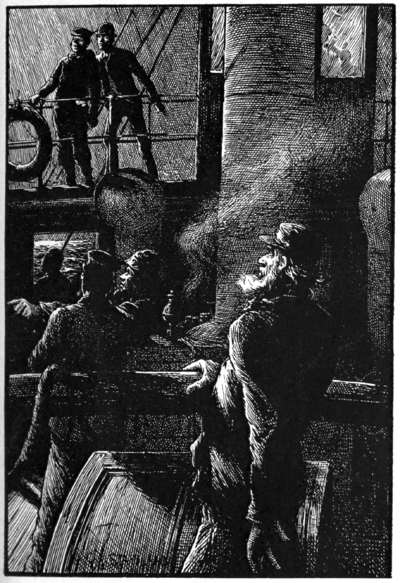
""'YE'RE BUSY UP THERE, BEDAD'" (p. 55)
He had more to say, but it remained upon his lips, for when he looked to the deck below, he saw the mate, Mike Brennan, standing there, his eyes winking in the powerful rays of the flare, but a strange curiosity holding him stiff as he glanced from the men upon the bridge to the distant signal, and again from the signal to the men upon the bridge.
The mate was as yet half-sober, but a glimmer of crazy intelligence lighted up his brain, and he stammered out with reckless simplicity—
"Ye're busy up there, bedad!"
This was his remark, and he went to his cabin again with a pretence of stupor and of sullenness which for a moment turned the others from all suspicion of him. For their part, they were too much engrossed in observation of Kenner's yacht, which lay a couple of miles or more ahead of them, to give him much of their thought; and elsewhere upon the tug all was silence, broken only when the look-out hailed the wheel or the bells rang in the engine-room below. The moon had now risen, and was lighting gloriously the white face of the coast of Kent and the dismal marshes of Canvey Island. There was not a cloud in the great silver arc of the heavens; the surface of the river itself was cut by the shadows into rippling, scintillating lakes of light, which showed the black hulls of innumerable barges and the silhouetted shapes of great steamers. And away out towards the coast of France and Belgium the long line of lanterns, revolving, flashing, stationary, marked the path of the deeper Channel, the great water-way to the mighty city which few of those upon the tug were to see again.
When they had passed the Nore, leaving the light a cable's length on the starboard bow, it became evident that Kenner was acting with a good deal of discretion. he has run his yacht well past the lightship to wait for the tug, and then had seemed to steer for the North Foreland. This was a mere subterfuge, a precaution which assumed the very unlikely possibility that other ships would observe him and sin some measure connect him with the tug. The intention of the menœuvre was not lost either upon Messenger or upon Kess Robinson; and they had scarcely come at the Mouse before the skipper of the tug expressed his satisfaction.
"He's layin' as if for Margate," said he; "and I don't know that he could better it. He'll pick up we in the open fast enough, and the wind's going to hold nor'-west and quiet, or I ain't fit for this job."
"He's certainly standing rather far down Channel," replied Messenger, as he leaned upon the rail and watched the disappearing hull of the American yacht; "but he's got the legs of us at any time, and it's wiser as it is. It wouldn't do to come near him or speak him till we're past Spurn Heas, any way; and he's not likely to lose us in a mist this watch, if I'm any judge of weather."
He spoke with some slight quaver of anxiety in his voice, for he was thinking of that curious play of chance which had so ordained it that the Gargantuan emprise of his life was not to be his own work, but that he must rely in some part upon others. Had it been possible that he could have gathered into his own hands the many reins which controlled so ill-assorted a team of rogues and vagabonds no quake of unpleasant apprehension would have moved him. But he was well aware that the ultimate success of the hazard hung upon the fidelity, the common sense, and the courage of many. And who could answer either for the men in the fo'castle of the tug or for the cutthroats that Kenner had shipped under his flag?
As he minded these things, watching the play of light from the North Foreland, and the twinkling lamps in the distant hamlets of Kent, the tug, under the skipper's direction, began slowly to alter her course. She had been laying with her head almost full east; but now she gradually came round, standing for a couple of hours well beyond the remoter shallows of the Maplin Sands, and soon was following a track which brought her far out in the North Sea. The movement was not lost upon the crew, looking to make straight for Flushing, and three of them came from the fo'castle to wait and watch with some expectancy. Even the engineer looked up from his hatchway as though something would mark the departure at the outset, and the whole company maintained a curious silence, lingering for an opening of the drama in which they played such very minor rôles.
It was no matter for surprise that the first words of the play were spoken ultimately by one who had been forgotten altogether by this company in the larger interest which the watching of the yacht promoted. Mike Brennan had gone down to his cabin again after the moment of the flare; but now, of a sudden, when all aboard were gazing over the starboard bow at the evolutions of the Semiramis, the mate appeared at the foot of the bridge, armed with a great bludgeon of iron; and behind him there stood Arthur Conyers, the elderly clerk, who had drawn his revolver and wore the aspect of a man puckered up for great emergencies. And it was the voice of the mate, then raised in a clear and unmistakably meaning tone, which awakened the others to the situation.
"Skipper," said the man, with one foot upon the ladder and a hand upon the rail, "I've a question to ask av ye concerning the course. Will ye hear it now, or will I be waiting?"
At the first sound of the mate's voice the skipper glanced down to the scene below. Temper and fear alike held him as the moment of the spectacle dawned upon him. Yet he spoke with some command, even before Messenger—who had reckoned up the danger at a look—could give counsel or take action.
"Mike Brennan," said he, "it's not the first time ye're concerning yourself with my affairs. Put yer dirty body in bed before I kick it there!"
The contempt of this was keen enough, but far from judicious, for it sent hot blood coursing through the Irishman's veins, and the skipper's lips were scarce shut before the mate had sprung up the ladder, and with one blow from the bar had sent him hurtling over the paddle-box into the sea, where he sank as a bag of rock, and left almost unruffled the long wave that engulfed him.
From that moment—as the scant record bears witness—the deck of the tug became a shambles. The greed of blood consumed the Irishman until he raved uncontrollably, and, making a mighty cut at Messenger, he missed his aim, and fell headlong to the deck below, where now the crack of Conyers' revolver was heard. The man, with his eyes open to the trap he had fallen into, had lost all self-restraint, and fired haphazard, the bullets singing above the heads of the tug's crew, who lay huddled together by the fore hatch, or skimming the deck, or burying themselves in the bulwarks, or ringing upon the cowls. And through it all he did not cease to cry out with all his voice, so that the tug rang with his shouts, and, believing that Capel was with him in the work, he appealed to him, and to Messenger upon the bridge.
"Capel," he cried, "for God's sake, shoot, man! There's murder done here—murder, I tell you! They're killing the mate! Do you hear me? We're in a trap, I tell you! in a trap, by Heaven!"
But Capel made no answer—he was cowering and sobbing aft, and when bis honest fellow had cried himself hoarse and emptied the chambers of his revolver, a new sound of firing burst up by the forecastle, where two of the crew were using their pistols at the mate, but to small purpose. Brennan, staggering with the dizziness of his fall, had got what shelter he could under the shadow of the paddle-box; but presently he ran with his bar at the three forward, and the skull of one cracked like a globe, while the other two fell howling down the hatchway. In that moment this man and Conyers were masters of the deck, and only Messenger, who had watched the whole scene from the bridge, was powerful to raise a hand.
Unto this point there had been little danger from Conyers, who, in his wild blundering and haphazard suspicion, had left Messenger alone, scarce understanding whether he were friend or foe. But when he had emptied his revolver and stood fumbling to refill the chambers in the black patch of shade which the wheel cast. Messenger sprang down lightly from the bridge and appeared before him as a swift apparition from the dark.
"Come," said he in that peculiarly stern voice he could command on occasion, "I think you've done enough for one night. Put down that pistol!"
Conyers obeyed him, as the weak ever obey the strong, even in the moment of danger.
"Now," continued the other in the same tone, "march aft, and don't come up again until I call you unless you want a body full of holes!"
The man, weary of the butchery, and suffering the terrors of reaction, went to the companion without a word and descended it, when the other locked the cabin-door upon him and turned round to see Capel's pallid face and trembling form.
"Capel," said he, "I'm thinking you're a big man in a difficulty. How came it that this cub got loose?"
"It was the mate," whimpered the other, "the mate, upon my word; he came down to the cabin when you had gone and swore he'd shoot me if I moved. Then he told Conyers—you know what—and they went forward together."
"Just as I thought. Well, some one's got to make it level with that mate, and there's no time to be drivelled away either; I'm going forward, and you're coming with me."
Capel had little relish for the job, but he was nigh as much afraid to stay as to advance, and he hid himself in Messenger's shadow and skulked forward with the new master of the ship. The mate, now scared and giddy, had thrown down his bar and was sitting upon a ballast chest; but he looked up at the soft sound of the footsteps, and sprang to his feet with a ferocious cry.
"Houly saints!" said he, grasping his weapon, "it's yerself, ye mouldy scounthrel, that I've been waitin' to be at—may the Lord giye me strength!"
He stood now full upright, the fine picture of a man in the moonlight; and at the sound of his voice the crew in the fo'castle showed for a moment at the hatch again. Had Messenger been alone with him he would have ended the business then and there with his revolver, but he feared the crew, to whom the mate was even then something of a hero; and he knew that the sound of repeated firing might bring ships upon the tug. In this, however, was his mistake; and even as he stood, with the irresolution of an instant, the Irishman whirled the great bar round and made a mighty stroke at his head. But the blow had been dealt with too great a vigour; the smooth iron slipped from the man's grasp; the bar hurtled through the air with terrible force. It passed above the shoulder of Messenger, who had dropped upon one knee, and, missing him, struck Sydney Capel so full across the face that the bones of his forehead cracked at the blow, and he fell, with the life out of him, prone upon the deck. For a moment the horrid tragedy held the others speechless; the mate shivered as though intense cold had gripped him; the crew crouched backward as from a madman. Messenger alone kept his wits, and, before the now unarmed Irishman had got his courage again, he hit him with his fist and felled him, striking him again and again with heavy blows until the man had no more sense in him than a log of wood. Then he called for a length of rope, and, binding him hand and foot, left him as he lay and went back to the bridge.
The moment was one of the most critical in this strange man's history. The most trivial curiosity of a drunken sailor had in one half-hour threatened the giant superstructure of design he had created with so much labour. Here he was almost full in the track of ships plying to the Scheldt and to Holland, by no means ready for the transfer of the bullion to the yacht, lacking the animal cleverness of the dead Kess Robinson, with the deck of the tug bloodstained, and his partner in the felony no longer living either to participate in success or to share the shames of failure. Indeed, his predicament was one of vast dangers, for the crew of the Admiral had become paralyzed with the precipitancy of the fight, and crouched in their hammocks daft with terror; the engineer went to his work mechanically; the man White, who had come back to the wheel, muttered and crooned like a hag at a distaff. Not one of them had the veriest suggestion of action or any thing but fearsome languor in him; not one but shuddered every time he turned his eyes toward the spot where the dead man lay. Messenger, even with his wire-knit nerves, suffered for some time the contagion of the terror. He found himself pacing the bridge with nervous strides, or pausing in keen thought, or gazing out seaward, where the sweep of the horizon gave him sparse encouragement. Kenner's yacht still lay a couple of miles away from them; but there was a fleet of North Sea smacks upon the port quarter, and a couple of steamers stood out clear some three miles away in their course. Under other circumstances that was not the time to have acted. The danger of remark and observation was too palpable. The sinking of the tug might even be reported in London before the morning watch. Yet the man had a haunting wish to quit the scene of the deadly brawl at the first moment possible. He gained a new terror from the want of talk, and at last he called the engineer, a Scotchman, by name Alec Johnson, and set upon his questioning.
"Well," said he, "this is pretty work for a beginning."
"Ay, it's a sorra spectacle, man, and yer no cutting a fine appearance, may I tell ye," replied Johnson, as he stood at the foot of the ladder and hesitated to mount it.
"I don't want your opinions," said Messenger testily, "but your notions, if you've got any. Do you think it's time to be moving from this ship?"
The engineer shrugged his shoulders, suggesting his indifference.
"Well," said he, "you're dawdlin' in queersome company. I've no stomach myself to jawk wi' the dead, but the sea's muckle full of ships for what ye were thinking of."
"That's true. You've some glimmer of intelligence, any way," answered Messenger, as he resumed his sentry-like perambulation, pausing only at the second turn to continue his argument.
"Is all right below when the time comes?" he asked with some anxiety. "We've got to see this hulk out of sight five minutes after we leave her, any way."
"Man, ye can rest on that!" said the Scotchman; "she'll just flichter and go down like a bag wi' a stone in her; and look ye: there'll be mist afore the morn, and it may give ye shelter."
"So there will," cried the other, as he turned away, leaving the engineer to go below. And for a couple of hours the tug steamed onward, the thud of her paddles the only sound, her decks untenanted save for the solemn, wakeful man upon the bridge, and the moody, inert, sullen fellow who took the wheel. Day had now broken, with cold grey light and piercing white mist, which settled humidly upon ship and watchers, and hid the near sea so that neither the yacht of the American nor such packets or smacks as lay by them could be seen. But anon a great wave of dull red light split the vapour through, floating it on wings of radiant colour, or dissolving it so that at last the waste of green water, all capped with playing flecks of foam, lay clear to the view, and the invigorating freshness of morning seemed to call nature anew to the labours of the day. That hour, so superb in its breath of strength, so life-giving to him who rises from long sleep, was an hour of new fear to those that remained in the shambles of the tug. As the sun rose it seemed to lighten the face of the dead man, who lay as he had fallen, with a hideous, ghastly glare upon him, so that the crew, coming with a new courage a little way aft, shrunk back and implored to be set free, or cried out that they would all be taken, yet feared to touch the dread thing and send it to the sea, which engulfs the dead in so sure a resting-place. Messenger himself understood with his usual perception that the tension could not be long endured, and at the change of the watch (there being but one steamer other than the yacht in their wake, and she many miles on their port bow) he suddenly gave the order to go about, and stood boldly for the Semiramis',' though all the risk of the action was apparent to him.
The men, raving with delight at the thought of release from the unendurable prison, now came scampering up their ladder, though they did not venture abaft the foredeck; and in a moment all was activity. There were but five of the crew remaining, and of these one was almost a boy, who was called "Billy," and reckoned half dolt, half idiot. As for the mate, who had lain near the fore hatch apparently insensible, and bound since the fray, he was forgotten by all in the thirst for change at whatever risk or price. The new course was, it may be imagined, at once observed by those on the Semiramis who fell to signalling; and in a run of ten minutes the tug had come alongside the big yacht, and, being grappled, twenty hands hoisted the bullion to the crane, and guided it over the aft hatchway. It was no time for greeting, no time for any thing but a babel of voices, a quick pumping of donkey-engines, a bustle, a confusion, and a riot when the men from the tug tumbled pell-mell upon the yacht, and the dead were forgotten, and the bound man below had no mercy from the hungry wolves who clustered about the gold.
The exciting work occupied some twenty minutes in performance, and having been accomplished, Roger Burke, upon the bridge of the Semiramis roared the order: "Let her go!" The tug swung away from the hull of the greater vessel almost with his words, and a few powerful strokes from the twin screws separated the doomed ship and the other by several cables' lengths. At the distance they waited for the end, but before the end could be there was an apparition upon the bridge of the Admiral which sent pallor to the faces of the exultant crew, and drew from the men cries of rage and of apprehension. For suddenly, as the tug drifted, the man who had been bound and forgotten, Mike Brennan, the mate, appeared by the wheel, and with frenzied imprecations called threats from Heaven upon the watchers and their ship. During one moment he stood, and then there came a great dull roar as of a mighty explosion in the engine-room below him; and the little steamer, heeling to the shock, cocked her stern above the playing waves, and in the next instant had plunged below them.
With the gurgle of the hull the mate disappeared; but as he went the voice of Billy, the daft boy, was heard in triumphant exclamation—
"I cut him free, I did it; who'll hear Billy, oh, dam clever, dam clever!"
The tug sank with his words, and while many of the crew called upon the skipper to search the waters for the spectre of the bridge, others observed that the strange steamer, which had been an hour ago but a speck on the horizon, loomed large on their starboard quarter, and Burke would wait for no man.
"Mate or no mate," said he, "I'm getting, and I guess ez there'll be a tight run as it is. If that ship's took the bearings of this business, there'll be half the cruisers floating on our track afore night, and that ain't my particular fancy, not much."
And at his command the Semiramis bounded forward to her doom.
It was upon the evening of the third day after the going down of the tug, at two bells in the watch, that the Semiramis entered the Minch, and began her passage southward. She had run at a high speed, but under no forced draught, and with all possible economy of fuel, up the North Sea to Duncansby Head. Thence rounding Cape Wrath (but at a great distance from the light to escape all observation) she had struck boldly past the Western Isles on her ultimate purpose of making the open Atlantic. And she was then ploughing her way upon a stiff swell, and against a full south wind, to the less dangerous water-way of the greater ocean.
During three days all the fever and unrest of inexplicable fear had sat heavy upon her crew; and in some part upon those most concerned in her fortunes. It had been a voyage girt about with apprehension, pursued in foreboding, matured in ignorance. Unmindful of the bulky cases of gold which lumbered the great saloon, and in which masters and men were at no distant date to participate, the hands had not ceased to ask themselves: What do those in London know? How far are we wise to hug shores like this? When will the pursuit begin? To their blunt intelligence it seemed the apex of folly that the Semiramis should, even for the space of a day, haunt the confined waters of the Scottish coast. Urged on by Johnson, the engineer of the sunken tug, and quietly encouraged by the evident restlessness of Kenner, they stated their views on the quarter-deck, or sulked in their own fo'castle, or even contemplated such an outbreak as would have ended the business upon the spot.
It was not difficult to realize that the cargo of money was to such as these an all-potent temptation. Although the precise means by which it had come into the power of Messenger and Kenner were unknown to them, its presence in the saloon was like a loadstone that drew them abaft the funnel irresistibly, and allowed them to think and speak of naught else but bullion. So strong was the temptation that on the second day the hand George White, who had been one of Robinson's men, was found in the cabin rolling over a keg of ingots in his effort to open it, and, being taken in the act by Burke, was ordered out for immediate punishment.
"I'll make an example of ye ez'll go right round the ship," said the skipper, as the man stood before him an' if that don't cure, I'll empty my shot-gun in yer hide!"
"Ye can't touch me," said the man sullenly; "I ain't signed for you, and I don't see no one here as is going to make me."
The hands had crowded round the engine-room hatch (where the discussion was held) at the sound of loud voices; and some of them murmured at the man's plea and agreed with him.
"Ye can't touch him," said they; "he's none o' youm, and we're all his way."
Burke looked at them very quietly as they spoke, and, one of the fellows approaching him in a threatening attitude, he suddenly whipped out a great army revolver from his hip pocket and hit the fellow such a crash over the head with it that he went reeling backward until his heel caught in the iron of a glass-light, and he fell his whole length upon the deck.
"Now," said the skipper, "I guess ez I'm open to any more arguments o' that sort. Is there them among ye, belike, as will step forward and state 'em?"
They all slunk away at the words, the man White seeking to shuffle off with the others; but Burke suddenly held him with a great grip and shook him so that his teeth chattered. "A-goin' for'ard to sleep it off a while, was ye? "said he. "Then I'm darned if I don't wake ye up a bit! Here! lash him up to the rail, some of ye, and make his legs fast to that ballast there. It ain't no queen's ship, ain't it? You didn't sign no papers for me, didn't ye? Wal, by Jerusalem! I'm a-goin' to sign 'em for ye, and seal 'em, too!"
Four lascars who had watched the whole scene with an Oriental indifference, at once stepped out to obey Burke's orders. Messenger and Kenner had kept back during this sharp encounter, both of them holding themselves altogether apart from the crew throughout the voyage; but Fisher, who stood upon the bridge, almost turned sick through the scene that followed. The burly seaman was triced up by his arms to the boards of the bridge; his feet were lashed to the ring of a ballast chest; his coat was torn off his back; and thus hanging by his arms, and almost bearing the whole of his weight, he received his punishment. Fifty swinging lashes from a whip with three leathern thongs descended upon his bare back, the sound of the blows echoing through the ship with the sound of a cane that beats heavily upon a board; and at each blow the seaman roared like a bull, while his cries for mercy were as pitiful as the wails of a child in pain. When they took him down, he had fainted; but Burke kicked his body with his foot, and, squirting a mouthful of his filthy tobacco upon the deck, he said:
"So ye didn't sign, my son! Well, that's my mark instead, en I reckon ez it'll take ye a week or two to wipe it off. Throw him into a bunk, one of yer, and if ez got any more views when he wakes, I calculate I'm ready to hear 'em on the same terms."
The scene was concluded in a wistful hush—the hush of men obeying, but not obedient. Burke's ferocity had cowed all spectators; for the moment it had overridden the danger, and it had sent Hal Fisher to the saloon with the gloomiest face possible. For three days past the lad had seemed to live in a hazy dream—a dream which had brought to him many pictures and many episodes, but chiefly shadows of impressions, as dreams will. He remembered that he had gone to his bunk two nights before, to be awakened in the morning watch by a great commotion and bustle on deck; but on trying his door he found it locked, and it was only after some hours, and when he had slept again, that he reached the deck, to learn that they were standing right out in the North Sea, and that many strange events had happened in the between-time. For one thing, his friend Messenger greeted him directly he had mounted the companion, and while he stood gaping at the sight of new faces, and wondering at the amazing fact of their appearance, the Prince had slapped him upon the back, and begun his explanation.
"Hal," said he, "you didn't look to see me this morning."
"I didn't look for any such luck," replied Hal, giving him grip for grip.
"Well, what did I tell you three days ago? The fact is, old man, I've been driven almost wild with work since three months ago, and now it's over, or nearly over."
"And I suppose you'll condescend to tell me something?" suggested Hal, with his old doubts upon him.
"Why, of course I'm going to tell you everything—and that's told in half-a dozen words. In the first place, we're going somewhere, and it's no twenty-four hours' pleasure trip—that you can see; in the second, we've got something on board that we wouldn't sell for a shilling a pound, Hal; it's a freight of money!"
He almost whispered the last words; and as he saw the boy's surprise he laughed cheerily, and, linking his arm with the comparative youngster's, he began to pace the deck abaft the engine-room.
"Yes," said he, picking up the thread without more ado, "Kenner and I are in for a big thing, old man. We're trying to run this freight to Buenos Ayres in the interest of the Argentine Government. It's a big job; and the men for'ard can't exactly be trusted as though they'd come from a seminary. We may have to fight. In any case, we've got to use our sea-legs. And you'll have to stand by us, as I said four days ago; but I needn't ask you if you'll do that?"
Fisher listened to the clumsy lie as a school-boy listens to a tar's yarn. The truth was that Messenger almost made the tale as he went; for he had to satisfy the boy's curiosity somehow, and certainly he met with no embarrassing questions. His pupil had seen little of life, and the obvious absurdity of the notion that there was unusual danger in carrying money to the Argentine never dawned upon his untrained mind. He only thought that here he was plunged in a moment into as good an adventure as ever he beard, and he answered with fine enthusiasm—
"Stand by you! Why, of course! Is there any one else I should stand by if it isn't you?"
The mutual confidence would have been beautiful if it had not been all on one side—an exchange of frankness for lies, of love for a selfish liking. Yet Messenger had the greatest satisfaction at that moment in having at least one honest hand with him on the ship; and if the truth be told, he trusted the boy alone of all the company. Kenner was a tricky rogue, who would turn upon him at any moment; Burke was a ranting bully who—then, at any rate—had the command of the situation; Messenger had to depend upon his wits and fine talent to come out of the undertaking even with his life. In such a situation the boy he had before befriended could be-friend him; and befriend him he did, as the development of the narrative proves all conclusively.
If I, the recorder, have harked back somewhat in an endeavour to make the situation upon the Semiramis clear, I can now progress more rapidly in laying it down that, with the one instance of the flogging excepted, the first three days of the flight lacked any episode of moment. There was the unrest I have spoken of upon the yacht, the mutterings, the occasional outbursts of temper; but, beyond these, no tour de force on the part of the men, no event of any interest upon the sea. So far, indeed, did the yacht stand off the shore that the light of Cape Wrath was not even seen; and, Burke believing that the notion of pursuit was an old woman's dream, they passed through the Minch on the evening of the third day, and at eight bells in the forenoon watch they sighted Skerryvore Lighthouse many miles distant on their port quarter. From that point they shaped a course west by south to run past Malin Head; and although they passed many steamers of considerable size which were making for Scottish ports, they stood as far from them as possible, and spoke none, nor, indeed, invited any observation.
This, then, was the situation on the third day, and it did not alter until midnight, when Fisher came on deck to take the middle watch. It had been agreed by the cabin party that they should, one by one, take duty at the head of the companion, lest the great temptation of the gold should lure any of the crew aft, and this duty the boy shared loyally with the others. For the matter of that, not one of them aboard took his clothes off from the first hour of the flight, nor did any of them let his revolver go far from his sight and grip. As for Fisher, he had been given a couple of pistols, and told to shoot down any man who attempted to enter the saloon without an open account of himself; and while he might have hesitated literally to obey this order, Messenger and Kenner got nearer to sleep during his watch than at any other time.
The boy being thus upon guard, and quiet reigning in the ship, the fourth day began with squalls from the north-west, and a tumbling sea, which spread sheets of bubbling foam upon the foredeck and sent gushing streams from the lee scuppers. The night was very dark, with mountains of heavy cloud which hid the heavens, and for the first two hours of the watch there was no moon. It was even bitterly cold, as with the cold of later winter; and Fisher, who paced the quarter-deck with many lively thoughts, shivered in his oilskins, and suppressed his yawns with difficulty. Burke was at that time sleeping, and his subordinate—a thin and very humble man, named Parker—paced the bridge, while aft the whistling of the sharp gusts in the shrouds alone broke the stillness.
Once or twice, as the lad strode up and down in the utter darkness, he had thoughts that others moved upon the deck near him; but his nerves were overwrought and weary, and the singing of a rope, or the thud of the heavier fleas, sent them twitching. As the bells were struck until four were numbered the depth of night was more intensified; the wind was shriller; the motion of the yacht more irregular. He found himself hanging to the rail at the top of the hatchway for sheer footing, and was there haunted by innumerable phantoms of suspicion to which the bleakness of the night gave birth. There were moments when he was certain that he heard, at the fall of the gale, whispers from the darker places by the bulwarks; other moments when he conjured up visions of figures, dark and armed, lurking behind the skylight. Or, again, he suffered from that illogical conviction, which many suffer in solitude, that some one stood by him in the dark and was about to clutch him; and this feeling was so strong that he was truly of a mind to awaken Messenger and the others, but did not, fearing to look a coward.
In this approach to terror he watched for some moments longer, when of a sudden, chancing to look down the higher line of the deck, he was absolutely sure that all was not a dream. There, almost at his feet, the hunched-up figure of a man lay timidly, as of a man watching to spring, but fearing. Hal looked at the man for a moment, whipping out his revolver as he did so, and was in the very act of firing when the watcher rose and gripped his arm.
"Billy no hurt!" he chattered; "you don't shoot Billy! They cut your throat jess now, cut every one. Billy know, he see 'em; oh, he see 'em!"
In this mood the daft lad raved whisperingly; but Hal stood wondering and still with the sudden alarm. Should he descend the companion silently, or should he fire a shot and bring the sleepers to their feet that way? For a moment he did not know, and as he waited twenty figures—armed, most of them, with knives and iron bars, but three carrying revolvers—came with cat-like tread from the deckhouse amidships to the poop.
The purpose of the men being no longer hid, Fisher set himself quickly to action. He fired three rounds from his Colt, and then bawled with all his strength for those below to come up. The sing of the bullets held back the throng for a moment, but no longer. They had not further need of stealth, and began to shout savagely, hugging close the one to the other for encouragement. Their answer to the pistol-shots was a discharge of their own weapons and many imprecations. In another moment they would have been all atop of the ladder and swarming down to the cabin; but of a sudden they held together with a great cry, and many of them fell upon their knees in an extremity of terror which no phrase could convey. And upon them there shone a great light, full of whiteness and dazzling—a light that came in focussed radiance across the sea, and cut a path of spreading brightness out of the very blackness of the fullest night.
The light fell upon them, as I say, and for many minutes they could neither speak, nor move, nor did any man ask his neighbour, whence comes the terror? It lay on many of their minds that some visitation of God had opened the sky to shed light upon their work; and until reason had rolled back upon her balance, they had neither tongues nor ears. But anon, when Burke and Messenger had come running up from the aft cabin, and the skipper had observed the dark hull of a cruiser, whose search-light played upon the yacht from a point some two miles away on the starboard quarter, they passed from their fear to wild oaths; and as the sound of a gun rolled over the sea, the white faces and bright eyes of the whole of them turned quickly to that place where the danger was to be observed.
So far as one can learn from his later narrative the first man to speak in that moment of panic was Burke, the skipper. Suddenly, as with the sound of a wild animal roaring, bis curses and orders echoed through the ship.
"Curse you for a parcel of lazy swine, get up!" he roared. "Get up, I say! Do you think ez it's the Day of Judgment, ye Chicago hogs? All hands on deck and to their places, ye white-livered lubbers! Move, move, or, by thunder! I'll come down and move ye!"

"UPON THEM THERE SHONE A GREAT LIGHT" (p. 79)
They awoke at this, rushing to their places. A double watch tumbled into the stoke-holes; a couple of gunners cleared the three-inch Nordenfelt guns which were fixed in the bow and amidships. In five minutes the whole thought of the contemplated scuffle for the gold was forgotten. Bells were ringing, orders were bawled, the forced draught began to roar in the furnaces. The whole deck, which had been a hive of silence ten minutes before, now echoed with movement, with voices, with the clamour of action. Nor was there need of explanation. Instinctively all aboard knew that the pursuit was no longer a possibility, but an actuality; that by some plain chain of circumstances those upon land had heard of their filibustering, and were seeking them. Men passed each other in those moments with scarce opportunity to exchange an opinion; but those that spoke uttered such convictions as: "She's after us, for sure!" or such questions as: "Be they going to take us?"—and a gloom settled sternly upon the more part of them. But they worked with an unquestionable will, though their new fidelity was as much a matter of self-preservation as their erstwhile treachery had been the outcome of covetousness.
While there was this hubbub of order upon the decks below, there was upon the bridge a display of fine command and skilled seamanship. Burke, who ruled with resonant voice, and was easy to be heard above the wind, had eyes both for his own men and the plunging cruiser. Messenger gripped the rail and smoked a cigar with easy assurance. Kenner was restless, and dared a pessimistic forecast at unseemly intervals.
"Wal," said he, "I said it was a swinging job at Monaco three months ago, and, by gosh! it looks like setting me up in the prophet line!"
Messenger listened to him with a child-like smile playing about his mouth, and answered—
"Why not go to bed till we're out of it? They tell me that some men get wonderfully good notions with their heads under the clothes."
"Maybe," replied the American, "and maybe I squirm. But don't you see he's driving us right along agen the Irish coast? and where are ye then?"
"Why, right along the Irish coast, I suppose, as you say so."
Kenner stood before him and looked him up and down.
"Prince," said he, "I guess if I rubbed ice agen you, you wouldn't melt it. Hang me if your mother didn't feed you on snowballs!"
"Perhaps," said Messenger; "anyway, she taught me that you don't go far on a harum-scarum, and it's true."
"But," argued the other, getting angry, "don't you see, man, that once she's forced us shoreward there'll be twenty ships on our tail? You don't seem to take it in!"
"That's likely," replied Messenger, as he struck a fusee. "There are few things, however, I don't take in when the opportunity comes. The fact is, I wasn't born a skipper, and I'm too old to turn to that job. Don't you think it's as well to leave the business to Burke?"
This latter word expressed the whole of the man. Since he had got the money upon the ship he knew that the better part of his work was done. He was not a seaman; it rested with Burke, the skipper, to get the bullion into port. He could only wait and watch, and take from chance the gift apportioned to him. Kenner, on the other hand, was a man who concerned himself in every person's business, and did nobody's. He envied the Prince his sang-froid, his illimitable calm, his assurance; and when he could get nothing out of him, he went to Burke, who had his hand upon the communicator, and renewed his absurdities.
The situation was at that time very critical. Dark still held down upon the sea, save in that arc of whiteness which the search-light cast. The wind blew almost a full gale; green seas swept the foredecks and threatened to flood the fo'castle. The yacht trembled from stem to stern as every foam-capped mount of water struck her and went swinging away down her whole length. So great was her speed that she scarce rode a sea, but dashed through it with foam-spurts shooting up incessantly above her prow and a quivering of her plates which sent fear palpitating through all who felt it. There was no thought then, however, either of tempests or of the great rolling volumes of foam and water which were driven by the wind in mighty devouring masses, until they struck the iron coast of Donegal, fifty miles away. All eyes were turned upon the cruiser there, pursuing as a hideous phantom of the night, clinging to them, despite the vast use of fuel, seeming to have gained upon them every time there was a lift of the night or any show of her beaming light. And when another hour passed, the conviction, which had been growing since the beginning of it, became emphasized, and men expressed it, crying: "We're took! Heaven help us, we're took!" and clinging together as those upon whom a vengeance comes, to find them unready.
And thus the night passed, and the angry dawn rose above the wildness of the sea.
Day broke slowly, with a low mount of black cloud over the sea and but scant abatement of the wind, which began to blow again from the fuller west. Torrents of cooling rain now poured upon the decks of the Semiramis and were sport for the hurricane, which tossed them hither and thither in blinding sheets. All over the angry waste of water the loud contest of the thundering rollers was to be heard and seen, booming out with the dull roar of rushing cataracts, or spurting high in silvery cascades where the greater waves were checked. The darkness of night was scarcely worse than the gloom of the new dawn—a gloom of lowering black vapour and raging sea, of the mournful wailing of the wind and suggested desolation.
When the light, such as it was, gave clearer outline to the worn face of the Atlantic, those upon the bridge of the yacht looked down upon a strange scene. There were but two ships on the sea with them; and of these one was the cruiser, which plunged through the swelling tempest a couple of miles away on their starboard quarter; the other was a full-rigged ship, now running under a storm-jib and reefed topsails toward the Irish coast. For the rest, there was nothing but the restless flash of white water, the swirl of giant billows, the crash of breaking rollers, the hemisphere of gathering cloud.
With such an environment the customary spirit of Burke's crew was altogether lacking. For the most part, the men lay huddled together just abaft the fore hatch, and had eyes for nothing but the pursuing cruiser, which seemed to hold the yacht so easily, yet could gain nothing upon her. They had even ceased to ask the question: "Shall we be took?" but remained inert and hopeless as the chase went on and the situation remained unchanged. Nor did those upon the bridge speak, but took it as men at war with chance but to whom chance is no taskmaster. This tension was almost insupportable for some hours, while the yacht plunged onward at a terrible pace, and thrilled and quivered as a woman who has received a blow. It might have endured to the end had not the cook, one-legged Joe, to whom all things were but meat for the pot, come up from the galley and begun, after his usual habit, to stump the deck, and call the hands to breakfast, as a muezzin calls to prayer in the cities of the Prophet. Joe was a half-caste, and his jerky step upon the fo'castle was the surest signal to merriment forward under placid circumstances; but on that morning of the fourth day it was little welcome, and for some time, at any rate, it met with curt response.
"Be gor!" cried the man, as he hopped up and down, his fine balance disregarding the vigour of the lurches—"be gor! if this don't beat cold rum! A sight of gemmelen what hab forgotten eight bells; and all for a bit of a ship that Joe wouldn't go for to jump over, sahs—not for to jump over!"
He stopped his antics before the Scotchman, Johnson, who was holding fast to the shrouds of the short foremast and surveying him with withering contempt.
"Man," said he to the cook, "ye're ower blithesome for the time of day, I'm thinking. Have ye no stomach for yon?"
"Sah," replied Joe, "you warm the innar man, sah; you gib 'em plenty stomach by-and-by; you gib 'em what young gemmelen call hot-pot and slops, sah—Joe know; he smell war, sah, while him a long way off!"
With this he fell to hopping up and down again on that ill-made steel leg, which served him at once as a means of ambulation, and, as the crew declared, in place of a cooking-spoon when the need was. For the matter of that, he bawled so lustily and with such effect that a few men presently turned down to breakfast, and Burke followed their example, leading Kenner and the others with him.
It was not the hour when men might think of food; but the skipper knew that long and arduous labour was before them all; and, for himself, he showed as good an appetite as a roisterer at a village fair, and washed down great hunks of meat with frequent potations from a bottle of Hollands.
"That's the stuff ez'll warm you best for a picnic such ez this is," said he, as he pushed the bottle to the others. "None o' your slops and fizzing pison fer me. Prince, nor yet coffee neither; I guess Rome wasn't took on that sort, en we ain't a-going to git this yere yallow cargo ashore on it no more'n they could—give me spirit!"
"You appear to be helping yourself," said Messenger, upon whom the excitement of the moment had no power for impression; "I don't see where we come in, any way. The fact is that all you fellows want to deaden your wits with that stuff at the very moment you have most need of them. I shall take coffee, if there's any to be got."
"Wal," interposed Kenner, "so should I if it wasn't an occasion. But if this don't beat a birthday fête, I never knew one. Blarm me! but I can think on liquor."
He consoled himself with the conclusion, and fell to work to prove it, holding a glass in one hand and food in the other, since the yacht rolled so terribly that the swinging lamp above the table threatened to strike the skylight at every lurch. In reality his craving for strong drink was the outcome of the raging anxiety—nay, even fear—which consumed him, and, indeed, all of them but the Prince, who made as good a breakfast as a hunting squire, and did not cease a gentle irony and banter through the whole of the meal.
"Burke," said he, in one of the intervals, "I want to know what you're going to do if we can't show that ship yonder a clean pair of heels before night."
"What em I going to do ? " asked Burke. "Wal, that's a fair question, and I'll give you a fair reply—I dun know!"
"Perhaps you can tell us, Kenner?" said Messenger, turning to the American. "You think on liquor, you know."
"That's so," replied Kenner; "but I ain't full up yet. I guess I can tell you one thing, though, my boy: if this hulk don't show a couple of knots more in the next two hours it's nothing stronger than skilly that most of us will be lapping, and that only for a spell."
Hal Fisher, who listened to the conversation eagerly, looked up at the words, and asked—
"What does he mean, Prince?"
"Means ez he'll have to dance the polker with no par-ket floorin' under him," replied Burke, who took up the conversation.
"And he means also," said Messenger quietly, "that this skipper of ours is a bigger fool than his bulk gives you any idea of."
"What's that?" cried Burke, bringing his huge fist upon the table with Gargantuan strength. "You're going to take that back, I reckon, en quick!"
Messenger leaned against the cushions of his seat, one of his hands resting upon a case of ingots, and just showed his white teeth in the suggestion of a leer. But Burke was fuddled with the liquor and quarrelsome, and he half rose from the table and asked, with a hiccough—
"Who commands aboard this ship?"
"Sober men," replied Messenger quietly.
"I'm asking you for a plain word, en no roundabout! Do I command ye, or do I not?"
"You may command who the deuce you like," answered Messenger testily; "but if you say two words to me, I'll pitch you off your own bridge!"
The threat was mildly said, but the slim man who spoke looked so well able to answer for his words that the great skipper sank back upon his seat with a senseless smile and turned the conversation.
"Go on!" said he. "I always knew ye for a ornery one, and if any one says as there's harm in ye, I give him the lie, the straight lie. The question is: What do yer want? I've done all ez I ken do, I reckon. Ken you do more? Will you tell me that?"
But no one answered him, and the Prince began to speak to Kenner.
"Kenner," said he, "every cock on his own dunghill, and every skipper on his own bridge so long as he's got the wits of a mule. The situation is as clear to me as that coffee-pot there. The ship we're running from is trying to drive us to the mouth of the Channel, and if she does so, the 'In Memoriam' notices will be up for all of us inside a month. Personally, I've no love for assisting at funerals, and I've less hankering to be the chief actor in one. Yet it's quite clear to me that, since they've got the legs of us, we must either find the open ocean, or leave the thing now, like a lot of old women trooping out of an excursion train. You told me that you could show heels to any thing swimming; but you can't, and that's the weak spot in the whole of it"
"Stay a bit! " cried Kenner; "you're not at a political garden-party, and I don't foller. I said this yacht could do twenty-two knots in a free sea; and so she can—I'll go my last dime on it!"
"That may be," replied Messenger; "but whatever she can do, the other is up to it. You've got eyes, and you can see as well as I can."
Burke looked up suddenly at the words, and chimed in—
"She's doin' twenty-two knots now, if that '11 help you !"
"Possibly," replied Messenger; "but I'm not interested. What I want to learn is the exact time and place when you mean to shoot for the open."
"Wal, if it's shooting you're after, you'll get plenty of that directly you put across her bows!" said Kenner expressively; and the skipper gave a great guffaw at his words, as a drunken man will ever laugh at a hand's breadth of pleasantry.
But the laugh was still upon his lips when the roar of a gun echoed over the sea, and the three mien sprang to their feet together.
"They've begun it already!" said Burke; and in a moment he shook off the grip of the drink and bounded up the companion. Thither the others followed him, to see a cloud of smoke enveloping the pursuing cruiser, and their own men lying about the deck in a depth of fear and craven sullenness which surpassed any thing they had yet been guilty of.
The hour which the men had spent in the cabin witnessed but little change in the path of the hurricane. There was, perhaps, a slight abatement in the velocity of the wind, and the black banks of cloud had burst asunder into great masses of rolling humidity, which showed other masses, and these of a purer grey or white, in the distance beyond them. Yet there was scarce a glimmer of sun, save for a space of five or six minutes, when a fan of spectral light shot down upon the green of the sea, dazzling with hues of sparkling brightness; but promising no fall of the gale nor moderation of the raging tempest. Everywhere the whited wave-caps tumbled joyously upon one another; everywhere the gigantic rollers made hills and valleys of green water, which swept the yacht and her pursuer onward as they would have swept a faggot of sticks or a board of wood. It was a scene worthy of the mighty grandeur of the Atlantic, of all the traditions of tempests which sweep upon her; but it had little charm for those upon the Semiramis nor, as one may know, for the hands of the cruiser, which then bore the whole brunt of the seas in the work which had fallen to her.
Burke's first question, when he got upon the bridge, was one concerning the gun which had just been fired, and whose smoke still lay upon the sea.
"You, there !" he cried. "Was that shell, or was it blarney?"
"It was a shell, sir," said the mate, Parker; "it just cleared the life-boat davits, sir, may it please you,"
"By thunder, it don't please me!" cried Burke. "What are they doing down below, the scum?"
At the words, he shouted down the tube for more coal, though the men were already reeling under the work, and the furnaces were white hot with an irradiant heat, which was almost unbearable in the stoke-hole. To hope for greater speed was the dream of a dreamer; yet, despite all that was being done, the two vessels maintained their relative places, and it had already become clear that, if there was no coming-between of chance, the yacht must be taken.
When Burke had exhausted his breath in childish abuse to his engineers, the humble mate, Parker, ventured to speak again.
"May it please you, sir, they're signalling," said he.
"Let 'em signal till blazes!" replied Burke ironically. "Do you think ez I'm daft enough to parley with 'em? No, I reckon not!"
"They say—for I read their flags," continued the mate, disregarding his bluster—"that if you don't let them come aboard at once, they'll fire shell on you."
"They say that, do they?" replied Burke ironically. "Well, I guess I ain't a dictionary, but I've got a word to answer that. Clear the aft gun, there!"
The men rushed aft at his word and cleared the Nordenfelt quick-firing gun, seeming to find consolation in the work. There was not one among them that had yet seen an action, either afloat or ashore; and to such as these the fire from the Nero—for they now knew the name of the cruiser—was a terror which the excitement of reply alone could mitigate. Even the Scotchman breathed a breath of enthusiasm, and stood near the group of workers, shouting and gesticulating with an energy altogether foreign to his countrymen. And he was in the very throes of a wild speech of exhortation when the Nero fired, for the second time, as she rose upon a mighty wave, and her shell, striking the yacht abaft the engine-room, but well above the water-line, carried away the bulwarks and shivered the skylight of the saloon into countless atoms. For long moments after the loud report a cloud of thick choking smoke held down upon the deck of the yacht, but when it cleared away, three men lay dead of those about the gun, and the Scotchman was not to be seen. He had stood at the very point of contact, and the bursting shell had blown his body into the sea.
When the whole havoc and destruction following this—in one sense—lucky shot was to be reckoned, the fear of the crew passed quickly to wild rage. Men, roaring like beasts, began to work the Nordenfelt wildly, or shook their fists in savage rage, or begged for liquor in the moments when reaction brought a new terror. The very deck they worked on was all slippery with foam and wet, making passage difficult, and the splinters of the broken woodwork, splashed with the blood of the dead, washed about in little pools near the scuppers.
As for the poor fellows who had gone down, they let them lie where they fell, their protruding eyes looking up with a glassy and rigid gaze to the heaven they could not see; their bodies rolling with the way of the ship, or even being trodden upon by the maddened brutes over whom the pall of capture loomed so threateningly. All this time the bellowing of Burke upon the bridge was scarcely audible in the shriek of the wind, which seemed to gather new strength from its momentary rest. The scattered billows of cloud were now bound together by the hurricane in an arc of dense blackness, whence the rain descended, and whipped the faces of the men until both they and those upon the cruiser abandoned all attempts at further exchange of shell and shot, and went onward, onward, to the horizon of blackness and the very depths of the hurricane.
In this mutual truce before a greater power than man's the race went on until after one o'clock, at which time the Semiramis crossed the mouth of the English Channel, still running southward, having sighted the White Star liner Teutonic outward bound, and, at a later hour, the Cunarder Campania, making for Queenstown. Both ships were plunging into the huge seas in a way that betokened the strength of the west windy and were casting fountains of foaming spray from their prows, or being swept by the green water, which seemed to mount nearly to their hurricane-decks. But they stopped to exchange signals with the Nero and when Messenger saw it, he said—
"Burke, that's bad; we shall have a whole fleet at our heels in twenty-four hours."
"Maybe," said Burke; "but I dun know ez worse luck'll come of it. That ship yonder is the last thing the Britishers have done, or she'd never have kept her mark on me all these hours, I guess,"
"Wal, we've got to thank this handsome zephyr for something," interposed Kenner, who had been immovable at the door of the chart-room since he came upon the bridge; "if it hadn't blown wild cats since yesternight, I reckon there'd have been a swimming party."
"We'll fix it up yet if there's no more ideas among us than we've got now," said Messenger gloomily; but Burke took him up quickly, crying—
"I guess not. If there's eyes left in my head, she's tailing off. Which among you is bearing me witness?"
"Tailing off!" yelled Kenner. "Do you say so? God forgive you, I believe you're right!"
"He is right," said Messenger. "She's half-a-mile further off than she was an hour ago."
It is an old remark that in moments of great danger the least oscillation in the balance of fortune is construed by those whom it favours as a great victory. No sooner did the crew hear Hal's words than they shouted with a savage joy which was as repulsive as their ravings of an hour ago. Crowding upon the poop, in defiance of all discipline, they roared out wild defiance and brutal oaths, as though the wind would bear them to the distant vessel. Then, when they had run a signal upon the flag halyards, they lowered it and hoisted it to express their merriment; and a brute, exceeding the others in brutality, suggesting that they should show their dead, they triced up one of the bodies to the gaff and allowed it to swing in hideous mockery.
Through all this Burke was silent.
"They're letting the steam go," said he; "and if you don't want a scald, leave 'em be."
Meanwhile the fact that the yacht was distancing the Nero was indisputable. She must have been then three miles from her, and it seemed possible that before night she would have run right out of sight.
To Messenger the time looked more than opportune for the shoot from the shore; but Burke enlightened him with one of those surprises which he appeared to gloat over.
"You're a mighty smart talker ashore. Prince," said he; "but you ain't worth a dollar a month, let alone a dime, at this business. Do you think ez I'm going to shift for Montevideo with the matter of a hundred ton of coal aboard?"
"Then what are you going to do?" asked Messenger, a new fear seizing him.
"I'm going to coal at Corunna in Spain; and this fall of wind is going to help me."
"But you loaded up with enough for the passage!" cried Messenger. "That was all arranged!"
"At sixteen knots," answered Burke grimly, "not at twenty-two, d'ye see? And you've been having twenty-two since the middle of last night."
"I never thought of that," said the other. "It's one of the things I didn't take in."
"I should fancy not," said Burke, "We ain't all so clever, though our tongues is long. But you've got to think of it now."
"It's a bad business, any way," replied the Prince; and then, for the first time since he had come aboard, his face clouded, and he did not seem to hear what was said to him.
The rumour that the Semiramis had not coal enough on board her to make the passage to the south was quick to be spread aboard among the hands; and it did not fail to inspire them for a moment with those gloomy thoughts which had already come upon Messenger. It was obvious to the meanest intelligence that danger lay near any European shore, and that safety was to be had only in the freer atmosphere of South American republics, where writs travel in shackles and treaties of extradition are mostly matters for mockery. Once in sight of Montevideo every man would have breathed a new breath of hope and of enterprise; but cooped up in a small yacht, with one of the fastest cruisers floating at their heels, and the necessity before them of touching at a Spanish port, what anticipation of ultimate success could the best among them entertain?
While the crew had thus a momentary appreciation of them, the fact that they were rapidly leaving the Nero behind acted as a tonic upon their spirits and presently recalled them to joviality. All that afternoon, as the cruiser's hull sank upon the horizon, they sang merrily; and when Burke, to save coal, slackened down speed to fourteen knots that there might be no doubt of the bunkers holding out to Corunna, there was almost the suspicion of riotous freedom among them. Such a display of spirits endured well into the night, the gale falling away somewhat after eight bells, and the moon flooding picturesquely upon the wildness of the Bay; but all were weary with the long watching, and at midnight the hands turned in, and the others made no delay in following their example, leaving Kenner as sentinel at the door and the ever humble Parker in his place upon the bridge. And for some time these men had nothing to do but to listen to the song of the gale and the wash of the sea, or to take a frequent look away to the shadowed horizon where the pursuing cruiser lay, though not plain to their sight.
Now Kenner, as the earlier record shows, was, in spite of his ever-ready braggadocio, a superstitious man. He had gone through the whole of this adventure with the feeling that ill to him personally was like to come of it; and on this particular evening his fears gripped him incessantly. For one thing, he could not rest assured that the Nero was really outpaced, and he went often to the deck to ask of Parker if there was any sign of her on the near sea, or show of her lights which would allow an estimate of the distance between them. But Parker invariably assured him that it was all right—"perfectly right, sir"—and he went back to the book he could not read and the cigar which he did not care to smoke. Toward six bells in the middle march his uneasiness became as profound as Fisher's had been some nights gone, and he even went the length of waking Messenger, who started up at once and felt for his pistol, expecting to hear of a new trouble with the men, or of anticipation of it.
"Well, what is it?" said he, when he had blinked awhile in the light, and looked into the chambers of his Colt to be sure that they contained cartridges. "What's the matter with you?"
"That's what I'm asking myself," said Kenner. "I've got as many jumps as a colt in a corral."
"You?"
"Yes, me!" replied Kenner. "I've not a strong love for nights. I've shot men, you'll remember, and it ain't particular pleasant to hear 'em talking. The sea's full of 'em to-night; I can see 'em every way I turn!"
Messenger shrugged his shoulders.
"That comes of having an imagination; it's a dangerous thing to cultivate recollections. I'll have to sit up with you; or, better still, you'll have to go to bed."
"I think not," said Kenner. "I guess I'd want a draught stronger than any medicine-man could give me to sleep tonight. I'm going to see it through, if it's a week."
"It won't be that," answered Messenger shortly; "tomorrow should pretty well settle it. But let's get above and learn what's stirring."
They went on deck, to find a night of weighty darkness, and no show of a single ship's light anywhere upon the horizon. The sea was still very rough, but the combat of fierce breakers had in part given way to a tremendous swell which followed the fall of the hurricane; and a long roll of the ship was welcome after the constant lurching which they had known for some days. Indeed, there was great vigour in the cold of the night air, and the flecks of surf which the wind scattered in their faces brought a freshness and a sense of strength which can only be had afloat and in the teeth of an ocean wind. Kenner especially seemed to get courage the moment he had escaped the close atmosphere of the saloon; and as he lighted a fresh cigar he bawled up to the bridge where Parker was, and asked for the tenth time, "What news?"
"There's no change, if it please you, gentlemen," said the meek Parker.
"Was there any sight of the ship when the wind fell?" asked Kenner.
"Not a sight, gentlemen," replied Parker. "I hope I do my duty, gentlemen; I try to—indeed, I do, gentlemen; and if it depends upon me, there'll be no danger—not the least, I assure you,"
"What does the tachometer show now?" enquired Messenger.
"It shows sixteen knots, I believe; I may say with confidence sixteen knots and a fraction which can scarcely be of moment."
"Isn't it rather dangerous to keep it down to that with dark about us like this?" asked Messenger, who had been looking aft over the port quarter for some time.
"That's what I told the skipper; but I may say without any offence that he is short, very short, gentlemen," answered Parker apologetically.
"What did he say when you told him?" interposed Kenner.
"Really, sir, I couldn't venture to repeat the words—so short, so very short."
"That's Burke all over" said Kenner; "he'd swear away his own head for the sake of getting an oath off. I'd quicken up a bit, if I were you, and take his warm language on a thick hide. I guess I don't like the look of it at all, eh, Prince?"
"I haven't liked the look of it for twenty hours past," replied Messenger, as the wind scattered fire from his cigar, and it went away glowing to leeward. "If I were Parker, I'd put her at twenty knots, and let him ramp; but it's not my business, as I said before. Have a cigar, Parker?"
"Well, gentlemen," said the mate unctuously, "you are very kind. I'm sure I hope I give satisfaction, gentlemen. I'll ring down for twenty knots; but he'll be very angry when the watch changes."
"Refer him to me," said Messenger, taking Kenner's arm; and then they walked aft, where the tarpaulin covered the damaged skylight, and, getting what shelter they could from wind and spray, they continued the conversation.
"I may be thick, Prince," said Kenner, "but I'm blessed if I can realize that we're afloat on this job."
"Well," answered Messenger, "if you've any doubts, you'd better go and wash in the money down stairs."
"Ay, it's there right enough," continued Kenner, "though a man's got to be good at figgers to know what's the meaning of a million sterling, even in dollars, by thunder! To think that you and I closed on it from a bit of a talk with a kid at Monaco!"
"Three months ago exactly," said Messenger, "and not a week since I told you that my plans were perfect. Well, there's always a rift in a lute like this, and you've got to mend it before you've any music. My mistake was a small one comparatively, but its effects have been wide. I've no doubt whatever that the mate was picked up, and that this business is written about in London now with letters as big as your foot—and that's pretty big, Kenner."
"I can't think why on earth you took the chap aboard," said Kenner thoughtfully; "I'd have seen him stretched first."
"Exactly. It's amazing how many things you think of when they can't possibly be of any use to anyone. I had my doubts about him, it is true, and was weak enough to take another man's estimate of them. That's where the folly came in."
"There," replied Kenner, "I'm with you all along; a big project means a big mind, and only one. We've had too many minds in this since the start of it, and what's the result? Why, we're on the road to be straightened out, every one of us. Look at it any way you like, you can't bluff it, for the hand ain't good enough. And I've had the notion ringing in my head ever since last night, when I dreamed we were took."
"Look here!" said Messenger angrily, "Don't let us have that woman's nonsense again. I can't see that the danger's insurmountable. It's great, of course; but we'll have to go into Corunna under a false name for coal, and then to risk it through the Doldrums. I should call the chance an even one."
Kenner had more words to say; but he stopped of a sudden as a figure joined them by the skylight, and he saw it was the figure of Fisher.
"Hello, young 'un!" cried he, "what brings you crawling out of bed?"
"I can't sleep," said Fisher; "I've done nothing but dream ridiculously ever since I turned in."
"You've caught it from Kenner," interposed Messenger a little contemptuously; "he's had a mountain on his chest for three days past."
"I dreamed the cruiser bad picked us up, and we were hit," said Fisher; "in fact, I saw the water rushing into my cabin, and it wasn't until I got on deck here that I knew I'd made a fool of myself."
"Wait a bit," said Kenner; "I guess you needn't be so ready. Look there!"
As he spoke the three men who had been standing in darkness were held to their places with cries upon their lips as a great flood of focussed light poured upon the deck of the yacht, and gave illumination for the tragedy which was to come. It was the search-light of the cruiser flashing upon them, and as they stood, and a great cry burst from their lips, they saw that she was not half-a-mile distant. Then flame shot from her gun amidships, and, with a terrible piercing crash, the yacht rolled her lee scuppers under.
For some moments a deadly stillness followed the sickening shiver of steel and of woodwork; but it was a stillness of terror and foreboding. The screws of the yacht had ceased to work; steam poured up in fleecy, hissing volumes from her engine-room; failing to head the waves, she was washed by them until she lay a heavy, rolling mass deep down in the sea. As for her men, they had come up almost with the reverberation of the shot, and stood—many of them half naked—dumb with the terror of the scene and its development. All was now still below, where dreadful cries had been heard for a moment after the shot fell; the smitten ship rolled heavily to starboard, flooded with spray and water, her desperate plunges foretold beyond questioning that the end of it all was near.
At this time it did not appear possible that the Semiramis could float for an hour. Although the cruiser ceased to fire at her, and lay playing upon her with the spreading radiance of her magnificent light, every man on deck awaited the moment when his body should shrink under the cold touch of the sea, and he should be drawn down in the vortex at once to death and to burial.
This very uncertainty, and the fact that the yacht continued to float in the face of her sore plight, added pitiably to the sufferings of the men. Burke had staggered upon deck at the first shock, and now stood muttering on the bridge, unable to gather his wits for a coherent order. The others, holding for shelter to the safety-line rigged aft, neither spoke nor thought of aught but the near prospect of death. Again, as in the other crisis, it was the voice of the one-legged man, Joe, who brought them all to their senses.
"Be gor! gemmelen," cried he, stumping aft with a quick step, "you go for blazes, sahs, and no mistake; you get your next slops mighty hot, sahs; you all go in the devil's foretop, and sign for long time, gemmelen—oh, yes, be gor!"
He stumped away, and shouted, now mocking, now inciting the crew to action, until even Burke was aroused at his words.
"You, there!" cried he to a small group of lascars and of seamen huddled up near the windlass. "Where's Nicolini?"
Nicolini was the engineer, but he and his "second" lay dead in the engine-room; and when no one answered Burke, the skipper turned to Parker—
"Don't stand shivering like a calf!" he roared. "Sound her for'ard, and see where she's hit; and aft, there, strip that gun and see if there's shot that's dry."
They bustled up at his orders, and although the ship lay heavy in the trough of the seas, they began to work both the Nordenfelt guns, and to pour, as it seemed, a futile stream of shot and bullets at the cruiser, which was now preparing to get the life-boat from the davits and to board the yacht before she sank. So clear was this that the near proximity of the new danger of capture drove, for a moment, all thought of the other from the men's minds; and they looked about them for weapons, with fierce threats upon their lips. Anon, they observed that the lifeboat had actually been launched, and they beheld her coming toward them, the great arc of light illuminating her path, and showing her, now thrown high upon a mount of water, now cast deep into the fallow of the sea; and the discovery moved them even to a greater intensity of savage anger. Yet this would have availed them no more than their loud defiance had not a very curious turn of fortune befriended, and for the hour, at any rate, diverted all the peril of this intrepid attack.
The chance came in the very instant when the Nero's boat was not a hundred yards away from them. How it was brought to pass they could scarce realize; but of a sudden the light of the cruiser went out and left blackness upon the sea. Scarcely daring to speak or to hope, the men of the Semiramis waited to hear the coming of the boat, but it never came. Twice the cruiser fired a gun, but no shell hissed over them; and when a third gun was fired, after an interval, they were sure it was a signal of recall to the boat. Then, indeed, an expectation of safety, newer, stronger, more potent, led them from their cowering laissez-aller; and as Burke roared the order for the hand-pumps to be worked, and for new soundings to be made, a ray even of cheerfulness moved them to activity.
At the end of half-an-hour, during which time they waited in momentary expectation of seeing the search-light again, dawn began to break upon the sea, being the morning of the fifth day. The first thought of all the men was for the cruiser, but when the night lifted, they saw her a long way off on their port bow, and no smoke came from her funnels, nor did she appear to contemplate any further pursuit. In fact, at the end of an hour she had almost disappeared, and Burke instantly called a conference in the cabin, while every hand worked for his life to pump out the engine-room, or to set upon the two short masts every stitch of canvas they would bear.
Burke's views were simple.
"We're knocked fair and square," said he, "with a hole big ez a barn door. From what I've learned we can't look to mend it this side of Spain."
"Will the yacht float that long?" asked Kenner, when he had heard the opinion.
"Maybe; maybe not," said Burke; "but the sea's fallin' and there's the boats."
"Wal," said Kenner, "I don't see where the boats come in—leastwise, not if you're going to take the yaller load along."
"What I can't quite understand," interposed Messenger, "is the reason they let us go at the very moment they were on top of us."
"You've to enquire down in their engine-room, I guess, to larn that," said Burke. "You may bet a bottle they didn't drop it because a fly settled on 'em."
"Do you think you can make Corunna with the rags you've got?" asked Kenner.
"I can try," replied Burke; "an' if it happens ez I don't—wal, you ain't much worse off than swimmin' abed here."
This was not an untrue reflection upon the condition of the saloon, into which the sea had poured until every cushion reeked of damp; and some of the kegs of gold even splashed in rolling pools of water. Everywhere below, in fact, the yacht was sodden with water; and although her custom was to stand up well under canvas, she now half buried herself in the long seas, and plunged ahead with heavy shocks and shivering labour. To live on her became a compulsory picnic, where the food was got haphazard, and was eaten with the salt which the waves cast. Once or twice she passed ships, and signalled to them that she needed no assistance; but the men, wearying in the work, became stupid with liquor, and lay about wet to the skin, or shivering with the deadly chill of exposure, which for many was to pass so soon into the chill of death. All that day and the next the stupor and inanition hung like a pall upon those who had made so great a cast for fortune, and upon their masters who had conceived it. To many of these a moment's warmth, a ray of heat, the shelter of a dry coverlet, would have been worth ten times their share of the vast plunder which now swam in the lapping seas of the saloon. But for them there was no relief. Water washed in the galley fires; the engine-room was full of it; the whole yacht reeked of it; and in the general desolation the men cried for land as children cry for the homes they have left and the havens of their comfort.
At what time—if ever—this wretched ship would have made Corunna no man may presume to tell. On the night of the eighth day the voyage ended abruptly, and with a mighty shock which, at the very moment of its coming, ended the yacht's history. She had struck hard upon the rocks of the northern coast of Spain; and as the seas rolled over her, and the men screamed in their terror, the commanding voice of Burke was heard crying—
"Shoreward, if you'd live! and every man for himself!"

"'SHOREWARDS, IF YOU'D LIVE!'"
Burke's cry rang out above the thunder of the surf, and echoed through the ship to its ultimate depths. Men in the first grip of sleep sprang from their resting-places at its clarion note, only to find themselves dashed hither and thither as splinters in a whirlpool. Others, dumb to knowledge in the clutch of drink, were drowned as they lay; or washed, yet insensible, to the crags and spikes of the hidden reef, where death took them. A few clung to safety-lines, or lashed themselves to booms or shrouds, and thus, for a spell, bore the brunt of the breaking seas.
The intensity of the night was so profound that for a long while no man knew where the ship lay or what was her environment. In that hour the zenith of the heaven was marked by an envelope of inky vapour which hid the moon and the stars; and the chilling rain beat incessantly upon those who for many days had cried for warmth and had not found it. As for the sea itself, it rose and fell with thunderous echoes. The gigantic breakers, driven by the north-west wind in hollowed and o'er-toppling ridges of water, dissolved themselves at length in swirling eddies of foam upon the reef, or sent showers of spray, as silver fountains, upon the darkness of the night. And over all was the trembling voice of the tempest—a voice which seemed to quaver with the cries of the doomed, and to join in one piteous and long-drawn wail the lamentations of the heavens and the dirge of the deep.
When the first shock had struck the yacht, Messenger, Kenner, and Fisher had been in the saloon, wrapped in blankets, and seeking sleep, even in face of the omnivorous damp. They had ceased, for some hours, to remember the gold, for the mockery of its possession was too obvious in the presence of the overwhelming peril of the sea; and other questions—but principally the one, shall we see the shore again?—were upon their minds, to the exclusion of all else. Thus it came that they lay in silent combat with feverish wakefulness when the Semiramis plunged onward to the iron haven of inhospitable Galicia, and struck, at last, some miles westward of the terrible Cabo Ortegal. But at the first touch of the shock the men awoke with fearsome cries, and, springing to their feet in the infinite darkness, found themselves battling with a flood of water which poured into the cabin and threatened to end them as they stood.
As they awoke, half choking, Fisher's voice was the first to be heard.
"Prince!" cried he, "Prince! where are you? My God, what is it?"
"I'm here!" cried Messenger back to him; "give me your hand. Did you feel the ship strike? Where's Kenner?"
"Going under!" moaned Kenner, as the water gurgled in his throat.
"Then make for the ladder!" cried Messenger, as he exerted himself with a supreme effort. "Hal, hold to me! If we've no legs now we'll drown like dogs!"
And then he fell to calling "Burke! Burke!" as though the skipper could hear him above the crash of seas.
For a spell the struggle was fierce; but Fisher, who had his courage back, fighting water with all his nerve, grasped the companion at last, and hauled himself up with fierce strength. The Prince was at his heels; but the American, tumbling headlong on the slippery floor, fell at the foot of the stairs, and lay there, while another sea poured its suffocating crest upon him. There he might have lain and died but for the lad, who, coming upon the deck, immediately looked about him to see how his companions had fared, and, observing only Messenger at his side, asked:
"Where's Kenner? I thought he was with you."
"He is on the floor, and dead by this," gasped the other, as the whip-like water cut his face, and he clung, with hands benumbed and shivering limbs, to the rail of the poop; "but it's every man for himself now! What an end! what an end!"
He said this, hoping to hold back Fisher, who had turned at to his companion again, for it came to him that he would be better wanting the American's company. But the lad had not heard the words, and was at the ladder while the man yet spoke them.
When at last he brought himself into the saloon, the rollers still shot water through the sky-light, and much poured through the open hatchway; the whole bulk of it washing dismally from end to end of the cabin as the hull swayed even in the shelter of the rocky cup which held it. Utter darkness, too, was upon the place! and when the lad stood shivering at the cabin door, he hesitated for a moment before leaving even the comparative light of the open. At such an instant there came to him the reflection. But the mood passed, and with a deep breath he stepped into the saloon; and being being almost immediately thrown off his foothold, his head went under the water, and he fought again with the unspeakable terror of the danger and the darkness.
Now, indeed, the water surged in his eyes, and got into his gullet, so that he gasped for breath like one upon the point of suffocation. Then he stood again, with the flood almost at his waist, and, going to advance a step, struck his head against the projecting frieze of the ceiling, and was thrown back almost insensible upon the soaking cushions. But the fall saved Kenner. As he lurched back with the pain of the blow he put his foot upon the American, and in a moment he had him in his arms and was staggering toward the companion. Nor did he know until he had laid him upon the deck, and there made sure that he breathed, whether the man were alive or dead.
The amazing darkness was, plainly, the first cause of so few escaping from the unhappy yacht. As the three men lay in what shelter they could, and even their wild exclamations were unheard in the play of seas, they had no vision or sign what had happened forward. And such a sight would have been of little moment to Kenner, who was nigh insensible; but the others had terror in the thought that they were alone, and yearned for a sight of the sky as sick men weary for dawn. Again and again Fisher asked of Messenger, "Can you see any thing?" Again and again he got for answer the plain monosyllable "No!" Once he thought that he observed the figure of Burke black upon the bridge, and heard his strong voice even above the crying of the gale; but the vision was gone in a moment, and the face of the impenetrable night alone remained. And for more than an hour the three survivors, as they then thought themselves, clung together for warmth under the poor breakwater they had found, and waited only for the death that seemed about to come to them.
It must have been three o'clock, and very near to the hour of dawn, when there was a break in the enveloping vapour, and less thunder of the waves. At that time, the three men, lying in dull stupor, heard the sound of Burke's voice—unmistakable and clear—and were by it aroused to show of activity. For the cleavage of cloud cast a dim light upon the scene, and showed to them the huge form of the man of iron upon the bridge; and the deep baying of his voice was to be heard above the falling seas.
"You, there, forward!" he suddenly bellowed. "That mast's going—look to yourselves!"
He spoke almost with the spreading of the steely light, then striking cold and grey upon the turmoil of the sea and upon the ship. The passing of the deeper darkness had with far-reaching swiftness conjured—as it seemed, from the very deep—distant shapes and forms as of cliff and headland; had set down a line of foam-washed shore; had surrounded the yacht with jagged spires of iron rock which stood over her as grim sentinels. The land rose a mile away dark and terrible and precipitous; but a great gulf of churning, seething billows cut them from it; and as the men realized their position a great shout went up from them, a-wailing and a-cursing, as of men about to die, but for whom in death there was no sleep.
"The mast! Come off the mast, I tell you!" roared Burke for the second time, and the men aft took up the cry as they saw his meaning. Eight of the hands were huddled together in the foretop; and the mast which sheltered them was giving to the seas, and threatening with every shook to plunge into the cavern of spuming water which lay between the crags.
In this minute of panic one of the hands, bolder than his fellows, set off to swarm across the top-mast stay, and was then hanging in mid-air, while the others watched him, but made no move to dare the passage. At first it appeared probable that the foremast would go before he had reached the bridge and had dropped upon it; and the intense excitement of those watching him got strength from the lurches of the stay, which promised every moment to hurl the seaman from his hold. Nor did those aft understand why the men remained in the foretop, wanting the knowledge that the yacht had broken in half at the engine room, and that her forepart lay completely submerged; while there was another great channel running between the aft-deck and the poop. The eight hands had taken refuge in the foretop at the first crash of disaster; and when the light came, they were, for the more part, half-dead with the cold and incapable of effort. One alone amongst them had life for the passage of the stay, and his struggles were unavailing, as the sequel proved.
The fellow had nigh reached the bridge—was getting purchase to make the leap, in fact—when the scene culminated. A "ninth" wave hit the tottering mast, and it snapped like a rotten branch, dashing the seven men hard upon the surface of the sea, and throwing the eighth from his hold so that he went down as from a trapeze. Then his head struck a spike of rock with such a horrid sound that those who heard it covered their faces and turned from the sight. Of the seven who went under with the mast but two rose again, showing terror-struck visages in the dawn light, and crying piteously, as though the sea would relent or the rocks rise to give them foothold.
Meanwhile Burke upon the bridge paced like a caged beast, for there was water everywhere below him, and he could not grasp any stay by which he might reach the safer haven of the poop. But when he saw the three aft, he seemed to gather coherence, and he bawled to them—
"You there! Have you got ever a line?"
"Not a yard but the lashing!" roared Messenger in reply.
"Do you make out anything ashore?" he asked next.
"Nothing but a headland, and hills beyond it," cried Messenger; but he went on with a question—
"Is it ebb or flow?"
"It's ebb, if I'm not dreaming," roared Burke. "We struck at the top of the tide. Is your end holding, or is she full?"
"She's holding; but there's more shift in her than I like," responded Messenger.
"Same ez with me," yelled Burke. "I'm going shoreward. I'll die quick, by gosh! if there ain't no other road."
The man was calm enough, and they watched him grasp a belt from the bridge and worm his shoulders into it. He stood thus irresolute above the chasm of waters for a long-drawn minute, and spoke again before the sea cast him to the venture, not biding his irresolution—
"Where's Kenner?" said he.
"Dying!" gasped Kenner, who had got consciousness, and sat up against the hatchway; but his croaking voice was lost in the scream of wind.
"Is he gone?" shouted the skipper, pausing at the lee side of the bridge.
"No, but he's mighty sick," cried Messenger, helping his voice with his hands.
"Wal," responded Burke, "he's had a run for his money, anyway. We'll share the yaller load in hell, all of us, I guess!"
He was about to say more, but the bridge beneath him of a sudden fell before the ceaseless onslaught of the swell, and, rearing up its edge high above the water, disappeared in a moment, carried by the rushing current which swept between the crags. Those on the poop saw Burke battling with the surf for a spell, then he disappeared between the islets of rock, and before they could think more of him their attention was turned to their own position and the hazardous shifting of the stern of the yacht.
Fisher was the first to notice it.
"Prince," said he, "we've got to move our quarters—the poop's going over."
"I was noticing it," replied Messenger.
"Do you think you could swim to shore if you got free of the rocks?" asked Fisher, adding: "One of us will have to stand by Kenner."
Messenger turned to look at the American, who was sitting half dazed and voiceless, and he said—
"Kenner, we're going to swim for it."
At these words the American raised his head and struggled to his feet.
"You won't leave me," he gasped; "I can't die alone!" And then he fell to wailing like a woman, and staggered toward the door of the staircase, whence he slid down the inclined plane of the deck until he was caught by the stream amidships and carried into the whirlpool. Fisher had followed him instinctively, and was in the water to grip him even before he sank for the first time; and from that moment began the lad's terrible battle with the cataracts of the reef. "Twice," said the lad, in his account of it, "I felt the seas closing over my head. Then a great hill of wave rose over me, and sent me deep down with a terrible singing in my ears. Each time that I rose, holding to Kenner—who, to my surprise, did not hamper me in the water—I saw the rocky pinnacles towering (they looked a great way) above me; and I was drawn so near to them in the vortex that I thought every minute I should be ended with a clout on the head which would stun me. How it really was I cannot say, but suddenly, as Kenner began to give in, and I was wasting all my strength in holding his head above water, we were carried immediately into a channel where there was scarcely any sea; and from that moment I could swim in comfort. Even then there seemed no hope of reaching the dark line of the shore; and the great headland, which loomed like some black phantom on my right hand, appeared only as a shadow on my hopes. You may judge of my surprise at last when, having swum no more than a couple of hundred yards, I found myself able to touch ground with my feet, and discovered that there was not a man's height of water below me. Thence onward was lurching, staggering work, but half-an-hour of it brought us right up out of the sea, and we sank breathless upon a heap of sand at the foot of a tremendous cliff, and there lay like dead men."
Meanwhile Messenger had not hesitated to face the terror of the rock-pool, and, having given one piteous glance at the wreck wherein all his hope lay, had dived boldly from the poop, and had come more readily than the others into the comparative calm of the open water, and so to the shallows. He was, as were the two who had first reached land, exhausted and nigh dead; he trembled with the cold; his face was an ashen colour; his clothes hung in rags upon him. But his first act, on coming to the inhospitable haven, was to turn a long look to the distant islets, where the relic of the ship lay, and to stand motionless for many minutes before he sank upon the sand and buried his face in his hands.
For he knew in that moment that the great stake he had played for was lost, and that the gold was gone.
Day broke with southern maturity, a day of relentless sun and intermittent breeze; and the warmth was as wine to the men marooned by the act of God in the haven of Galicia. Even Kenner, who had been very near to death, felt the blood coursing through his veins again; and Fisher slept upon a sheet of sand, regardless of the powerful rays which, even in the hours of the early morning, poured down upon him. Messenger alone, shivering and silent, was cowed into the depths of melancholy by the overwhelming visitation which had fallen upon the yacht.
Nor, indeed, is it to be marvelled at that this man, to whose far-reaching mind the whole emprise had been due, should have lain under such subjection. Even three days before the coming of that unlooked-for disaster a future, at least of action and of possibility, opened before him. The possession of the gold in the cabin of the yacht had steeled him to face all the hazards of exile, of capture, and of pursuit. He contemplated, with no dismay, the vigilance of governments and the zeal of private persons. Once in South America with some hundreds of thousands of pounds at his call, and his own wits to befriend him, he would have scoffed alike at the diplomacy of ministers and the treachery of republics. But on that morning after the wreck he stood on the shores of Spain, a hunted man and a man without resource, friendless in an unbefriending land, the wreck of an ambition and the tool of a crime; and as the gloom of his hope deepened his face had more than its usual pallor, his mind was limp, his marvellous foresight seemed entirely to have left him.
Kenner, like enough, would have known the depressing spell of thoughts such as these if the buffeting he had got in the sea had not knocked thought out of him and left to him only thankfulness that he was rid of the peril. Fisher, on the other hand, who had passed through the week as a man in a dream, had neither hurt from the sea nor a haunting of the mind to combat, and he slept, being content that he had come to shore and that the terrible days of the voyage were gone forever.
The place where they had come to was rugged enough, yet by no means lacking the picturesque. From the headland of rock, which marked the extent of a mountainous and black peninsula, the shore trended rapidly into a gentle bay. At the head of this there came tumbling down a narrow sparkling river, which flowed out of the hills so steeply that its falls and tiny cataracts were discernible from the remoter shore, whereon the castaways had been thrown. In this bay, whose beach was of a curiously gold-like sand, irradiating flashing lights in the play of the sun, the sea lay with little movement, tiny waves lapping the shore gently, as with caresses, and the softest of breezes coming from the land, laden with the scent of flowers and of the hay. It is true that the scene derived little ornament from its background of wild, seemingly inaccessible, and treeless hills; but in the lower valleys there was almost a wealth of verdure, and a venta or church perched here and there among the heights (but at a great way from the shore) was evidence of some human presence; though there was none near the sea nor at the place where the men of the Semiramis had first touched land.
There all was bleak, bold, barren; the walls of iron rock shot up with forbidding face to vast heights; there was no sign of track or path, of coast-guard or signal station; and away out to sea the needles of rocks whereon the yacht had foundered seemed alone in possession of the water. Beyond them and the line of sandy shallow the great rollers of the bay sported and foamed in long lines of green and white, and cast up fountains of glistening spray above the place of wreckage and the fateful reef. Truly a scene of desolation, and one which warranted the dumb despair of Messenger and his friend, and even the sleep of the weary lad.
Fisher, perhaps, would have slept all day had not Kenner, coming to some sense with the sun, aroused him before nine o'clock and pointed out the danger of his proceeding.
"I'll tell you what, youngster," said he, as the boy opened his eyes drowsily, "you aren't in Hyde Park, and this doesn't strike me as a particularly slap-up spot for camping. You'd got the sun full down on you."
"I must have had," said Fisher, rubbing his head woefully. "I feel as heavy as lead. Where's the Prince?"
Messenger rose at his words and came across to them.
"That's just what I'm asking myself," said he, as he sat down beside them, hatless, as they were, and half dressed, since most of his clothes were spread upon the beach to dry. "Where are we, and where are the rest of them?"
"Do you think that any of them lived besides ourselves?" asked Fisher earnestly.
"Lived!" said Kenner contemptuously; "how could they? By gosh! boy, if it hadn't been for you, Jake Kenner would be breakfasting wrong side up this morning!"
"Rot!" cried Fisher; "you'd have done the same for me."
The American went a little red in the face at this, for he knew that, had the positions and the power been reversed, Fisher would have gone down like a stone; but he checked his thought, and, holding out his hand, said simply—
"Shake, and if I live, look to me to stand by you. I wouldn't go through that night again not to get the gold back!"
At the word "gold" Fisher turned sympathetically to Messenger, and asked:
"Is some of the loss yours, Prince?"
"Yes," said Messenger, with a shrug; "Kenner and I are the chief sufferers."
"Won't some of the kegs wash ashore?" said Fisher next.
"I think not," replied Messenger, smiling for the first time. "Gold is a little heavier than flax, eh, Kenner?"
"I can't talk of it," said Kenner, turning away with the sigh of a broken man. "Every time I look away there it's like putting a knife in me. What an end!"
"It won't bear words," interposed Messenger suddenly; and then, without more talk, he began to pace the beach with long strides, pausing often to look seaward, or to bite at his finger-nails, as his habit was.
"He's thinking something out, I guess," said Kenner, as he watched him. "What he thinks out has generally got grit at the bottom of it."
"I wish he'd think out breakfast," said Fisher. "I don't know how you feel, but I've a void; and there doesn't seem much to eat here but cold rock and sea-weed."
"I've been of your opinion since you set me down," said Kenner feelingly; "I'd give a pound for a jug of wine."
"It would be the same thing if you'd give two," cried Fisher; "that is, if we stop here."
"If we stop here!" cried Kenner. "Wal, I'm fixed up, any road. I couldn't walk a mile if a hogshead of dollars was staked on it."
"Let's begin by drying ourselves, at any rate," continued Fisher. "The mariners in Horace hung up their clothes as an offering to the gods, you know. Here goes for the compliment!"
He stripped himself to the waist, and, making headgear of his handkerchief, he laid out his own clothes and those of Kenner in the glaring sun, and then, getting what shade he could from the overhanging crags, he said as a man who is satisfied—
"It occurs to me, Kenner, that if you played the Barmecide, and I played Shacabac, we might pass our time until the washing is dry. It looks as though it were going to be precious slow here; and I'm just as stiff as a lay-figure."
"You may knock me down in the same lot," cried Kenner with gusto; "what I can spell right here is thirst, and stroke the t's, too!"
"The first thing to do, don't you know," said Fisher, with his customary half-jocular readiness, "is to strike inland for a town, or, failing a town, for a village, or if we don't find either, why, then for an hotel. We've got some cash among us, surely, and directly we can put our hands on an English consul we'll make him send us home again. I'd give something to set foot in the Strand and breathe a real 'pea-soup' wouldn't you?"
Kenner, hunching himself up till he resembled a bundle, looked at the boy out of the corner of his ill-set eyes, and then chuckled. He was thinking that a good many people in London would be glad to have the acquaintance of the party just then. But he did not say anything; rather, he turned the conversation by pointing to Messenger.
"Where's he steering for?" he asked. "I never knew his double in my life you can't chain him, and you can't set him free; he's all wires and wheels, like a calculating machine! Look at him now striding along at six mile an hour, and halloaing at the hill to clear his lungs of salt; you'd think he'd got a patch in his head if you didn't know him."
"He's not halloaing at the hill," cried Fisher; "he's calling to someone. There's a man running along the sand, and it looks like old Burke! It is, too, as I'm alive! What luck!"
On this he began to dress, with a disregard for the niceties of the toilet which was admirable; and Kenner, taking heart that another lived, stood up on his feet, and lurched along with him toward the distant men. There was now no doubt of Burke's identity, for there he was with his rolling, reckless gait, his arms bare, and his head without a hat, coming swiftly over the sands toward them; and when he paused, it was to waken the hills with the echo of his resounding hail. At last he stood with Messenger, and they could see him pointing hurriedly toward the reef where the yacht had struck, or, again, to the bleak hills and the desert-like meadows. When they reached him, Kenner sank breathlessly upon the sand with the effort; but the skipper, curtly avoiding all greeting, continued his narration.
"What I've been tellin' 'em, Kenner," said he, "is ez we're only at the beginning of it. I'm not sure we're quite that fur, and I reckon the Prince is my way. The yaller stuff is under water right enough; but you're not wanting more'n decent eyes in your head to see that the aft end of the ship has been fixed right up in the cradle there, and that she's holding still. Maybe her timbers are knocked right out of her; maybe they ain't. If my judgment's worth a dollar, there's about six feet of water over the bar at low tide, and the kegs don't go for to travel far on a bottom like that. What we're wanting is a gig and a rope to begin on, and after that the dark to work in."
"Why the dark?" said Kenner, to whom night had become a terror. "Give me day, and take your dark to blazes!"
"He's quite right," said Messenger; "I've thought of that from the first. There must be some sort of coastguard here, and once we're sighted the thing will ring through Europe, and we'll have to listen to the music. Safety doesn't lay out on this shore here; it lays up in the hills and under what cover we can get. The same's true of the boat; we must lay hands on the first one we come to, and what's to be got ashore must be shipped and landed at the first possible moment. Where do you think we are, Burke?"
"We're not a continent off the toe of the Bay," replied Burke; "though if you ask me to pin it on the chart for you, I don't know ez I could do within a hundred mile. The shore's foreign to me except by hearsay, and that's bad enough."
"I've heard strange things of it," said Messenger; "but there's no time to think of them now. The immediate necessity is meat and drink, and after that cover."
"If I'm choosing, it's more drink you may order to bring on," interposed Kenner; "I'm as weak as a rabbit."
"You'll have to walk a while, any way," said Messenger; "and if you can't, we'll have to carry you. There should be some path up to the heights from here, and the sooner we find a camping-place the better."
Kenner rose at this inducement, and, walking between two of them, made good way along the smooth sand, following the trend of the bay toward the distant river. They walked with moderate ease a mile or more, finding no break in the sheer face of the rock upon their right; for the headland was extraordinarily prominent and precipitous where its crags did not absolutely jut out above the beach. Yet they could see that there was lower land toward the neck of the bay; and they were moved with such a powerful excitement, begotten of the thought that the money might in some part be recovered, that they went with light step, and that which was near to merriment. So they came to the place where the cliff began to show a less rugged and a shorter face, when of a sudden there was a rattling of rocks just ahead of them, and a curious figure jumped out as it were from a ledge of the headland to the soft sand below.
The figure was that of a dark, weather-beaten Spaniard, a man of some age, but exceedingly ill-clad. He carried an old musket slung across his worn and ragged zamarra; and wore sea boots to his hips, though they spoke of much service and of decay. His sombrero was black, with velvet trimming upon a portion of it; and his beard fell deep upon his chest, and had grown over his face so that little was to be seen of him but dark and savage eyes, and ears that were outstanding beyond experience. But he displayed a surprised curiosity in the coming of the four; and stood watching them, or shooting quick glances out at the sea, as though he looked to find their ship at anchor or in difficulty.
When he had satisfied himself that they had no ship, but apparently were equally curious as to his identity, he wheeled round as he had come, and disappeared in a moment behind a low bush, plunging, as it seemed, into the face of the rock. They saw him, some minutes after, higher up on the side of the precipice; and then it was evident that he followed a path which led to the verdurous plains between the distant hills and the foreshore. Often he looked back at them, or stayed in his curiosity to see if they would follow him; but, observing that they did not, he went from their sight at last, although his path was to be traced by a peculiarly shrill whistling, which echoed across the ravine, but was not answered.
This sudden apparition did not appear to be to the liking either of Messenger or of Burke.
"Prince," said the latter, "that chap don't mean peace and goodwill, you bet. There's more like him in the hills, for sartin, and just as handsome. I'm for moving on quick."
"Exactly," said Messenger; "the traditions of this part of the Bay aren't quite what you would call pleasant. Let's get on."
They moved at a brisk pace now, coming quickly to the goat path up which the Spaniard had disappeared; but, keeping the shelter of the lower bay, they struck for the river, thinking the probability of getting some boat to be larger there; and when they had walked a mile, they fell upon a little cabin built curiously as a nest some few feet above the beach. It was no more than a shanty of wood, roofed with weed, and curiously ornamented with shells; but smoke mounted from a hole in its roof and curled up the cliff; and its door stood open, showing proofs of habitation within. The four men stopped at once before this curious dwelling, and seeing that no one was for the moment in possession, they held a consultation.
"I ain't goin' to say for sure, but it appears to me that this is the particular hotel of Goat-in-the-boots yonder," said Burke; "the first house in the city by the look of it."
"It's a dreadful-looking hole, certainly," said Messenger, putting his head in at the door, to withdraw it quickly, "and doesn't exactly smell of attar of roses—but there might be food there. What do you think, Kenner?"
"I was thinking you might find a keg of beer," said Kenner, stumping up, "and leave an I O U on the table for it."
"Of course," cried Messenger, "we sha'n't raid the men; but who's going in? I'd sooner face a cattle stampede than that hole."
"Your senses is too highly developed. Prince," said Burke bluffly; "you've never run a cargo of black cattle, I guess—why, for sure, they ain't exactly violets; but it depends on your taste."
With this he made a dive into the room, the others watching him while he rummaged with no gentle hand, and came out again presently, laden with three bottles of a common wine and some great hunks of pan de centeno, the dry and unpalatable maize-bread of the Galicians. He was walking away with them when Fisher called out—
"I say, we ought to pay something. I've got half-a-crown, if that will do."
Burke took the money, returned to the room, put the coin in his own pocket, and came out again.
"Now," said he, "the sooner we reach a yard of grass and lie low the better; I don't hanker arter ovations myself—not much, in summer."
A walk of a few furlongs carried them to the slope of the cliff, and as the precipice decreased, so was the vegetation more abundant. They came at last to a point where the path rose, with broad steps, from the seashore to the wooded land above; and this they ascended, to find themselves upon a bare plain whereon rye had been grown; but there were trees green with some luxuriance beyond it, and a close-knit wood edging upon these again. It was in the wood that they finally took shelter, grouping themselves round the trunk of a chestnut-tree which had been felled; and upon this they spread their victuals for lack of table. The meal was sorry enough; but the men were long gone in fasting, and the American especially gulped down his wine with the unslakable thirst of the fever-stricken or the delirious.
"I was near dead for that," said he with satisfaction, when he had emptied a bottle; "and it isn't exactly Château Lafitte, is it?"
"It's not bad stuff," said Messenger, partaking of it moderately; "but all these Spanish wines are poor in the north."
"What about the bread, then?" asked Fisher. "It reminds me of sawdust or mortar—I'm not sure which."
"The bread's all right," said Kenner, making pretence to eat it with satisfaction; "if our chance of getting up the kegs of yellow stuff was as good, I don't know that I'd find fault with the menu."
"You're waking up, Kenner," said Messenger; "that's the first sensible thing you've said. The question is, Where are we going to clap hands upon a boat? There ought to be a village, or at least an inn, somewhere within five miles; but it will take a lot of tacking to get a craft without raising the neighbourhood. Of course two will have to stay to watch from the shore here; it would be a mad thing to lose sight of the place for a moment."
"That's sense," said Burke; "two of us make inland, two remain within a mile of here; but the two that goes hasn't got time on their hands, and shouldn't sleep over the job—leastwise, that's my notion of it."
The interesting point was not argued, for there came as he spoke a sharp report from the shore; and while they yet listened the first report was followed by a second and a third, which echoed in the distant hills and sent the birds screaming from the trees.
"Do you hear that?" cried Burke. "That ain't no Spanish rat-piece, I'd lay my life on it—that's a Winchester, and I guess we're moving!"
They all sprang to their feet at his words; and, keeping to the shelter of the wood, made their way quickly, that they might get a sight of the shore.
As the men followed the woodland path through a torturous maze of abundant trees and heavy undergrowth, they came presently to a clearing on the summit of a low cliff; and when they had climbed a sharp bank, set about with thorny bushes, they found themselves upon a small plateau whence could be seen the whole sweep of the bight. Below them were the golden sand and the lapping wavelets. The turrets and spire of a castellated building shone in the sun at the far side of the bay; the murmur of the mountain stream was in their ears as it fell from ravine to ravine and bubbled at last in the blue water of the Atlantic. But vastly more engrossing than all these was the scene upon the foreshore not a quarter of a mile away from the spot on which they stood.
Here they observed at the first glance the form of the yacht's longboat drawn up in some part out of the sea, but yet the centre of a very pretty adventure. In the stern of the boat was the man called One-legged Joe, who lay back at his ease, his whole leg dangling over the side of his ship, and his leg of wood stuck up in the air with a yellow signal-flag flying at the foot of it. But this display of subtle humour was not the best of his occupation; for as he reclined in the boat he discharged his Winchester at intervals, and he had for targets two ragged Spaniards, who were armed only with sticks, and a third, who was no other than "Goat-and-boots" of the morning. The latter held his musket, and was, when Burke first saw him, loading with great haste for a renewal of the attack upon the nigger; but his fellows lay prone upon the sand in the endeavour to avoid the skim of the bullets, and were crawling slowly toward the life-boat when the campers first came out upon the cliff.
Now when Burke and his three got a sight of this, in one way, droll business, their surprise was as great as though they had seen a dead man walk up suddenly out of the sea. They had never looked to hope that any man but themselves was saved from the ship; and the amazing appearance of the sailor, Joe, was quite beyond their explanation. And for a breathing-space they stood, not knowing whether to laugh or to shout, while the bullets from the half-caste's rifle kicked up trails in the wet sand, and the shots from the Spaniard's musket ricochetted in the little lakes of water and appeared to cover the Englishman with spray.
"You may lay me out," said Burke, when he had surveyed the scene for some minutes, marvelling, "if that black-and-white nigger ain't got the life of a cat."
"I'd like to bet he's lined through with cork," muttered Kenner, as he watched him. "I never knew his like yet—and ashore in the longboat, too!"
"I saw the boat go," said Messenger, shading his eyes to be more sure with them; "it was carried away with the gear of the mast. He must have swum to it."
"Perhaps his leg floated him up to the beach," chimed in Fisher; "he's got a signal-flag on it now, any way. Did ever a man see such shooting, though? Why, he doesn't get within fifty yards of them!"
"But they'll be within fifty yards of him in a minute, I'm thinking," cried Messenger; "and I'll tell you what—this is about the worst business that could have happened to us. Don't you see that, once these shore folk know we're lying by, they'll be on top of us with a cargo of redcoats? What then, Burke?"
"Ay, what then?—ez you ask," said Burke, with a repetition of the query. "That nigger's due for a clout on the top in five minutes if we don't step down. But, ye see, there's the boat placed right under our noses. You're not going to pass that by, for sure?"
"I guess not," said Kenner; "not if my word counts one."
"I've thought of that," said Messenger quickly; "we can't leave the boat; that doesn't want discussing. The question is: Can we do with another hand, or is the nigger to be left to them?"
"You wouldn't leave the man?" gasped Fisher, who had frozen at the bold idea. "Why, he's one of us!"
"Maybe," remarked Burke laconically, "but white skins count here afore black; leastwise, where Roger Burke is reckoned with. I'm thinking, though, that if there's to be pistol practice ashore here, the sooner we add to the company the better."
"That's sense!" cried Messenger; "we haven't got a dry cartridge among us, and he's picked up a rifle; it's worth some risk to get that Winchester. The point is, how are we to get it? If we show up, we shall have shot in us, especially when they see our number; if we lie low, they'll rap him on the head. But I tell you what, if we drop behind the bushes down there, and halloa, we may do all we want without showing as much as an arm."
The proposition was agreed to, and they ran along the cliff sharply, descending with the path until they were down upon the beach, but hid by the shelter of the thorn-bushes which bordered the sand. Even while they ran the situation of the seaman in the boat had become desperate; for although he had hit the Spaniard who carried the musket, and the fellow was crawling along the sand in agony, the other two had now come up to the boat, and were laying about them with their cudgels, while the nigger roared like a bull and dealt slashing blows with the butt of his rifle. At this moment the four behind the bushes shouted with all their strength, and at the volley of sound the Spaniards stayed their hands and stood back; but the one-legged man sprang up at the opportunity, and, carrying his rifle in his hand, he hobbled with amazing rapidity of gait toward the cliff, and was in a moment under cover of the shrubbery.
"Come aboard, gemmelen!" said he, as he sat down and gasped. "Very warm outside, gemmelen; warm as my country, and a sight warmer, sahs—be gor, I've heap plenty shot in me—heap plenty, you take my word, sahs!"
He went on thus in his mongrel jargon, but the others did not listen to him, for the Spaniards were standing in consultation by the life-boat, apparently undismayed at the volley of the voices, and contemplating, as it seemed, a fresh attack upon the place of sounds. But Messenger, who saw that it was vital to end the delay, took the Winchester rifle which the nigger had carried, and, with fine marksmanship, sent a couple of bullets at them, and hit the taller of the two in the hand at the very moment he was opening the locker in the boat. The fellow uttered a loud cry as the shot struck him, and, a third shot hitting his companion in the arm, the pair made off, reeling like drunken men, and were soon lost to sight behind the projection of the cliff. The third man of their party, who had been wounded at the first bout with the nigger, had already vanished; and, the shore being thus void of men, Burke led the way to the life-boat, and, caring nothing for Joe's tale of the wondrous method of his escape, they ran the ship into the water, and rowed out rapidly into the bay.
It was now near to mid-day, and the sun beat upon the glassy sea with intolerable strength. While the men rowed from the shore they could see the fiery light glowing upon the caps of the barren hills and lighting even the crannies of the deeper valleys. Over the more open sweeps of grass, which lay among the lower pine-woods, herds of swine were roving; and a few sheep hugged the shelter of the spreading woods. But the light was blue with a brilliancy which was dazzling, and the driven men, worn with fatigue and doubt and danger, pulled mechanically, and by unspoken consent, to the river's mouth and the shade which it promised to them.
As they came nearer to the neck of the bay they had the better sight of their haven and of its possibilities. The stream fell from a great height of the mountains to the sea, but there was a deep blue pool where it struck the shore, and about this wooded slopes flanked so steeply that the trees upon their heights hung over the bay; and many a cove, roofed with clinging creeper and sheltering bush, offered harbourage from the outer waters. Into one of these, whose mouth was almost hidden by trailing shrubs, the men pulled the life-boat, to find themselves in that which was almost a cave, though it had a roof of fibrous wood and palm-like leaves, and was the home of a myriad of insects. Here all observation from within or without was impossible; soft light streamed down through a trellis of green; the air was deliciously cool, and for the first time since they had come to Spain the survivors of the Semiramis could think, not alone of their immediate circumstances, but of that overwhelming ill which had set them thus upon an inhospitable shore, with the vast treasure for which they had dared such hazards lying, it might be, upon the rocky bed of the reef, or even then swept by the strength of currents into the deeper sea, whence no man should raise it.
In the shadow of the cove Messenger pursued again the only idea which had engrossed him since he came ashore.
"Burke," said he, "I was thinking that the tide will be full low about four in the morning. Is that so?"
"It should be," replied Burke, "if tides here ain't as queer as the company."
"In that case we might pull out a little after midnight and see what luck we get then. The thing is,—if we should have any luck, what are we to do with the stuff, and how are we to hold it? To me it seems plain enough; we must get a ship—buy one up at the nearest port, which you call Ferrol, I believe—and lie low here with the freight until the man that goes for the ship picks us up. It's most cursedly unfortunate that we had a brush with those fellows; but that we must forget. I don't suppose they'll follow us across the bay here, and this seems to me just the place to lie in, while we search every yard of the reef we can reach, working always by the dark. There is no earthly reason, providing our suppositions are right—why we should not do well of the venture now. You won't forget that there are less to share"
"I was remembering that all along," said Kenner. "There's three in it now, and if half of the load remains, we're rich men. For my part, I've a notion, though, that you might as well seek out yonder for greenbacks as for kegs—why, look at the current! Who's seen the like of that?"
"There's current enough," interrupted Burke, as he drew the boat further up the cove and hitched the painter to a root which sprang from the bank, "but that don't concern us. Any child ken see ez the aft cabin is riz up just like a load in a cradle. Whether the money lies there or is swep' away you'll learn by looking, and not by talking; and you won't look till the dark falls."
"Meanwhile," hazarded Fisher, who lay his length in the bow of the ship and listened—"Meanwhile we shall have to forage for victuals, as you call them, Burke; my clock strikes lunch!"
"Put me down for that," said Kenner; "lunch and another bottle of Spanish vinegar, if it's on tap!—eh, Joe, what are you going to cook for lunch?"
The half-caste had curled himself up astern during the row across the bay, but now he woke up at the mention of cookery, and said—
"Be gor! you cook odd man out, sahs! You cook yourselves by-and-the-by."
"Has any one thought of searching the locker?" asked Messenger of a sudden. "I suppose you found the rifle there, Joe?"
"Jess so, sah," said Joe; "I take the liberty to kick him open, and drink your rum, sahs—very good rum; nice long bottle, gemmelen"
"And a nice long throat!" said Messenger, as he held up a flask of spirit which had lain in the locker of the ship, together with a large provision of biscuits, tinned meats, and ammunition both for a pair of Winchester rifles and for Colt's army revolvers. All the boats of the Semiramis had been charged thus against peril of the sea; but never did provision come in more handily. There was food enough in this water-tight garner against a week of concealment; and the spirit in particular helped Kenner against his ailments and to strength. Indeed, the meal under the shade of the green haven was near to a merry one, and was flavoured with that salt of excitement and expectancy which in some measure moved them all.
About four of the clock, when the power of the sun had fallen away, and the men had slept heavily upon the hard boards of the boat, they awoke in better hope than they had known since they came to the shore. There was now more suppleness of limb and mind, a greater readiness for activity among them; and they listened to Messenger, who had naturally assumed a dictatorship, with willing ears.
"It's time now," said he, "that we had a look round us shoreward as well as to sea. I am proposing that Fisher and I make our way carefully to the heights here and prospect, while, you three have watch of the boat. A gunshot on either side means that help is wanted; but any man who shows himself when he can lie low deserves what he gets. What I want to find out is if there's a village within two miles of here; and if so, whether it's a place where we're likely to get help or the other thing."
They all agreed to this readily, and Fisher, having taken a dozen cartridges from the water-proof box in the locker, he left with Messenger on the outpost work. To quit the cave of branches was no easy task—unless they had pulled into the cove, which they did not wish to do; but they contrived to force a path through the trellis of green where it met the bank, and then by climbing nimbly they came up to a verdurous wood which ran by the shore, and into this they plunged.
The wood was dark in the shade of great chestnut trees, and alive with the hum of myriads of gnats and flies and with the note of birds. It was a strange contrast with the barren hills beyond; but thus is all Galicia, the province, or, rather, four provinces, of tropical valley and sterile upland, of fine pasturage and iron mountain. The two men, following the shelter of the thicket for some half-a-mile, could see in the more open glades the herding swine and cattle, with here and there a shepherd lying his length upon the sward; but, beyond the one castle-like building, which now presented a fine face, they had no sight either of village or of habitation.
At a distance, it might be, of a mile from the cove Messenger, who was going before Fisher, came upon a bridle-path, there being a second branching from this, and leading downward to the valley. He stopped at the divergent ways, and, speaking in a whisper, said—
"You take the lower road; but do not show yourself in the open unless you see an object. If you want me, fire once; but you won't do that unless you're in any danger, and that isn't likely unless you run against the men we saw this morning. I trust to you."
Fisher nodded his head for agreement, put his hand upon his pistol to see that it was ready, and went swiftly down the ravine toward the more open woodland. If the truth be written, he had been overcome by no mind for the business since the beginning of it upon the yacht; and the subsequent days did not turn him to affection for it, but left him n doubt if there was one honest man among the company. The business of the money he did not in any way understand; but his faith in Messenger was no longer unquestioning; and although he had no proof to warrant him, he yet knew that a gulf had opened between his one friend and himself, and that nothing coming after could ever bridge it over again. Yet, for the moment, the common necessities of the company compelled him to participate in its actions. He had no manner of proof against the men he judged, no support for his conjecture; he could but theorize, and his theory, being honest, drove him to close action with the survivors of the yacht.
As he thought of these things, descending into the woody valley, which lay on the hither side of the mountains, he came, after a sharp walk, into a sylvan glen of the thicket, a shady bower of moss and fern and grass, with a burn splashing in the middle of it and a fringe of low trees set prettily upon its banks. The place was one for concealment, and gave no promise of habitation; but his surprise was very great when a dog, a Dane of prodigious size, ran up to him enquiringly and forbade advance or even retrogression. No sooner, however, had he drawn back a pace into the wood than the mistress of the dog, a vivacious girl in a cotton frock and an English-looking straw hat, was at the collar of the hound, patting him with a gentle caress and drawing him away to the tree-trunk whereon she had been sitting. Fisher, looking at her across the glade, bethought him that he knew her face; a moment's reflection assured him that he had seen her often before. She was the Spanish girl he had watched curiously at Monaco, the daughter of the woman who had inspired Kenner to such gloomy thoughts and Messenger to such light humour!
This discovery set the lad much at his ease. Messenger, he remembered, had told him to conceal himself from all those who were about the coast, but here at least was a civilized being; Spanish, perhaps, yet none the less to be welcomed in that dismal haven. He had last seen the girl in the whirl of life at Monaco; it must be confessed that he had watched her often interestedly—yet here was she in this wild haven, and surely her presence promised help for the party. In any case, he determined to speak to her, believing that the Prince would approve the act; and he advanced from the thicket readily, thinking as he did so what a sorry figure he must cut with his washed-out clothes, his dank hair, and his collarless shirt; and as the girl stood looking at him amazedly he said in very ill French, since he had no Spanish—
"I hope I don't frighten you, but I am one of the survivors of a yacht that's been wrecked off here, and I'm looking for the nearest village or something civilised. I thought perhaps you might help me."
The girl heard him with luminous black eyes very wide open. When she answered, it was in good English, as good as his own, though just touched with an accent that gave to it a potent charm.
"I can speak your language," said she, "better than I can speak French. I was educated at Isleworth, near London. I remember you at Monaco; you were with the dark Englishman there. My mother is still in Italy, but the big house over there is ours, and we expect her back every day."
"We seem to be in luck!" cried Fisher. "Our yacht went ashore on the bar of the bay, and, so far as we know, there are only five of us left alive. We've had a hard time, and the three men we met on the shore were so glad to see us that they began to shoot when we landed. I was looking for some shelter when I met you, and perhaps some of your people can put us in the way of getting it."
The girl looked up at him timorously, stroking the great hound, but hesitating to speak. When she answered, it was with restrained voice, and shyly.
"I am afraid," said she, "that you will find little hospitality in the village of Espasante or anywhere here. There is a coast-guard station at Carnero, and the watchman would be the safest man to go to; or you might ask in the village for the priest, who is named Semello. Our own house is shut up; and even to-day a stranger is not quite safe alone in this wild place. Have you a boat with you?"
"Yes," said Fisher, "the yacht's longboat was washed up sound upon the sand, and if it hadn't been for the biscuit in it, we should have wanted a dinner to-day. I should have thought, though, that there would have been some house near where we could have got food and rest just for the day."
"That is because you don't know the coast," said she earnestly; "it's a dreadful place, though I say it, who have lived half my life here. If you would listen to me, you would not stay another day here—not another hour—when you can get away."
The girl seemed to speak so earnestly that Fisher, with her words in his ears, bethought him that there was something, at any rate, for Messenger to know, and to know without loss of time. The recollection made him a little abrupt in thanking her who had advised him, and, with a curt word, he turned upon his heel and re-entered the wood. But he had not gone many steps before he heard the Spanish girl's voice, and when he looked round, she was running after him with a light pannier of straw in her hands. This she offered to him without a word, though she spoke pity with her great eyes, and her cheeks flushed with the effort she made. Then she ran off again as she had come; and presently he found the basket to be full of fruit, and a bottle of wine with some fine oatmeal biscuits lay in the bottom of it. His first impulse of the gift was to sit upon the sward and slake his thirst with the luscious grapes; yet he remembered the others and their need, and went straight on toward the shore.
Scarce, however, was he in the dark place of the wood before he heard a crackling of the bushes ahead of him, and, as he stood a moment, a great Spaniard appeared upon the path and held up a cudgel as a signal for him to stop.
His first thought as he saw this man was one which sprang from his natural pugnacity. He was not altogether wanting the conviction that a Briton is more than the equal of three Frenchmen and a "Portugee," as the old rhyme goes; and the fellow who stood in his path, though a man of great stature, did not alarm him overmuch. Yet he remembered Messenger's injunction that he should not bring a brawl about him if it were to be avoided; and, with this in his mind, he stood looking at the Spaniard for a moment, and then jumped lightly from the path to the thickness of the undergrowth at the side of it.
Here was an abundance of long grass and shrubs, but principally of sharp-cutting thorns; while the ground was soft and boggy, and the weed clinging and tenacious. It seemed to him that a few paces in a marshy slough like this would put all danger behind him; but as he went on forcing his way through the thickness of the bramble there came the whip-like sound of shot about his ears; and he looked back, to see the heads of two other men showing between the trees upon his left hand, and he knew that the adventure had become serious.
A second loud report now echoed in the woods, and a great eagle-hawk that he could see stooping down from the infinitely blue sky stopped in his descent and winged away to the distant hills. This time two of the shots stung him upon the left arm, but he had no other hurt; and he fell upon his hands and knees, leaving the precious basket behind him, and wormed his way with wondrous quickness, though his flesh was cut and his clothes torn to ribbons by the briar through which he went. He could now hear the pursuers crashing through the bracken behind him, and their fierce shouts, answered again from two or three points in the wood, told him that they set some price upon his capture—indeed, that they meant the worst to him; and, while he was prompted to use his revolver, he hesitated because of Messenger's words and of his own hope of safety.
The way had now become more open, and there was grass in lieu of marsh; but the vociferations of the shoremen were louder; and it seemed to him that they had all come together and were crashing through the brushwood, which rose almost to their chests. They did not shoot any more, however; and when he came to the clearing, it was plain to him that he must either up and run for it, taking the risk of the shot, or remain to be knocked on the head for a certainty in the semi-darkness of the glade. He had but the vaguest notion whither the journey would carry him; but he judged that it must be in the way of coming at the creek again; and even as he started to run he remembered the importance of keeping hid the knowledge of the cave and of the men it sheltered. With this thought he rose up from the ground, and, hunching up his shoulders, he fled like a deer that is hunted, hearing the savage cries redouble as he showed himself, but no gun shot, which surprised him. Anon he found himself panting up a steep hill-side where firs grew thick, but not so as to hamper him; and as the Spaniards roared the louder and then fell to silence in the ardour of pursuit he longed for a sight of the sea with a longing he had never known before.
Now the place where all this happened was a mile or more from the lagoon in which the longboat had been made fast; and Fisher, who thought that he was running toward the neck of the bay, was, in truth, moving in a line parallel to it. His path, after it had carried him through the woods (the Spaniards being close upon his heels in the going), brought him at length to the ravine down which the river passed to the sea; and when, panting and breathless, he came out of the woodland, he found himself on the edge of a cañon, at he bottom of which the mountain stream ran swiftly. His position at this time was one of great hazard. His flight had been for the chief part upward, over heavy ground. One of the ragged shoremen following him was not then a hundred yards away; there was before him a precipice with a sheer drop of a hundred feet or more, and he knew that other Spaniards were coming up through the wood, and awaited momentarily to see them.
Driven by the need of the situation, he did then what he had before thought of doing, and fired one shot from his revolver. It was answered by a single shot from another pistol, but upon the other side of the ravine. A moment after Messenger appeared upon the rocky path which ran along the opposing precipice, and, observing the hazard at a glance, he shouted with echoing strength of voice—
"To the left, man! there's a bridge a hundred yards below you."
Fisher needed no other word than this. Although the bridle-track on which he stood presently inclined so steeply that it fell sheer against the face of an iron cliff, he began to run steadily, with one of his pursuers upon his very heels. A moment after another appeared on the summit of the rock which shot up on the right hand of his path, and took a heavy stone in his hand, waiting for the runner to pass beneath to hurl it down. Thus the situation stood that upon one side of the ravine there ran Messenger, and upon the other Fisher, who had a Spaniard at his heels, a second upon the cliff under which he was to pass, and more after him in the shelter of the higher woods. Some of the latter now showed themselves, but upon the upland, debouching from the woods, to cut off the runner before he could reach the bridge of logs which lay a furlong away down the cañon. Had these men possessed muskets the race would scarce have been run; but, beyond the one fellow who had shot at Fisher in the woods, there was none with better equipment than a cudgel, or a great stone snatched from the path, and they could but run, in the hope of coming up with him at the bridge, or striking him down as he trod the ribbon-like track upon the hillside.
Half-way down the path a shout from Messenger compelled Fisher to stop abruptly. As he did so he looked to the height above him, and saw that he had come to the place where one of the Spaniards stood poising a great stone and waiting for his coming. The man was in the very act of hurling the boulder when Messenger fired at him, and the fellow, being hit in the hand, let the rock go crashing down with a reverberating note to the depths of the chasm. At the same moment a warning cry from Messenger awakened Fisher to the danger behind him, and he turned on his heel sharply, to find the man who had pursued him already within arm's-length. The fellow had even raised his cudgel for the blow; but, Fisher quickly closing with him, he dropped backward upon the path with the lad holding to his throat.
There never was, it may be, a more hazardous place upon which two men might struggle than this. The track was not three feet wide; the rock rose up sheer on the one side of it; there was the chasm upon the other. Fisher himself had been dragged down upon the burly Spaniard in the fall; and the man had now gripped him about the waist and was making Herculean efforts to hurl him over the precipice. He, in turn, had his knee in the fellow's ribs and his hands about his throat; but the man, even in the face of the semi-suffocation from which he suffered, drew a sheath-knife from his belt, and made Fisher let go at the throat and clutch the arm which threatened him. But the lad's muscles strained and stood out as he twisted the fellow's hand downward upon him, and presently so mastered him that the point of the blade stood turned toward his chest.
In this convulsive and silent fight for sheer footing and for life the two men were watched by the other Spaniards and by Messenger, none of them for a space moving or crying out; but when some minutes had gone, the latter called with all his strength to Fisher that he should free himself, for the others were now running swiftly down the path to the help of their man. At this cry the lad raised himself backward by one surpassing effort, and then dropped with his weight again upon the Spaniard, driving the knife deep into his chesty so that the man gave one long groan and then lay still. But Fisher, fearing nothing now but the coming of the others, fled down the path with the shouts of the shoremen in his ears, and was at the hither side of the bridge while the Spaniards yet raved about the body of their man.
Being safely come over the chasm, the two Englishmen now hurried through the woods to the shore, finding as they went that pursuit was not continued. At the foot of the mountain path, when they had crossed a shallow wood, they came out upon the creek at the opposite side to that by which their boat lay; and, the Spaniards being not in sight, they whistled twice, and the craft put out for them; but no sooner had they made her fast in the cave again when there was sound of voices in the wood above them, and a boat, which appeared to be that of the coast-guard, appeared in the bay.
It was now far in the afternoon, there being a greater red light upon the hills and a deeper purple in the higher ravines. The tide being almost run out of the bay, the strange boat which approached the river kept to the centre of the stream, the men in her having undoubtedly come to shore to learn what was the business of the firing in the upland. A greater misfortune could not, it seemed, have come upon the party; for, on the one hand, there were the Spaniards, wild hillmen of Galicia, who would scarce let the hunt for the strangers lie; and, on the other, the representatives of Spanish authority, to fall into whose hands meant certain extradition to England for the whole of them.
This being so, at the very first sight of the coast-guard, Messenger, put up his hand for complete silence, having first dragged down the branches over the ship, and whispered to the others to hold her steady. And the whole of them waited with scarce a breath while the wash of oars sent water rippling into the creek, and eight men in rough uniform, but all armed heavily, rowed across the cove and made fast to the opposite bank.
It is no figurative statement to say that the five hid away under the bushes scarce moved a hand during this manœuvre. They were in some part relieved to find that the men made no attempt to search the banks of the cove (nor, indeed, did the Spanish guard suspect the presence of a boat upon the shore); but their uneasiness was greater when seven of the eight ran up to the hills and were heard whistling one to the other in the high places. What they did there, or whether the shoremen fled at their coming, in some part fearing that their share in the adventure should be discovered, the others never knew; for by-and-by they came again as they had gone, and, without as much as a look at the bushes, they rowed straight out toward the headland, and, indeed, toward the rocks where the end of the Semiramis had been.
At the sight of this course Kenner could no longer keep silence—
"Prince," said he, with a ghastly face, "they're rowing straight for the reef—did ye see that?"
"I did," said Messenger curtly. "Do you suggest that we should row after them?"
"But," cried Kenner, "they'll find the money"
"Possibly," said Messenger. "It will be found by the first man that touches the point—if they're going there, they'll bring it back with them."
"He's right!" cried Burke, though he ground his teeth; "and they're laying dead on the tack. Look at 'em now!"
The boat, as he said, was holding on the tack, the course being set, as it seemed, straight out to sea. Once or twice there broke from the Americans snarling curses and muttered oaths, but Messenger sat very still, with deeper lines in his face, and his hands moved restlessly, as the hands of a nervous man will. Thus it was for one terrible quarter of an hour, when the distant boat went up the bay; but at the last a shout, which was not to be held back, burst from the five, and Kenner sobbed like a woman. The coast-guard had pulled round the headland, and the bay was empty.
"That," said Messenger, when the critical moment was obviously past, "was the worst ten minutes of my life," and be wiped from his forehead the sweat which streamed upon it. But Kenner was already helping himself to the rum, and the others drank, while Fisher began to tell them what had passed on shore, and to try and mend his rags. When he spoke of his meeting with the Spanish girl, Kenner looked up quickly, but checked the words upon his lips, and relapsed into moody silence, sitting through the whole narration as one thinking. Had Messenger noticed him he would have remembered his words at Monaco, when he said that he would meet the Spanish woman again. Bat the necessities of the moment outweighed any recollections, and Kenner maintained his silence until Fisher concluded. At the end of his tale, and when they had made a pretty bandage of one of his hands, which was sorely injured, Burke cut in with his advice—
"Look, now," said he, "it's mighty poor fortune; but ez far ez I ken see, when we put our feet in that hog-sty this morning, we went for to stir up blazes. You may bet that the man in the boots told his chaps, and they told other chaps, and it's round the town by this time, if ez there is a town. What you're going to do. Heaven knows. Prince! I've rid roads in my time; but I was never so near to the floor—never, as I'm living"
"Wal," said Kenner, who at this forced himself to speak, "I've thought your way since morning; if you'd be asking for my word, I'd say let the stuff lie, and be dd to it! There's money ashore if you live to get it; but what's your chance when it's more than your neck's worth to show in a town, and you've no craft to work in but a cockleshell which won't carry you ten mile in a sea, let alone against the kind of sea you've got to face to make Ferrol?"
"All that's true enough," replied Messenger, who had listened to them very patiently; "but it's argument that's as narrow as the bridge of your nose. In the first place, do you think we've any chance of walking through Spain without a shilling in our pockets, when, by this time, we must be papered on every shore in Europe? In the second, how do you propose to get out of Spain and reach the other side until you've touched some of the freight that you're now talking about as though it was to be had at sixpence a pound? Why not say at once that none of you have yet realized what you were playing for? Where I am concerned, I shall stay here as long as I can walk; but any of you that chooses had better go now."
"Where you stop, I shall stop," said Kenner; "you know me well enough for that. Not that I don't think you're right; you're right all along. We've sat on the stuff and fed on it, yet there's not a man among us but yourself that knows what it would look like if rolled out on this shore in sovereigns. And that's nat'ral, I guess. But as for being with you, I'm with you to the end."
"You may pass that round," said Burke, as the man shook hands—a practice beloved of every American—and then he continued with satisfaction, "I reckon, Prince, ez your talk is like oil to a lamp—it lights all of us. Once the load is ashore here, and we've got our arms in it, there's a dozen roads to take. What I'm looking for now is dark—the sooner the better! "
"And an hour's sleep," said Messenger; "there's nothing like a doze to clear the mind, and we don't want any thick heads for the work we've got before us. The nigger there will watch, for he's slept all day."
"Be gor, sah," said the nigger; "you think I sleep, you labor under a lie, sah; watch better with eyes shut, sah—presarve the sight, by golly!"
"I'm thinking if you sleep this watch that there'll be darned little of you to preserve, anyway!" said Burke; and with that they all turned in, and not a man of them moved until dark was down upon the sea, and from the distant cape the light shone flickering and feeble, as do so many of the headland lanterns on this desolate coast. At that hour Messenger, huddled up amidships, shook himself like a dog; and when he had sat up, he awakened the others, but to the nigger he gave a fierce kick, for the man was heavy with sleep, and lay hunched up in the bows. All being thus aroused, they pushed out the boat silently from the alcove, and, scarce daring to use their oars, crept to the bay in the shelter of the dark, and then rowed with that fierce excitement and brooding expectancy which were so entirely the outcome of the situation.
Was the gold still lying in the poop of the ship, or had the poop broken up so completely that the kegs had gone swirling away in the current to be lost in the deep of the sea beyond the headlands? Would they ever look upon that power of treasure again, or was it engulfed with the unnumbered dead, and the ships of the ages, and the wealth of cities and of nations which the Atlantic has fed upon since her conquest? Had any from the shore anticipated them? If they recovered the gold, could they drag it through Spain with them? These were but a tithe of the questions the men asked themselves as they drove the ship over the shallows of the bay, and onward, until the greater waves touched her, and she began to rise upon the swell of the bar. Then all eyes were turned to the reef; and when they had rowed a short space, the first of the crags of rock seemed to take shape from the sea, when it rose before them as a dark pinnacle, Burke uttered a low cry of exultation, for the poop stood clear up above the water, and in the stillness there was no wave so great that it broke upon it.
A few strokes now carried them to the cradle of rock in which the last of the Semiramis lay. Though this presented a sheer face to the land, it fell away on the far side of the bar; and the men, bringing the boat under shelter of the crag, waited until the tide should fall, for it was yet but an hour after high water.
When at last the ebb set in more rapidly, Burke sprang from the bows to the plateau with nimble step, and, being come up on the poop, he presently disappeared into the cabin. But the others waited with a great silence upon them, robbed of words by the moment of his mission; yet possessing full knowledge of the meaning both of good tidings and of bad.
| This article uses material from the Wikipedia article Metasyntactic variable, which is released under the Creative Commons Attribution-ShareAlike 3.0 Unported License. |