One of Kent’s Washington friends once criticized the scientist’s mode of motoring, as follows: “Kent’s a good driver, and a fast one, and careful; but he can never rid himself of the theory that there’s a strain of hunter in every well-bred motor-car.”
Cross-country travel was, in fact, rather a fad of Kent’s, and he had trained his light car to do everything but take a five-barred gate. After departing from the Nook, it rolled along beside Sundayman’s Creek sedately enough until it approached the wide bend, where it indulged in a bit of path-finding across the country, and eventually crept into the shade of a clump of bushes and hid. Its occupant emerged, and went forward afoot until he came in view of Hedgerow House. At the turn of the stream he leaped a fence, and made his way to a group of willows beneath which the earth was ridged with little mounds. Professor Chester Kent was trespassing. He was invading the territory of the dead.
From the seclusion of the graveyard amid the willows a fair view was afforded of Hedgerow House. Grim as was the repute given it, it presented to the intruder an aspect of homely hospitable sweetness and quaintness. Tall hollyhocks lifted their flowers to smile in at the old-fashioned windows. Here and there, on the well-kept lawn, peonies glowed, crimson and white. A great, clambering rose tree had thrown its arms around the square porch, softening the uncompromising angles into curves of leafage and bloom. Along the paths pansies laughed at the sun, and mignonette scattered its scented summons to bee and butterfly. The place was a loved place; so much Kent felt with sureness of instinct. No home blooms except by love.
But the house was dead. Its eyes were closed. Silence held it. The garden buzzed and flickered with vivid multicolored life; but there was no stir from the habitation of man. Had its occupants deserted it? Chester Kent, leaning against the headstone of Captain Hogg of damnable memory, pondered and wondered.
From the far side of the mansion came the sound of a door opening and closing again. Moving quickly along the sumac-fringed course of the creek, Kent made a détour which gave him view of a side entrance, and had barely time to efface himself in the shrubbery when a light wagon, with a spirited horse between the shafts, turned briskly out into the road. Kent, well sheltered, caught one brief sufficient glimpse of the occupant. It was Doctor Breed. The medical officer looked, as always, nerve-beset; but there was a greedy smile on his lips.
Kent’s mouth puckered. He took a deep breath of musical inspiration—and exhaled it in painful noiselessness, flattening himself amid the greenery, as he saw a man emerge from the rear of Hedgerow House. The man was Gansett Jim. He carried a pick and a spade and walked slowly. Presently he disappeared in the willow-shaded place of mounds. The sound of his toil came, muffled, to the ears of the hidden man.
Cautiously Kent worked his way, now in the stream, now through the heavy growth on the banks, until he gained the roadway. Once there he went forward to the front gate of Hedgerow House. The bricked sidewalk runs, thence, straight and true to the rose-bowered square porch which is the mansion’s main entry. Kent paused for the merest moment. His gaze rested on the heavy black door. Heavier and blacker against the woodwork a pendant waved languidly in the faint breeze.
To the normal human being, the grisly insignium of death over a portal is provocative of anything rather than mirth. But Chester Kent, viewing the crape on Hedgerow House, laughed as he turned to the open road.
Meditation furrowed the brow of Lawyer Adam Bain. Customarily an easy-minded participant in the placid affairs of his community, he had been shaken out of his rut by the case in which Kent had enlisted him, and in which he had, thus far, found opportunity for little more than thought.
“Nobody vs. Sedgwick,” grumbled he. “Public opinion vs. Sedgwick,” he amended. “How’s a self-respecting lawyer going to earn a fee out of that? And Len Schlager standing over the grave of the corpus delicti with a warrant against searching, so to speak, in his hand. For that matter, this Professor Kent worries me more than the sheriff.”
A sharp humming rose in the air, and brought the idle counselor to his window, whence he beheld the prime author of his bewilderment descending from a car. A minute later the two men were sitting with their feet on one desk, a fairly good sign of mutual respect and confidence.
“Blair?” said Lawyer Bain. “No, I don’t know him, not even to see. Took Hogg’s Haven, didn’t he?”
“Then he doesn’t use this post-office?”
“No. Might use any one of half a dozen. See here.” He drew a county map from a shelf. “Here’s the place. Seven railroad stations on three different roads, within ten miles of it. Annalaka would be way out of his reach.”
“Yet Gansett Jim seems to be known here.”
“Oh; is it Blair that the Indian works for? I never knew. Closer’n a deaf mute with lockjaw, he is. Well, I expect the reason he comes here occasionally is that it’s the nearest license town.
“‘Lo! the poor Injun when he wants a drink
Will walk ten miles as easy as you’d wink.’”
“Do you know most of the post-offices around here?”
“There isn’t but one postmaster within twenty miles that I don’t call by his first name, and she’s a postmistress.”
“Then you could probably find out by telephone where the Blair family get their mail.”
“Easy!”
“And perhaps what newspapers they take.”
“H’m! Yes, I guess so.”
“Try it, as soon as you get back.”
“Back from where?”
“Back from the medical officer’s place. I think he must have returned by this time.”
“You want to see Tim Breed?”
“No; just his records. Burial permits, I suppose, are a matter of public record.”
“Yes. All you’ve got to do is to go and ask for ’em. You won’t need me.”
“Regrettable as his bad taste is,” said Kent with a solemn face, “I fear that Doctor Breed doesn’t regard me with that confidence and esteem which one reads of in illuminated resolutions.”
“And you want me as an accelerator, eh?” smiled the lawyer. “All right. It’s the Jane Doe permit you’re after, I suppose.”
“Which?”
“Jane Doe. They buried the corpse from Lonesome Cove under that name. Unidentified dead, you know.”
“Of course! Of course!” assented Kent.
“If you’re looking for anything queer in the official paper you won’t find it.”
“You’ve examined it yourself?”
“Yes.”
“Good! Nevertheless, I’d like to see the record.”
Together they went to the medical officer’s quarters. Doctor Breed had come in fifteen minutes before. Without preliminary, Lawyer Bain said:
“I want to see that Jane Doe certificate again.”
“Aren’t you afraid of wearin’ out the ink on it, Adam?” retorted the other with a furtive grin.
“And I,” said Chester Kent in his suavest manner, “venture to trouble you to show me the certificate in the case of Wilfrid Blair.”
Something like a spasm shook the lineaments of Doctor Breed’s meager face. “Blair!” he repeated. “How did you know—” He stopped short.
“How did I know that Wilfrid Blair is dead?” Kent finished for him. “Why, there has been time enough, hasn’t there?”
The physician’s hands clawed nervously at his straggling hair.
“Time enough?” he murmured. “Time enough? I’m only just back from the Blair place myself.”
“News travels faster than a horse,” observed Kent.
“It don’t travel as fast as all that,” retorted the medical officer, and shut his teeth on the sentence as if he could have bitten the tongue that spoke it.
“Ah,” commented Kent negligently. “Then he died within two hours or so?”
“This morning,” retorted the other. “It’s all in the certificate.”
“All?” inquired Kent, so significantly that Lawyer Bain gave him a quick look.
“All that’s your business or anybody else’s,” said Breed, recovering himself a bit.
“Doubtless. And I’m to be permitted to see this document?”
Breed pushed a paper across the table. “There it is. I just finished making it out.”
“I see,” said Kent, giving the paper a scant survey, “that the cause of death is set down as ‘cardiac failure’.”
“Well. What’s the matter with that?”
“Just a trifle non-committal, isn’t it? You see, we all die of cardiac failure, except those of us who fall from air-ships.”
“That record’s good enough for the law,” declared the medical officer doggedly.
“Who was the attending physician?”
“I was.”
“Indeed! And to what undertaker was the permit issued?”
“It was issued to the family. They can turn it over to what undertaker they please.”
“Where is the interment to be?”
“Say, looky here, Mr. Man!” cried the physician, breaking into the sudden whining fury of hard-pressed timidity. “Are you trying to learn me my business? You can go to hell! That’s what you can do!”
“With your signature on my certificate?” inquired the scientist, unmoved. “I won’t trouble you so far, Doctor Breed. I thank you.”
Outside in the street, Lawyer Bain turned to his client. “You didn’t look at the Jane Doe paper at all.”
“No. I’m not so interested in that as in the other.”
“Something queer about this Blair death?”
“Why, the fact that the attending physician and the certificating officer are one and the same, that there doesn’t appear to be any real cause of death given, or any undertaker, and that the interment is too private for Breed even to speak of with equanimity, might seem so, to a man looking for trouble.”
“Not another murder?” said the lawyer.
One side of Chester Kent’s face smiled. “No,” said he positively, “certainly not that.”
“There has been a lot of scandal about young Blair, I’m told. Perhaps they’re burying him as quietly as possible just to keep out of the papers.”
“I shouldn’t consider his method of burial likely to prove particularly quiet,” returned Kent. “Of course I may be wrong; but I think not. The most private way to get buried is in public.”
“Well, if a death was crooked I’d want no better man than Breed to help cover it. By the way, the sheriff has been away since yesterday afternoon on some business that he kept to himself.”
“That also may mean something,” remarked Kent thoughtfully. “Now, if you’ll find out about that newspaper matter, I’ll go on over to Sedgwick’s. You can get me there by telephone.”
In the studio Kent found Sedgwick walking up and down with his hands behind his back and his head forward.
“Why the caged lion effect?” inquired the scientist.
“Some one has been having a little fun with me,” growled Sedgwick.
“Apparently it was one-sided. What’s this on the easel?”
“What would you take it to be?”
“Let’s have a closer look.”
Walking across the room Kent planted himself in front of the drawing-board, upon which had been fixed, by means of thumb-tacks, a square of rather soft white paper, exhibiting evidence of having been crumpled up and subsequently smoothed out. On the paper was a three-quarter drawing of a woman’s head, the delicate face beneath waves of short curly hair, turned a little from the left shoulder, which was barely indicated. Setting his useful monocle in his eye, Kent examined the work carefully.
“I should take it,” he pronounced at length, “to be a sort of a second-hand attempt at a portrait.”
“You recognize it, though?”
“It bears a resemblance to the face of the corpse at Lonesome Cove.”
“Pretty good likeness, for a thing done from memory, I think.”
“Memory? Whose memory?”
“Well—mine, for instance.”
“Oh, no. That won’t do, you know. It isn’t your style of drawing at all.”
“Setting up for an art critic, are we?”
“Aside from which you certainly wouldn’t be using this sort of paper, when you’ve cardboard to your hand.”
“So you’re not to be caught, I see,” said Sedgwick, with a nervous laugh.
“Not in so plain a trap, at any rate. Where did that precious work of art come from?”
“Heaven knows! Ching Lung found it lying on the door-step, with a cobblestone holding it down. I’d like to lay my hands on the artist.”
“You’d crumple him up as you did his little message, eh?” smiled Kent.
“At least I’d have an explanation out of him. It’s a fact though, that I lost my temper and threw that thing into a corner, when Ching first handed it to me. Then it occurred to me that it might be well worth saving. Interesting little sketch, don’t you think?”
“No.”
“What? You don’t find it interesting?”
“Profoundly. But it isn’t a sketch.”
“What would you call it, then?”
“A copy.”
“How can you tell that? You haven’t seen the original from which it was made, have you?”
“No.”
“Then, what’s the basis?”
“Quite simple. If you had used your eyes on it instead of your temper, you might have seen at once that it is a tracing. Look for yourself, now.”
Taking the magnifying monocle that Kent held out, the artist scrutinized the lines of the picture.
“By Jove! You’re right,” said he. “It’s been transferred through tracing-paper, and touched up afterward. Rather roughly, too. You can see where the copyist has borne down too hard on the lead.”
“What’s your opinion of the likeness—if it is the likeness which you suppose?” inquired Kent.
“Why, as I remember the woman, this picture is a good deal idealized. The hair and the eyes are much the same. But the lines of the face in the picture are finer. The chin and mouth are more delicate, and the whole effect softer and of a higher type.”
“Do you see anything strange about the neck, on the left side?”
“Badly drawn; that’s all.”
“Just below the ear there is a sort of blankness, isn’t there?”
“Why, yes. It seems curiously unfinished, just there.”
“If you were touching it up how would you correct that?”
“With a slight shading, just there, where the neck muscle should be thrown up a bit by the turn of the head.”
“Or by introducing a large pendant earring which the copier has left out?”
“Kent, you’re a wonder! That would do it, exactly. But why in the name of all that’s marvelous, should the tracer of this drawing leave out the earring?”
“Obviously to keep the picture as near like as possible to the body on the beach.”
“Then you don’t think it is the woman of the beach?”
“No; I don’t.”
“Who else could it possibly be?”
“Perhaps we can best find that out by discovering who left the drawing here.”
“That looks like something of a job.”
“Not very formidable, I think. Suppose we run up to the village and ask the local stationer who has bought any tracing-paper there within a day or two.”
As the demand for tracing-paper in Martindale Center was small, the stationer upon being called on, had no difficulty in recalling that Elder Dennett had been in that afternoon and made such a purchase.
“Then he must have discovered something after I left him,” said Kent to Sedgwick, “for he never could have kept his secret if he’d had it then.”
“But what motive could he have?” cried the artist.
“Just mischief, probably. That’s enough motive for his sort.” Turning to the store-keeper Kent asked: “Do you happen to know how Mr. Dennett spent the early part of this afternoon?”
“I surely do. He was up to Dimmock’s rummage auction, an’ he got something there that tickled him like a feather. But he wouldn’t let on what it was.”
“The original!” said Sedgwick.
“What does Dimmock deal in?”
“All kinds of odds and ends. He scrapes the country for bankrupt sales, an’ has a big auction once a year. Everybody goes. You can find anything from a plough-handle to a second-hand marriage certificate at his place.”
“We now call on Elder Dennett,” said Kent.
That worthy was about closing up shop when they entered.
“Don’t your lamp work right, yet, Professor Kent?” he inquired.
“Perfectly,” responded the scientist. “We have come to see you on another matter, Mr. Sedgwick and I.”
“First, let me thank you,” said Sedgwick, “for the curious work of art which you left at my place.”
“Hay-ee?” inquired the Elder, with a rising inflection.
“Don’t take the trouble to lie about it,” put in Kent. “Just show us the original of the drawing which you traced so handily.”
The town gossip shifted uneasily from foot to foot. “How’d you know I got the picture?” he giggled. “I didn’t find it, myself, till I got back from the auction.”
“Never mind the process. Have you the original here?”
“Yes,” said Elder Dennett; and, going to his desk he brought back a square of heavy bluish paper, slightly discolored at the edges.
“That’s a very good bit of drawing,” said Sedgwick, as he and Kent bent over the paper.
“But unsigned,” said his companion. “Now, Mr. Dennett, whom do you suppose this to be?”
“Why, the lady that stopped to talk with Mr. Sedgwick, and was killed in Lonesome Cove.”
“Then why did you leave out this earring in copying the picture?”
“Aw—well,” explained the other in some confusion, “she didn’t have no earrings on when I seen her. And it looks a lot more like, without it.”
“Your bent for gratuitous mischief amounts to a passion,” retorted the scientist. “Some day it will get you into deserved trouble, I trust.”
“I guess there ain’t no law to prevent my givin’ away a picture, if I like,” sulked the Elder.
“Perhaps you’d like to give away another one.”
Yankee shrewdness sparkled in the eye of Mr. Dennett. “Mr. Sedgwick said that was a good drawin’, and I guess he knows. I guess it’s worth money.”
“How much money, would you guess?”
“Five dollars,” replied the other, in a bold expulsion of breath.
At this moment, Sedgwick, who had been studying the picture in the light, made a slight signal with his hand, which did not escape Kent.
“Five dollars is a big price for a rough pencil sketch,” said the scientist. “I’d have to know more of the picture to pay that for it. Where did you find it?”
“In this book. I bought the book at Dimmock’s rummage auction.” He produced a decrepit, loosely-bound edition of the Massachusetts Agricultural Reports. “The picture was stuck in between the leaves.”
“No name in the book,” said Kent. “The flyleaf is gone. But here’s the date of publication: 1830.”
“That would be just about right,” said Sedgwick with lively interest.
“Right for what?” demanded Dennett.
Before there was time for reply, Kent had pressed a five-dollar bill into his hand, with the words:
“You’ve made a trade.”
“Wait,” protested the Elder. But the sketch was already in Sedgwick’s possession.
“It’s an Elliott,” said that gentleman. “I’m sure of it. I’ve seen his sketches before—though they’re very rare—and there’s an unmistakable touch about his pencil work.”
“In that case,” said Kent suavely, “Mr. Dennett will be gratified to know that he has sold for five dollars an article worth fifty times that.”
They left him, groaning at his door, and went to look up Dimmock, the rummage man. But he was wholly unable to throw any light on the former owner of the reports, in which the drawing had been tucked away. There the investigation seemed to be up against a blank wall.
“Isn’t it astounding!” said Sedgwick. “Here’s a portrait antedating 1830, of a woman who has just died, young. What was the woman I saw; a revenant in the flesh?”
“If you ask me,” said Kent slowly, “I should say, rather, an imitation.”
Further he would not say, but insisted on returning to the Nook. As they arrived, the telephone bell was ringing with the weary persistence of the long-unanswered. To Kent’s query, Lawyer Bain’s voice announced:
“I’ve been trying to get you for an hour.”
“Sorry,” said Kent. “Is it about the newspapers?”
“Yes,” said the lawyer. “I’ve got the information.” And he stated that four newspapers went regularly to Hedgerow House,—The New York Star and Messenger and The Boston Eagle to Alexander Blair, and The Boston Free Press to Wilfrid Blair.
Over this information Kent whistled in such melancholy tones that his host was moved to protest.
“You’re on the track of something, and you’re keeping it dark from me!”
“I’m not traveling the most brilliantly illuminated paths myself, my young friend,” replied Kent, and lapsed into silence.
The artist set the Elliott sketch beside the copy, and compared them for a time. Then he fell to wandering desolately about the studio. Suddenly he turned, walked over to his friend, and laid a hand on his shoulder.
“Kent, for the love of heaven, can’t you do something for me?”
“You mean about the girl?”
Sedgwick nodded. “I can’t get my mind to stay on anything else. Even this infernal puzzle of the pictures doesn’t interest me for more than the minute. The longing for her is eating the heart out of me.”
“My dear Frank,” said the other quietly, “if there were anything I could do, don’t you think I’d be doing it? It’s a very dark tangle. And first of all I have to clear you—”
“Never mind me! What do I care what people think?”
“Or what she may think?”
Sedgwick’s head drooped. “I didn’t consider that.”
“It may be the very center-point for consideration.”
“If there were only something to do!” fretted the artist. “It’s this cursed inaction that is getting my nerve!”
“If that’s all,” returned Kent slowly, “I’ll give you something to do. And I fancy,” he added grimly, “it will be sufficiently absorbing to take your mind from your troubles for a time at least.”
“Bring it on. I’m ready!”
“All in good time. Meantime, here’s a little test for your intelligence. Problem,” continued Kent, with a smile: “when the bewildered medieval mind encountered a puzzle too abstruse for ordinary human solution, what was its refuge?”
“Magic, I suppose,” said Sedgwick after some consideration.
“Good! You get a high mark. The medieval mind, I may observe, was at times worthy of emulation.”
“Explain.”
“I am seriously thinking, my dear young friend,” said Kent solemnly, “of consulting an astrologer.”
“You’re crazy!” retorted Sedgwick.
“I wish I were for a few hours,” said Kent with entire seriousness. “It might help.”
“Well, that’s where I’ll be if you don’t find something for me to do soon. So, come on, and materialize this promised activity.”
“If you regard a trip to the Martindale Public Library as activity, I can furnish that much excitement.”
“What are you going to do there?”
“Consult the files of the newspapers, and pick out a likely high-class astrologer from the advertisements.”
“That has a mild nutty flavor; but it doesn’t excite any profound emotion in me except concern for your sanity.”
“You’ve said that before,” retorted Kent. “However, I’m not sure I shall take you with me, anyway.”
“Then that isn’t the coming adventure?”
“No; nothing so mild and innocuous.”
“Are you asking me to run some danger? Is it to see her?” said Sedgwick eagerly.
“Leave her out of it for the present. There is no question of seeing her now.”
The artist sighed and turned away.
“But the danger is real enough, and pretty ugly.”
“Life isn’t so wholly delightful to me just at present that I wouldn’t risk it in a good cause.”
“But this is a bigger risk than life. There’s an enterprise forward which, if it fails, means the utter damning of reputation. What do you say?”
“Kent,” said Sedgwick after a moment’s thought, “I’m thirty-two years old. Ten years ago I’d have said ‘yes’ at the drop of the question. Perhaps I value my life less and my good name more, than I did then. What’s the inducement?”
“The probable clearing up of the case we’re on.”
“Is that all the information I get?”
“I’d rather not tell you any more at present. It would only get on your nerves and unfit you for the job.”
Again Sedgwick fell into thought.
“When I come to tackle it,” continued Kent, “I may find that one man could do it alone. But—”
“Wait. You’re going into it, are you?”
“Oh, certainly.”
“With, or without me?”
“Yes.”
“Why couldn’t you have said so at first and saved this discussion?” cried his host. “Of course, if you’re in for it, so am I. But what about your reputation?”
“It’s worth a good deal to me,” confessed the scientist. “And I can’t deny I’m staking it all on my theory of this case. If I’m wrong—well, it’s about the finis of my career.”
“See here, Chet!” broke out his friend. “Do you think I’m going to let you take that kind of a chance for me?”
“It isn’t for you,” declared the other with irritation. “It’s for myself. Can’t you understand that this is my case? You’re only an incident in it. I’m betting my career against—well, against the devil of mischance, that I’m right. As I told you, I’m naturally timid. I don’t plunge, except on a practically sure thing. So don’t get any foolish notions of obligation to me. Think it over. Meantime, do you care to run over to the library? No? Well, for the rest of the evening I can be found—no; I can not be found, though I’ll be there—in room 571.”
“All right,” said Sedgwick. “You needn’t fear any further intrusion. But when is our venture?”
“To-morrow night,” replied Kent, “Wilfrid Blair having officially died, as per specifications, to-day.”
Trout are a tradition rather than a prospect in Sundayman’s Creek. Some, indeed, consider them a myth. Hope springs eternal in the human breast, however, and a fisherman, duly equipped, might have been observed testing the upper reaches of the stream on the morning of July tenth. Although his rod and tackle were of the best, his apparel was rough, not to say scrubby. An old slouch hat was drawn down over his forehead, and staring blue glasses sheltered his eyes against the sun, which was sufficiently obscured—for most tastes—by a blanket of gray cloud, promising rain. Under arching willow, and by promising rock, his brown hackle flickered temptingly, placed by an expert hand. But, except for one sunfish who had exhibited suicidal curiosity, there was none to admire his proficiency. One individual, indeed, had witnessed it, but without admiration—an urchin angling under a bridge for bullheads.
“W’at yer gittin’ with that rig?” he had inquired with the cynicism of the professional.
“Oh, some snags, and an occasional branch, and now and then a milkweed,” returned the angler amiably.
“Well, you can’t fish below the nex’ bend,” the urchin informed him. “Them folks that bought Hogg’s Haven has wire-fenced off the creek.”
“I had just as lief get tangled in a wire fence as any other kind,” replied the angler with cheery pessimism, whipping his fly into a shaded spot where a trout would surely have been lurking if the entire salmo family hadn’t departed for the Happy Fishing Grounds, several generations back, in consequence of the pernicious activities displayed by an acquisitive sportsman with an outfit of dynamite in sticks.
“Suit yerself,” retorted the boy. “You won’t get nothin’, anyhow.”
The rumble of a vehicle distracted his attention, and he looked up to observe with curiosity a carriage full of strangers pass across the bridge. The strangers were all in black. The angler had looked up, too; but immediately looked away again, and turned to continue his hopeful progress toward the bend. Not until he had rounded the curve did he pause for rest. Beyond sight of the youthful Izaak Walton, he waded out upon the bank, produced a glass, and applied it to his eyes, turning it upon the willow grove on the borders of the Blair estate. The briefest of surveys satisfied him, and he resumed his fishing and his waiting. He was waiting for the funeral service of Wilfrid Blair.
Notices in the Boston and New York papers had formally designated the burial as “Private”. That invaluable aid, Lawyer Adam Bain, who seemed to have his fingers on the pulse of all the county’s activities, had informed Kent that telegraphic summons had gone out to a few near relatives, and that the relatives, together with a clergyman, were expected that morning. That is why Chester Kent, a famous master of the art of fly fishing, was whipping a “dead” stream.
For a patient hour longer his questing flies explored unresponsive nooks and corners. At the end of that time he sighted a figure coming from Hedgerow House, and dodged into a covert of sumac. The glass brought out clearly the features of Alexander Blair, set, stern, and pale. Blair walked swiftly to the willow thicket where lay Captain Hogg and his unnamed victims, looked down into the raw fresh excavation, and turned away. Another man, issuing from the house, joined him. From his gestures Alexander Blair seemed to be explaining and directing. Finally both returned to the house.
“Handling the whole business himself,” commented Kent. “I like his courage, anyway.”
Half an hour afterward the little funeral procession moved from the house. There was no hearse. Six men carried the coffin. They were all strangers to Kent, and their clothes gave obvious testimony of city origin. Half a dozen other men, and three women, heavily veiled, followed. Kent thrust his glass into his pocket and lifted his rod again. By the time the clergyman had begun the service Kent was close to the obstructing fence. He could hear the faint solemn murmur of the words. Then came the lowering of the casket. The onlooker marked the black and silver sumptuousness of it, and thought of the rough hemlock box that enclosed the anonymous body in Annalaka churchyard. And, as his fly met the water, he smiled a little, grim, wry smile.
It was over soon. The black-clad group drifted away. One member paused to glance with curiosity at the roughly clad angler making his way up stream. For Kent judged it wise to absent himself now, foreseeing the advent of one keener-eyed than the mourners, whose scrutiny he did not desire to tempt. Shortly Gansett Jim came to the grave. Hastily and carelessly he pitched in the earth, tramped it down, and returned. Carriages rolled to the door of Hedgerow House, and rolled away again, carrying the mourners to their train. Not until then did Kent snug up his tackle and take the road.
No sooner had he reached the hotel and changed into dry clothes, than he made haste to the Nook, and thus addressed Sedgwick. “Now I’m your man for that tennis match.”
“Kent, I don’t like your looks,” observed his friend, remarking the scientist’s troubled eyes.
“Don’t you? Where are the implements of warfare?”
“Here they are,” said the other, producing rackets and balls. “You look to me done up.”
“Well, the great game is always something of a gamble, and being usually played for higher stakes than money, is likely to get on one’s nerves.”
“The great game?” repeated Sedgwick inquiringly, giving the words Kent’s own emphasis.
“Yes. The greatest of all games. You know the Kipling verse, don’t you?”
“‘Go stalk the red deer o’er the heather.
Ride! Follow the fox if you can!
But for pleasure and profit together
Afford me the hunting of Man.’”
“So, we’re man-hunting, then, to-night,” said the artist quickly.
“Far from it,” replied Kent, with fervency. “Let’s drop the subject for the time being, won’t you? I’ve had a morning none too pleasant to look back on, and I’ve got an evening coming none too pleasant to look forward to. Therefore, I shall probably give you the licking of your life on the tennis-court.”
“As to the evening,” began Sedgwick, “while I’m—”
“Frank,” cried Kent, “there’s a query trying to dislodge itself from your mind and get put into words. Don’t let it!”
“Why?”
“Because at one single question from you I’ll either bat you over the head with this racket or burst into sobs. It’s a toss-up which.” He threw the implement in the air. “Rough or smooth?” he called.
Kent played as he worked, with concentration and tenacity, backing up technical skill. Against his dogged attack, Sedgwick’s characteristically more brilliant game was unavailing, though the contest was not so uneven but that both were sweating hard as, at the conclusion of the third set, they sought a breathing space on the terraced bank back of the court.
“That’s certainly a good nerve sedative,” said the artist breathing hard; “and not such rotten tennis for two aged relics of better days, like ourselves.”
“Not so bad by any means,” agreed his opponent cheerfully. “If you had stuck to lobbing, I think you’d have had me, in the second set. Wonder how our spectator enjoyed it,” he added, lowering his voice.
“What spectator? There’s no one here, but ourselves.”
“Oh, I think there is. Don’t be abrupt about it; but just take a look at that lilac copse on the crest of the hill.”
“Can’t see any one there,” said Sedgwick.
“No more can I.”
“Then what makes you think there’s any one?”
“The traditional little bird told me.”
“Meaning, specifically?”
“Literally what I say. There’s the bird on that young willow. You can see for yourself it’s trying to impart some information.”
“I see a grasshopper-sparrow in a state of some nervousness. But grasshopper-sparrows are always fidgety.”
“This particular one has reason to be. She has a nest in that lilac patch. A few minutes ago she went toward it with a worm in her beak; hastily dropped the worm, and came out in a great state of mind. Hence I judge there is some intruder near her home.”
“Any guess who it is?”
“Why it might be Gansett Jim,” replied Kent in a louder voice. “Though it’s rather stupid of him to pick out a bird-inhabited bush as a hiding-place.”
The lilac bush shook a little, and Gansett Jim came forth.
“He went to Carr’s Junction,” said the half-breed curtly.
“You found his trail?” asked Kent.
The other nodded. “This morning,” he said.
“Find anything else?”
“No. I kill him if I get him!” He turned and vanished over the rise of ground back of the court.
“Now what does that mean?” demanded Sedgwick in amazement.
“That is Gansett Jim’s apology for suspecting you,” explained Kent. “He is our ally now, and this is his first information. What a marvelous thing the bulldog strain in a race is! Nobody but an Indian would have kept to an almost hopeless trail as he has done.”
“The trail of the real murderer?” cried Sedgwick.
Kent shook his head. “You’re still obsessed with dubious evidence,” he remarked. “Let me see your time-table.”
Having studied the schedules that the artist produced for him, he nodded consideringly. “Boston it is, then,” he said. “As I thought. Sedgwick, I’m off for two or three days of travel—if we get through this night without disaster.”
Night came on in murk and mist. As the clouds gathered thicker, Chester Kent’s face took on a more and more satisfied expression. Sedgwick, on the contrary, gloomed sorely at the suspense. Nothing could be elicited from the director of operations, who was, for him, in rather wild spirits. The tennis match seemed to have sweated the megrims out of him. He regaled his chafing friend with anecdotes from his varied career; the comedy of the dynamiter’s hair; the tragedy of the thrice fatal telephone message at the Standard Club; the drama of the orchid hunt on Weehawken Heights. From time to time he thrust a hand out of the window. Shortly after midnight there was a splatter of rain on the roof.
“Good!” said Kent, stretching elaborately. “Couldn’t be better. Life’s a fine sport!”
“Couldn’t be worse, I should think,” contradicted Sedgwick.
“Depends on the point of view, my boy. No longer can my buoyant spirit support your determined melancholy—without extraneous aid. The time has come for action. Be thankful. Get on your coat.”
Sedgwick brightened at once. “Right-o!” he said. “Get your lamps lighted and I’ll be with you.”
“No lights. Ours is a deep, dark, desperate, devilish, dime-novel design.”
“Ending, most likely, in the clutch of some night-hawk constable for violation of the highway laws.”
“Possibly. We’ve got to chance it. ‘Come into the garden, Maud,’” chanted the scientist.
Sedgwick started. “I thought we were going to motor somewhere. What about the garden?”
“About the garden? Why, somewhere about the garden there must be, I should guess, certain implements which we need in our enterprise.” He executed a solemn dance-step upon the floor and warbled,
“‘Oh, a pickax and a spade, a spade,
For and a shrouding sheet!’”
A sudden thought struck cold into the heart of Sedgwick. “Be sensible, can’t you?” he exclaimed. “What do you want with a pickax and spade!”
“My wants are few and small. If you haven’t a pick, two spades will do. In fact, they’ll be better. I was merely sticking to the text of my Hamlet.”
His shoulders slumped, his jaw slackened, and, as his figure warped into the pose of the gravedigger he wheezed out the couplet again. The cold thought froze around Sedgwick’s heart. He visioned the wet soil of Annalaka burying-ground, heaped above a loose-hasped pine box, within which went forward the unthinkable processes of earth reclaiming its own.
“Good God! Is it that?” he muttered.
The mummer straightened up. “In plain prose, do you possess two spades?” he inquired.
Speechless, Sedgwick went out into the dark, presently returning with the tools. Kent took them out and disposed them in the car.
“Get in,” he directed.
“If we had to do this, Kent,” said Sedgwick, shuddering in his seat, “why haven’t we done it before?”
The other turned on the power. “You’re on the wrong track as usual,” he remarked. “It couldn’t be done before.”
“Well, it can’t be done now,” cried the artist in sudden sharp excitement. “It won’t do. Stop the car, Kent!”
Kent’s voice took an ominously deliberate measure. “Listen,” said he; “I am going through with this—now—to-night. If you wish to withdraw—”
“That’s enough,” growled the artist. “No man alive can say that to me.”
The car slowed up. “I beg your pardon, Frank,” said Kent. “We’re both of us a little on edge to-night. This is no time for misunderstandings. What is on your mind?”
“Just this. Annalaka burying-ground is watched. Lawyer Bain said as much. Don’t you remember? He told us that the house next door is occupied by an old sleepless asthmatic who spends half her nights in her window overlooking the graves.”
The car shot forward again. “Is that all?” asked Kent.
“Isn’t it enough?”
“Hardly. We’re not going within miles of Annalaka.”
“Then our night’s work is not—” Kent could feel his companion’s revolt at the unuttered word, and supplied it for him.
“Grave robbery? It is.”
“Where?”
“In a private burying-ground on the Blairs’ estate.”
“Wilfrid Blair’s grave? When was the funeral?”
“This morning. I was among those present, though I don’t think my name will be mentioned in the papers.”
“Why should you have been there?”
“Oh, set it down to vulgar curiosity,” said Kent.
“Probably you’d say the same if I asked you the motive for this present expedition. I suppose you fully appreciate the chance we are taking?”
“Didn’t I tell you that it was rather more than a life-and-death risk?”
Something cold touched Sedgwick’s hand in the darkness. His fingers closed around a flask. “No, no Dutch courage for me. Where is this place?”
“On Sundayman’s Creek, some fourteen miles from the Nook as the motor-car flies.”
“Fourteen miles,” repeated Sedgwick musingly, following a train of thought that suddenly glowed, a beacon-light of hope. “And these Blairs have some connection with the dead woman of the cove, the woman who wore her jewels.” His fingers gripped and sank into Kent’s hard-fibered arm. “Chet, for the love of heaven, tell me! Is she one of these Blairs?”
“No nonsense, Sedgwick,” returned the other sternly. “You’re to act,—yes, and think—under orders till the night’s job is done.”
There was silence for nearly half an hour, while the car slipped, ghostlike, along the wet roadway. Presently it turned aside and stopped.
“Foot work now,” said Kent. “Take the spades and follow.”
He himself, leading the way, carried a coil of rope on his shoulders. For what Sedgwick reckoned to be half a mile they wallowed across soaked meadows, until the whisper of rain upon water came to his ears.
“Keep close,” directed his guide, and preceded him down a steep bank.
The stream was soon forded. Emerging on the farther side they scrambled up the other bank into a thicker darkness, where Sedgwick, colliding with a gnarled tree trunk, stood lost and waiting. A tiny bar of light appeared. It swept across huddled and half-obliterated mounds, marked only by the carpet of myrtle—that faithful plant whose mission it is to garland the graves of the forsaken and the forgotten—shone whitely back from the headstone of the old slave-trader, came to a rest upon a fresh garish ridge of earth, all pasty and yellow in the rain, and abruptly died.
“Too dangerous to use the lantern,” murmured Kent. “Take the near end and dig.”
Delving, even in the most favorable circumstances, is a fairly stern test of wind and muscle. In the pitch blackness, under such nerve-thrilling conditions, it was an ordeal. Both men, fortunately, were in hard training. The heavy soil flew steadily and fast. Soon they were waist deep. Kent, in a low voice, bade his fellow toiler stop.
“Mustn’t wear ourselves out at the start,” he said. “Take five minutes’ rest.”
At the end of three minutes, Sedgwick was groping for his spade. “I’ve got to go on, Chet,” he gasped. “The silence and idleness are too much for me.”
“It’s just as well,” assented his commander. “The clouds are breaking, worse luck. And some one might possibly be up and about, in the house. Go to it!”
This time there was no respite until, with a thud which ran up his arm to his heart, Kent’s iron struck upon wood. Both men stood, frozen into attitudes of attention. No sound came from the house.
“Easy now,” warned Kent, after he judged it safe to continue. “I thought that Jim dug deeper than that. Spade it out gently. And feel for the handles.”
“I’ve got one,” whispered Sedgwick.
“Climb out, then, and pass me down the rope.”
As Sedgwick gained the earth’s level, the moon, sailing from behind a cloud, poured a flood of radiance between the tree trunks. Kent’s face, as he raised it from the grave, stretching out his hand for the cord, was ghastly, but his lips smiled encouragement.
“All right! One minute, now, and we’re safe.”
“Safe!” repeated the other. “With that opened grave! I shall never feel safe again.”
From between the earthen walls Kent’s voice came, muffled. “Safe as a church,” he averred, “from the minute that we have the coffin. Take this end of the rope. Got it? Now this one. It’s fast, fore and aft. Here I come.”
With a leap he clambered out of the excavation. He took one end of the rope from Sedgwick’s hand. “All ready to haul?” he inquired in matter-of-fact tones.
“Wait. What are we going to do with this—this thing?” demanded his co-laborer. “We can never get it to the car.”
A low chuckle sounded from the shrubbery back of them. The resurrectionists stood, stricken.
“An owl,” whispered Sedgwick at length.
“No,” replied Kent in the same tone. Then, in full voice, and with vivid urgency, “Haul!”
Up came the heavy casket, bumping and grating. Even through the rope Sedgwick felt, with horror, the tumbling of the helpless sodden body within. With a powerful effort Kent swung his end up on the mound. The lantern flashed. By its gleam Sedgwick saw Kent striving to force his spade-edge under the coffin lid, to pry it loose. The chuckle sounded again.
“That’s enough,” said a heavy voice, with a suggestion of mirthful appreciation.
Sheriff Len Schlager stepped from behind a tree. He held a revolver on Kent. Sedgwick made a swift motion and the muzzle swung accurately on him.
“Steady, Frank,” warned Kent anxiously.
“I’m steady enough,” returned the other. “What a fool I was not to bring a gun.”
“Oh, no,” contradicted the scientist. “Of what use is my gun? We’re in the light, and he is in the shadow.”
“So you’ve got a gun on you, eh?” remarked the sheriff, his chuckle deepening.
“I didn’t say so.”
“No; but you gave yourself away. Hands up, please. Both of you.”
Four hands went up in the air. Kent’s face, in the light, was very downcast, but from the far corner of his mouth came the faintest ghost of a whistled melody—all in a minor key. It died away on the night air and the musician spoke in rapid French.
“Attention! La ruse gagne. Quand lui donnerai le coup de pied, battez-le á terre.”
“What’s that gibberish?” demanded Schlager.
“Very well,” said Sedgwick quickly, in the tone of one who accepts instructions. “I’ll be still enough. Go ahead and do the talking.”
“Better both keep still,” advised the deceived sheriff. “Anything you say can be used against you at the trial. And the penalty for body-snatching is twenty years in this state.”
“Yes; but what constitutes body-snatching?” murmured Kent.
“You do, I guess,” retorted the humorous sheriff. “Steady with those hands. Which pocket, please, Professor?”
“Right-hand coat, if you want my money,” answered the scientist sullenly.
“Nothing like that,” laughed the officer. “Your gun will do, at present.”
“I haven’t got any gun.”
“I heard you say it! Remember, mine is pointed at your stomach.”
“Correct place,” approved Kent, quietly shifting his weight to his left foot. “It’s the seat of human courage. Well!” as Schlager tapped pocket after pocket, without result, “you can’t say I didn’t warn you. Now, Frank!”
With the word there was a sharp spat as the heel of Kent’s heavy boot, flying up in the coup de pied of his own devising, caught the sheriff full on the wrist breaking the bones, and sending the revolver a-spin into the darkness. As instantly Sedgwick struck, swinging full-armed, and Schlager went down, half-stunned.
“Pin him, Frank,” ordered Kent.
But Sedgwick needed no directions, now that resolute action was the order of the moment. His elbow was already pressed into the sheriff’s bull neck. Schlager lay still, moaning a little.
“Good work, my boy,” approved Kent, who had retrieved the revolver.
“Who clubbed me?” groaned the fallen man. “I didn’t see no third feller. And what good’s it going to do you, anyway? There you are, and there’s the robbed grave. Exaggerated by assault on an officer of the law,” he added technically.
“That is right, too, Kent,” added Sedgwick with shaking voice. “Whatever we do, I don’t see but what we are disgraced and ruined.”
“Unless,” suggested Kent with mild-toned malice, “we rid ourselves of the only witness to the affair.”
A little gasp issued from the thick lips of Len Schlager. But he spoke with courage, and not without a certain dignity. “You got me,” he admitted quietly. “If it’s killin’—why, I guess it’s as good a way to go as any. An officer in the discharge of his duty.”
“Not so sure about the duty, Schlager,” said Kent with a change of tone. “But your life is safe enough, in any event. Pity you’re such a grafter, for you’ve got your decent points. Let him up, Sedgwick.”
Relieved of his assailant’s weight, Schlager undertook to rise, set his hand on the ground, and collapsed with a groan.
“Too bad about that wrist,” said Kent. “I’ll take you back in my car to have it looked after as soon as we’ve finished here.”
“I s’pose you know I’ll have to arrest you, just the same.”
“Don’t bluff,” retorted the other carelessly. “It wastes time. Steady! Here comes the rest of the party.”
Across the moonlit lawn moved briskly the spare alert figure of the owner of Hedgerow House. His hand grasped a long-barreled pistol. He made straight for the grove of graves. Within five yards of the willows he stopped, because a voice from behind one of them had suggested to him that he do so.
“I also am armed,” the voice added.
Hesitancy flickered in Mr. Blair’s face for a brief moment. Then, with set jaw, he came on.
“Two men of courage to deal with in a single night. That’s all out of proportion,” commented the voice with a slight laugh. “Mr. Blair; I really should dislike shooting you.”
“Who are you?” demanded Mr. Blair.
“Chester Kent.”
“What are you doing on my property at this hour?”
“Digging.”
“Ah!” It was hardly an exclamation; rather it was a contained commentary. Mr. Blair had noted the exhumed casket. “You might better have taken my offer,” he continued after a pause of some seconds. “I think, sir, you have dug the grave of your own career.”
“That remains to be seen.”
“Schlager! Are you there?”
“Yes, Mr. Blair. They’ve broken my wrist and got my gun.”
Mr. Blair took that under consideration. “It doesn’t strike me that you are much of a man-hunter,” he observed judicially. “Who are they?”
“Francis Sedgwick is the other, at your service,” answered the owner of that name.
An extraordinary convulsion of rage distorted the set features of the elderly man.
“You!” he cried. “Haven’t you done enough—without this! I would come on now if hell yawned for me.”
Stricken with amazement at the hatred in the tone, Sedgwick stood staring. But Kent stepped before the advancing man. “This won’t do,” he said firmly. “We can’t any of us afford killing.”
“I can,” contradicted Mr. Blair.
“You would gain nothing by it. If one of us is killed the other will finish the task. You know what I am here for, Mr. Blair. I purpose to open that coffin and then go.”
“No,” said the master of Hedgerow House; and it was twenty years since his “no” had been overborne.
“Yes,” returned Chester Kent quietly.
Mr. Blair’s arm rose, steady and slow, with the inevitable motion of machinery.
“If you shoot,” pointed out Kent, “you will rouse the house. Is there no one there from whom you wish to conceal that coffin?”
The arm rose higher until the muzzle of the pistol glared, like a baleful lusterless eye, into Kent’s face. Instead of making any counter-motion with the sheriff’s revolver, the scientist turned on his heel, walked to Sedgwick, and handed him the weapon. “I’m going to open the coffin, Frank,” he announced. “That pistol of Mr. Blair’s is a target arm. It has only one shot.”
“True,” put in its owner, “but I can score one hundred and twenty with it at a hundred yards’ range.”
“If he should fire, Frank, wing him. And then, whatever happens, get that casket open. That is the one thing you must do—for me and yourself.”
“But he may kill you,” cried Sedgwick in an agony of apprehension.
“He may; but I think he won’t.”
“Won’t he!” muttered the older man on an indrawn breath. “I’d rather it was the other scoundrel. But either—or both.”
Sedgwick stepped to within two paces of him. “Blair,” he said with a snarl, “you so much as think with that trigger finger, and you’re dead!”
“No, no killing, Frank,” countermanded Kent. “In his place, you’d perhaps do as he is doing.”
“Don’t take any chances, Mr. Blair,” besought the sheriff. “They’re desperate characters. Look what they done to me!”
“There’s a testimonial,” murmured Kent, as he picked up his spade, “for one who has always worked on the side of law and order.”
He worked the blade craftily under the lid and began to pry. The cover gave slightly. Mr. Blair’s pistol sank to his side. “I should have shot before warning you,” he said bitterly. “Violating graves is, I suppose, your idea of a lawful and orderly proceeding.”
The rending crackle of the hard heavy wood was his answer. Kent stooped, and struggled up bearing a shapeless heavy object in his arms. The object seemed to be swathed in sacking. Kent let it fall to the ground, where it lopped and lay. “All right,” said he, with a strong exhalation of relief. “I knew it must be. And yet—well, one never is absolute in certainty. And if I’d been wrong, I think, Frank, we could profitably have used that gun on ourselves. You can drop it, now. Come over here.”
Courageous though Sedgwick was, his nerves were of a highly sensitive order. He shuddered back. “I don’t believe I can do it, Chet.”
“You must. As a witness. Come! Brace up!”
Setting the bull’s-eye lantern down, Kent produced a pocket-knife. Sedgwick drew a long breath, and walking over, crouched, steeling his nerves against the revelation that should come when the cords should be cut and the swathings reveal their contents. “If I keel over, don’t let me tumble into the grave,” he said simply, and choked the last word off from becoming a cry of horror as he beheld his friend drive the knife-blade to the hilt in the body, and then whip it across and downward with a long ripping draw under which the harsh cloth sang hideously.
“Open your eyes! Look! Look!” cried Kent heartily.
A strong trickle of sand flowed out of the rent in the sack and spread upon the ground.
“That is all,” said Kent.
Relief clamored within Sedgwick for expression. He began to laugh in short choking spasms.
“Quiet!” warned Mr. Blair, in a broken tone of appeal. “You’ve found out the secret. God knows what you’ll do with it. But there are innocent people in the house. I see a light stirring there now. We—I must do what I may to shelter them.”
A glimmer shone from the ground floor of one of the wings. Thither Mr. Blair ran, calling out as he went. When he returned, his face was like a mask.
“Now,” said he, “what is this matter? Blackmail?”
Kent’s face withdrew, as it were, behind his inscrutable half smile. “Peace, if you will,” said he. “A truce, at least.”
“I should like to know just how much you know.”
“An offer. I will tell you whenever you are ready to tell me all that you know. I think we are mutually in need of each other.”
“I wish you were at the bottom of that pit,” retorted the other grimly. “You and your scoundrel of a friend with you.”
“Thank you for myself,” said Sedgwick. “If you were twenty years younger I would break every bone in your body for that.”
“Steady, Frank,” put in Kent. “Judge no man by his speech who has been through what Alexander Blair has been through to-night. Mr. Blair,” he added, “you’ve refused my offer. It is still open. And as an extra, I will undertake, for Mr. Sedgwick and myself, that this night’s affair shall be kept secret. And now, the next thing is to cover the evidence. Spades, Frank.”
The two men took up their tools.
“I’ll spell you,” said Alexander Blair.
While the sheriff, mourning softly over his fractured wrist, sat watching the house in case of alarm, the scientist, the painter, and the trust magnate, sweating amid the nameless graves, hurriedly reinterred the sack of clean sand which bore the name of Wilfrid Blair.
“And now,” said Chester Kent, petting his blistered palms, as the last shovelful of dirt was tamped down, “I’ll take you back with me, Mr. Sheriff, to Sedgwick’s place, and do the best I can for you till the morning. About six o’clock we’ll find you unconscious below the cliffs where you fell in the darkness. Eh?”
Despite his pain the sheriff grinned. “I guess that’s as good as the next lie,” he acquiesced. “You fight fair, Professor.”
“Then answer me a fair question. What were you doing at Hedgerow House to-night?”
“Why, you see,” drawled the official, “I saw you fishin’ that stream, and it come to my mind that you was castin’ around for more than trout that wasn’t there. But I didn’t hardly think you’d come so soon, and I was asleep when the noise of the spade on the coffin woke me.”
“Bad work and clumsy,” commented Kent with a scowl. “Come along. My car will carry three. Sedgwick can sit on the floor. Good night, Mr. Blair. All aboard, Frank.”
There was no answer.
“What became of Sedgwick?” demanded Kent.
“He was here half a minute ago; I’ll swear to that,” muttered the sheriff.
Kent stared anxiously about him. “Frank! Frank!” he called half under his breath.
“Not too loud,” besought Alexander Blair.
The clouds closed over the moon. Somewhere in the open a twig crackled. Sedgwick had disappeared.
Hope had surged up, sudden and fierce, in Sedgwick’s heart, at the gleam of the candle in Hedgerow House. He was ready for any venture after the swift climax of the night, and his hope hardened into determination. Faithfully he had taken Kent’s orders. But now the enterprise was concluded, to what final purpose he could not guess. He was his own man again, and, perhaps, behind that gleam from the somber house, waited the woman—his own woman. Silently he laid his revolver beside his spade, and slipped into the shadows.
He heard Kent’s impatient query. He saw him as he picked up the relinquished weapon and examined it: and, estimating the temper of his friend, was sure that the scientist would not stop to search for him. In this he was right. Taking the sheriff by the arm, Kent guided him through the creek and into the darkness beyond. Mr. Blair, walking with heavy steps and fallen head, made his way back to the house. Sedgwick heard the door close behind him. A light shone for a time in the second story. It disappeared. With infinite caution, Sedgwick made the détour, gained the rear of the house, and skirting the north wing, stepped forth in the bright moonlight, the prescience of passion throbbing wildly in his breast.

She sat at the window, bowered in roses.
She sat at the window, head high to him, bowered in roses. Her face was turned slightly away. Her long fine hands lay, inert, on the sill. Her face, purity itself in the pure moonlight, seemed dimmed with weariness and strain, a flower glowing through a mist.
With a shock of remembrance that was almost grotesque, Sedgwick realized that he had no name by which to call her. So he called her by the name that is Love’s own.
She did not change her posture. But her lips parted. Her lids drooped and quivered. She was as one in a lovely dream.
He stepped toward her and spoke again.
“You!” she cried; and her voice breaking from a whisper into a thrill of pure music: “You!”
There was, in the one syllable, so much of terror that his heart shivered; so much of welcome that his heart leaped; so much of joy that his heart sang.
Bending, he pressed his lips on her hands, and felt them tremble beneath his kiss. They were withdrawn, and fluttered for the briefest moment, at his temples. Then she spoke, hurriedly and softly.
“You must go. At once! At once!”
“When I have just found you?”
“If you have any care for me—for my happiness—for my good name—go away from this house of dread.”
“What?” said Sedgwick sharply. “Of dread? What do you do here, then?”
“Suffer,” said she. Then bit her lips. “No! No! I didn’t mean it. It is only that the mystery of it— I am unstrung and weak. To-morrow all will be right. Only go.”
“I will,” said Sedgwick firmly. “And you shall go with me.”
“I! Where?”
He caught her hand again and held it to his heart. “To
“‘See the gold air and the silver fade
And the last bird fly into the last light’,”
he whispered.
“Don’t!” she begged. “Not that! It brings back that week too poignantly. Oh, my dear; please, please go.”
“Listen,” he said. “Heart of my heart, I don’t know what curse hangs over this house; but this I do know, that I can not leave you here. Come with me now. I will find some place for you to-night, and to-morrow we will be married.”
With a sharp movement she shrank back from him.
“Married! To-morrow!” The words seemed to choke her. “Don’t you know who I am?”
Fear chilled his mounting blood as Kent’s analysis of the probabilities came back to him.
“If you are married already,” he said unsteadily, “it—it would be better for me that Kent had let him shoot.”
“Who?” she cried. “What has been passing, here? You have been in danger?”
“What does it matter?” he returned. “What does anything matter but—”
“Hark!” she broke in, a spasm of terror contracting her face.
Footsteps sounded within. There was the noise of a door opening and closing. Around the turn of the wing Alexander Blair stepped into view. His pistol was still in his hand.
“Still here, sir?” he inquired with an effect of murderous courtesy. “You add spying to your other practises, then.” He took a step forward and saw the girl. “My God! Marjorie!” he cried.
Sedgwick turned white, at the cry, but faced the older man steadily.
“I fear, sir,” he said, “that I have made a terrible mistake. The blame is wholly mine. I beg you to believe that I came here wholly without the knowledge of—of your wife—”
“Of whom?” exclaimed Blair; and, in the same moment, the girl cried out, “Oh, no, no. Not that!”
“Not?” exclaimed Sedgwick. “Then—”
“Marjorie,” interrupted Mr. Blair, “do you know this man?”
“Yes,” she said quietly.
“Since when?”
“Since two weeks.”
“And he has come here before?”
“No.”
“Then why do I find him here with you to-night: this night of all nights?”
“He is not here with me,” said she, flushing.
“I came from—from where you saw me,” began Sedgwick, “on a reckless impulse. Believe me, sir—”
“One moment! Marjorie, I think you had best go to your room.”
The girl’s soft lips straightened into a line of inflexibility. “I wish to speak to Mr. Sedgwick,” she said.
“Speak then, and quickly.”
“No; I wish to speak to him alone. There is an explanation which I owe him.”
“And there is one which he owes you,” retorted Blair. “As he seems to have been too cowardly to give it, I will supply his deficiencies. In order that there may be no misunderstanding, let me present Mr. Francis Sedgwick, the murderer.”
A low cry, the most desolate, the most stricken sound that Sedgwick had ever heard from human lips, trembled on the air. Before he could gather his senses to retort and deny, she had drawn herself to her feet—and the rose-bowered window framed only emptiness. Sedgwick whirled upon the other man. “Of course,” he said with deceptive calmness; “you know that you lie.”
“I know that I speak truth,” retorted Mr. Blair with so profound a conviction that the other was shaken.
“Is it possible that you really believe it?” he exclaimed.
“So possible that, but for the scandal, I would do what I can not invoke the law to do, and exact life for life. And to crown all, I find you with my son’s wife—”
“Your son’s wife!” The cry burst from Sedgwick’s lips.
“—in the dead of night, at a rendezvous,” concluded Blair.
“That is a lie,” said Sedgwick very low, “for which I shall kill you if you dare repeat it even to your own thoughts. It was no rendezvous. Is your mind so vicious that you can’t believe in innocence? Stop and think! How could it have been a rendezvous, when I came here, as you know, for another purpose?”
“That is true,” said the other thoughtfully. “That still remains to be explained.”
“By you,” returned the artist. “You speak of your son’s wife. To carry out the farce of the sham burial, shouldn’t you have said his ‘widow’?”
“The widow of a day—as you well know,” answered Mr. Blair bitterly.
“As I do not know, at all. But I think I begin to see light. The rose-topazes on the dead woman’s neck. Her topazes. That helps to clear it up. The dead woman was some past light-o’-love of Wilfrid Blair’s. She came here either to reassert her sway over him or to blackmail him. He gave her his wife’s jewels. Then he followed her to the cliffs and killed her, perhaps in a drunken frenzy. And you, Mr. Alexander Blair, to save your son, have concealed him somewhere, bribed the sheriff and the medical officer, contrived this false death and burial, and are now turning suspicion on a man you know to be innocent further to fortify your position. But what damnable lie have you told her?”
During this exposition, Alexander Blair’s face was a study in changing emotions. At the close his thin lips curled in the suggestion of a sardonic grin.
“I leave you to the company of your theory, sir,” said he, and the door closed sharply after him.
Three hours later, wet and bedraggled, but with a fire at his heart, the night-farer came to his home and roused Kent from slumber on the studio couch.
“And where have you been?” demanded the scientist.
“She was in the house. I’ve seen her.”
“Exactly what I wished to prevent. I don’t think you’ve done yourself any good.”
“Any good,” groaned his friend. “She left me believing that I am the murderer of the unknown woman.”
“Indeed! You’ve done worse, even, than I had feared. Tell me.”
In brief outline, Sedgwick told of the moonlight interview. Kent gripped at his ear lobe, and for a time sought silently to draw clarification of ideas from it.
“Do you know,” he said at length, “I wouldn’t wonder if Blair really thought you the murderer.”
“I would,” declared Sedgwick savagely. “He knows who murdered that woman. It was his own son, whom he pretended to bury, for a blind.” And the artist proceeded to outline eagerly his newly developed idea.
“That’s an interesting theory,” said Chester Kent slowly. “A very interesting and ingenious theory. I’ll admit to you now that something of the sort occurred to my mind early in the development of the mystery, but I forsook it because of one fact that rather militates against its probability.”
“What is that?”
“The fact,” replied Kent with a slow smile, “that Wilfrid Blair was dead before his father ever learned of the tragedy of Lonesome Cove.”
Suit case at his side, Chester Kent stood on the platform of the Martindale Center station, waiting for the morning train to Boston. Before him paced Sedgwick, with a face of storm.
“This is something I must do for myself,” the artist declared, with that peculiar flatness of obstinacy which goes with an assertion repeatedly made. “Not you, nor any other man, can do it for me.”
“Not you, nor any other man, should attempt it at all, now,” retorted the scientist.
“That’s the view of the pedant,” cried Sedgwick. “What do you know of love?”
“Nothing, except as a force obstructive to reason.”
“But, Chet, I must see her again,” pleaded Sedgwick; “I must—”
“Exhibit that tact and delicacy which you displayed at your last meeting,” broke in Kent curtly. “Asking a woman to marry you, on the day of her husband’s burial!”
“It wasn’t her husband’s burial.”
“She supposed it was.”
Sedgwick checked his nervous pacing. “Do you think so? You believe she wasn’t a party to that ghastly fraud?”
“Certainly not. She attended the funeral ceremony in good faith. In my belief the real circumstances of Blair’s death are as unknown to her as they are to—to you.”
“Assuming always that he is dead. Your confidence being so sound, it must be based on something. How did he come to his death?”
“If I knew that, I shouldn’t be going to Boston to consult an astrologer.”
“Have you still got astrology on the brain?”
“Hopelessly,” smiled Kent.
“Luck go with you. And I—”
“Yes: and you?” queried Kent, as the other hesitated.
“I am going back to Hedgerow House,” concluded the artist obstinately.
“If I were employed to work on this case,” observed Kent dispassionately; “if it were a mere commission, undertaken on money terms, I should throw it up right here and now.” He took a long strong pull at the extension end of his ear, and whistled a bar or two of Pagliacci. “Do you know room 571 at the Eyrie?” he asked abruptly.
“No. Yes; I do, too. That’s your temple of white silence, isn’t it?”
“Correct. Humor me thus far. Walk up to the hotel. Give this card to the clerk. Get the key. Go to that room at once. Lie down on your back with your eyes open, and think for one hour by the watch. If at the end of that time, you still believe you’re right, go ahead. Will you do it?”
“Agreed. It’s a bargain. But it won’t change my mind.”
“A bargain’s a bargain. It won’t need to,” said Kent coolly. “By that time, if I have any understanding of Mr. Alexander Blair, he will have put your Lady of Mystery on the morning train which leaves for Boston by one of the other roads. If not—why, you may take your chance.”
“Tricked!” said Sedgwick. “Well, I owe you too much to go back on my agreement. But—see here, Kent. She’s going to Boston. You’re going to Boston. You can easily find out where the Blairs live. Go to her for me and find—”
“Heaven forbid!” cried Kent piously.
“Why?”
“Haven’t I told you that I am a timid creature and especially about females? Over seventy I like ’em, and under seven I love ’em. Between, I shun ’em. I’ll do anything for you but that, my boy,” he concluded, as the train came rumbling in.
“Then I shall have to follow, and look her up myself,” returned his friend. “I’ll wire you before I come. Good-by.”
“By the way,” said Kent, leaning out from the car step upon which he had swung himself, “don’t be disturbed if you miss that drawing which we bought from Elder Dennett, at a bargain.”
“Miss it? Why, where is it?”
“In my suit case.”
“What’s it doing there?”
“Why, you see, if it’s a sketch for a finished portrait by Elliott, as I suspect, some of the art people in Boston might recognize it. Good luck! I hope not to see you soon; too soon, that is!”
Chance and a deranged railway schedule conspired against the peace of mind of the shy and shrinking Kent. Outside of Boston a few miles is a junction and a crossing. Here Kent’s train was held up by some minor accident. Here, too, the train from the north on the other road stopped for orders. Thus it was that Kent, stepping out to take the air, found himself looking into an open Pullman window, at a woman’s face framed in deepest black: a young face, but saddened and weary, whose unforgettable appeal of wistfulness had looked out upon him from the canvas in Sedgwick’s studio.
“Mrs. Blair!”
For once in his life, Chester Kent’s controlled tongue had broken the leash. Immediately he would have given a considerable sum of money to recall his impulsive exclamation. He was in an agony of shyness. But it was too late. The girlish face turned. The composed eyes scanned a serious-looking man of indeterminate age, clad in the cool elegance of light gray, and obviously harassed by some catastrophic embarrassment.
“I beg p-p-pardon,” stuttered the man. “Are you Mr. Blair? I’m Mrs. Kent.”
At this astonishing announcement, amusement gleamed in the woman’s eyes, and gave a delicate up-twist to the corners of the soft mouth.
“I don’t recognize you in your present attire, Mrs. Kent,” she murmured.
“No. Of course not. I—I—meant to say—that is you know—” Kent gathered his forces, resolved desperately to see it through, now. “I’m M-M-Mrs. Blair and I suppose you’re Mr. Kent.”
The soft music of her laughter made Kent savage. “Damn!” he muttered beneath his breath; and then went direct to the point. “There are things I want to speak to you about. I wish to get on your car.”
“Certainly not,” replied she decisively. “I do not know you.”
“I am a friend of Francis Sedgwick’s.”
The warm blood flushed her cheeks rose-color, and died away. Her lips quivered. So much of mute helpless misery did her face show, that Kent’s embarrassment vanished.
“Try to believe me,” he said earnestly, “when I tell you that I wish only to save both of you misunderstanding and suffering. Needless misunderstanding and suffering,” he added.
“It is too late,” she said hopelessly.
“Forgive me, but that is foolish. Your mind has been led astray. Sedgwick is absolutely blameless.”
“Please,” she begged in a half whisper, “I can’t listen. I mustn’t listen. I have tried to make myself believe that he acted in self-defense. But, even so, don’t you see, it must stand forever between us?”
“Now, what cock-and-bull story has Alexander Blair told her?” Kent demanded of his mind. “How much does she know, or how little?”
The jar and forward lurch of the car before him brought him out of his reverie.
“Can I see you in Boston?” he asked hurriedly.
She shook her head. “Not now. I can see no one. And, remember, I do not even know you.”
Kent cast about rapidly in his mind, as he walked along with the car, for some one who might be a common acquaintance. He mentioned the name of a very great psychologist at Harvard. “Do you know him?” he asked.
“Yes. He is my mother’s half-brother.”
“And my valued friend,” he cried. “May I get him to bring me?” He was almost running now beside the window.
“Yes,” she assented. “If you insist. But I will hear no word of—of your friend.”
“I understand. Agreed,” called Kent. “To-morrow morning, then.”
And he walked, whistling a melancholious theme, to the platform. Another whistle answered his. It was that of his train, disappearing around the curve a mile down the track.
Belated, but elated, Kent, after some inquiries, reached his destination by an intricate exchange of trolley lines, and went direct to Cambridge. He found his friend, one of the finest and profoundest philosophers of his time, sitting in a closed house over a game of that form of solitaire appropriately denominated “Idiot’s Delight.”
“Very soothing to the mind,” murmured the professor, after welcoming his guest. “So many matters turn out wrong in this world that one finds relief in a problem which usually turns out right.”
“I’ve a little problem of my own which may or may not turn out right,” said Kent, “and I want your help.”
“It is long since you have done me the honor to consult me,” said the old scholar, smiling. “Not, indeed, since the instance of the cabinet member who was obsessed with a maniacal hatred of apples.”
“Without you, I should never have so much as approached the solution of Mr. Carolan’s recall,” returned Kent. “But this present affair calls for aid, not advice.”
“Either is equally at your service,” replied the philosopher courteously.
Kent outlined the case to him.
“You see,” he said, “there is an obvious connection between the unknown body on the beach, and the Blair tragedy.”
“Poor Marjorie!” exclaimed the old man. “For her marriage I blame myself, largely. When Marjorie Dorrance was left an orphan, I was her nearest relative of an age and position such as to constitute a moral claim of guardianship. She visited here when she was eighteen; came like a flood of sunlight into this house. A beautiful vivid girl, half-child, half-woman; with a beautiful vivid mind. For her mother’s sake, if not for her own, I should have watched over her, and warded her against the danger of an ‘advantageous’ marriage, such as is always imminent in the set which she entered. Ah, well, I live among the dust and cobwebs of my own dim interests—and when I returned from one of my journeys into the past, I found that Marjorie was engaged to that wretched creature. Now, he is dead. Let be. I have seen little of her in late years. God grant the life with him has not crushed out of her all her sweetness and happiness.”
“While I am no judge of women,” said Kent judicially, “I should venture to aver that it hasn’t. But about calling on her—my being a stranger, you see—and in the first days of her widowhood—social conventions, and that sort of thing.”
The old scholar made a sweeping gesture of surprising swiftness, suggesting incongruously the possession of great muscular power. The cards flew far and wide, from the stand.
“Mist and moonshine, my dear sir! Moonshine and mist! Marjorie is one of those rare human beings who deal honestly with themselves. Her husband’s death can be nothing but a welcome release. She feels no grief; she will pretend to none. Not even to herself. I will take you to her to-morrow.”
“Blair ill-treated her?” asked Kent.
“Oh, ill-treatment! That is a wide term. I believe that the poor weakling did his best to keep faith and honor. But ropes of mud are strong. Those with which he had bound himself drew him resistlessly back to the sewers. Hers was but a marriage of glamour, at best. And, at the first scent of foulness in her nostrils, it became only a marriage of law. Society does her the justice to believe her faithful to him, and praises the devotion with which, since his breakdown and retirement, she has given up her world to devote herself to his care. Essentially the girl is Puritan in her concepts of duty.”
“Does she know anything of the manner of Blair’s death?”
“No one knows much of it, from what I understand, unless it be Alexander Blair. One of the family, who went to Hedgerow House for the funeral, called upon me, as a courtesy due to Mrs. Blair’s nearest relative. Alexander Blair, he said, was reticent; his dread of publicity is notorious. But from what he, the relative, could ascertain, the affair was substantially this: On the evening before the woman’s body was found, Wilfrid Blair, who had been exhibiting symptoms of melancholia, left the house secretly. No one saw him go; but, about the time that he left, the unknown woman was seen in the vicinity of Hedgerow House.”
“By whom?”
“By a half-breed Indian, a devoted servant of the family, who was practically young Blair’s body-servant.”
“Gansett Jim! That helps to explain.”
“Whether or not Wilfrid Blair had arranged a meeting with this woman is not known. As you know, she was found with her skull crushed, on the sea beach. Blair was afterward discovered by his half-breed servant, mortally injured, and was brought home to die.”
“That is Alexander Blair’s version of the tragedy?”
“As I understand it.”
“Well, it’s ingenious.”
“But untrue?”
“In one vital particular, at least.”
“Are you at liberty to state what it is?”
“Wilfrid Blair never was brought home.”
“Ah? In any case, Alexander Blair is striving to conceal some scandal, the nature of which I have no wish to guess. By the way, I should have added that he suspects a third person, an artist, resident not far from his place, of being his son’s assailant.”
“Francis Sedgwick.”
“You know the man?”
“It is on his behalf that I am acting,” replied Kent.
“My informant, however, inclines to the belief that Alexander Blair is wrong: that Wilfrid Blair killed the woman and then inflicted mortal wounds upon himself. Perhaps you would better see my informant for yourself.”
“Unnecessary, thank you. Mr. Blair is not telling quite all that he knows. Nevertheless, the theory which he propounds as to his son’s assailant, is natural enough, from his point of view. Although,” added Kent thoughtfully, “it will be most unfortunate if it leads him to distrust Mrs. Blair.”
“Marjorie? Am I to infer that her good name is involved?” demanded the old man.
“Hardly her good name. Mr. Blair believes—if I correctly follow his mental processes—that Francis Sedgwick met his son on the night of the tragedy, by chance or otherwise, and that in the encounter which he believes followed, Wilfrid Blair was killed. Unfortunately, some color of motive is lent to this by the fact that Sedgwick had fallen desperately in love with Mrs. Blair.”
“Impossible! Marjorie is not the woman to permit such a thing.”
“Without blame to her, or, indeed, to either of them. She also believes, now, that Sedgwick killed her husband.”
“And—and she was interested in your friend?” asked the old scholar slowly.
“I fear—that is, I trust so.”
“You trust so? With this horror standing between them!”
“It must be cleared away,” said Kent earnestly. “Circumstantial evidence is against Sedgwick: but, I give you my word, sir, it is wholly impossible that he should have killed your niece’s husband.”
“To doubt your certainty would be crassly stupid. And are you hopeful of clearing up the circumstances?”
“There I want your aid. The night of the tragedy a person wearing a dark garment embroidered with silver stars, was on Hawkill Heights. I have reason to believe that this person came there to meet some one from the Blair place; also, that he can tell me, if I can find him, the facts which I lack to fill out my theory. It is to run him down that I have come to Boston.”
“A man wearing a dark garment embroidered with silver stars,” said the philosopher. “Surely a strange garb in this age of sartorial orthodoxy.”
“Not for an astrologer.”
“Ah; an astrologer! And you think he came from Boston?”
“I think,” said Chester Kent, drawing some newspaper clippings from his pocket; “that somewhere among these advertisements, taken from the newspapers which are subscribed for at Hedgerow House, he is to be found.”
“There I ought to be able to help. Through my association with the occult society I have investigated many of these gentry. Great rascals, most of them.”
“Whom would you consider the most able of the lot?”
The old man set a finger on one of the clippings. “Preston Jax,” said he, “is the shrewdest of them all. Sometimes I have thought that he had dim flashes of real clairvoyance. Be that as it may, he has a surprising clientele of which he makes the most, for he is a master-hand at cozening women out of their money. More than once he has been in the courts.”
“Probably he is my man. Anyway, I shall visit him first, and, if I find that his office was closed on July fifth—”
“It was, and for a day or two thereafter as I chance to know, because one of the occult society’s secret agents was to have visited him, and could not get an appointment.”
“Good! I shall see you, then, to-morrow, sir.”
“Clarity of vision go with you, amid your riddles,” said his host with a smile, shuffling the cards which Kent had gathered up for him. “Here is my all-sufficient riddle. Watch me now, how I meet and vanquish the demon mischance.” He turned up a card. “Ah,” said he with profound satisfaction, “the seven of spades. My luck runs in sevens.”
Ten o’clock of the following morning found the Harvard professor formally presenting his friend, Chester Kent, to Mrs. Wilfrid Blair, at the house of the cousin with whom she was staying.
“My dear,” said the old gentleman, “you may trust Professor Kent’s judgment and insight as implicitly as his honor. I can give no stronger recommendation, and will now take my leave.”
Kent resisted successfully a wild and fearful desire to set a restraining hold upon the disappearing coat tails, for embarrassment had again engulfed the scientist’s soul. He seized himself by the lobe of the ear with that grip which drowning men reserve for straws. And—to continue the comparison—the ear sank with him beneath the waves of confusion. Mrs. Blair’s first words did not greatly help him.
“Have you an earache, Professor Kent?” she inquired maliciously.
“Yes. No. It’s a habit,” muttered the caller, releasing his hold and immediately resuming it.
“Isn’t it very painful?”
“Of course it is,” said he testily; “when I forget to let go in time—as I frequently do.”
“As you are doing now,” she suggested.
Kent bestowed a final yank upon the dried fount of inspiration, and gave it up as hopeless.
“I don’t know exactly how to begin,” he complained.
“Then I will help you,” said she, becoming suddenly grave. “You are here to speak to me of some topic, wholly distinct from one forbidden phase.”
“Exactly. You make it difficult for me by that restriction. And I rather like difficulties—in reason. Let me see. Have you lost any jewels lately, Mrs. Blair?”
The girl-widow started. “Yes. How did you know?”
“You have made no complaint, or published no advertisements for them?”
“I have kept it absolutely secret. Father Blair insisted that I should do so.”
“They were valuable, these jewels?”
“The rings were, intrinsically, but what I most valued was the necklace of rose-topazes. They were the Grosvenor topazes.”
“A family relic?”
“Not my own family. My husband’s mother left them to me. They came down to her from her grandmother, Camilla Grosvenor.”
“You speak that name as if it should be recognizable by me.”
“Perhaps it would, if you were a New Englander. She was rather a famous person in her time. C. L. Elliott painted her—one of his finest portraits, I believe. And—and she was remarkable in other respects.”
“Would you mind being more specific? It isn’t mere curiosity on my part.”
“Why, my uncle could have told you more. He knows all about the Grosvenors. My own knowledge of Camilla Grosvenor is merely family tradition. She was a woman of great force of character, and great personal attraction, I believe, though she was not exactly beautiful. When she was still under thirty she became the leader of a band of mystics and star-worshipers. I believe that she became infatuated with one of them, a young German, and that there was an elopement by water. This I remember, at least: her body washed ashore on the coast not very far from Hedgerow House.”
“At Lonesome Cove?”
“Yes. The very name of it chills me. For my husband it had an uncanny fascination. He used to talk to me about the place. He even wanted to build there; but Mr. Alexander Blair wouldn’t listen to it.”
“Would you know the face of Camilla Grosvenor?”
“Of course. The Elliott portrait hangs in the library at Hedgerow House.”
Kent took from under his coat the drawing purchased from Elder Dennett.
“That is the same,” said Mrs. Blair unhesitatingly. “It isn’t quite the same pose as the finished portrait. And it lacks the earring which is in the portrait. But I should say it is surely Elliott’s work. Couldn’t it be a preliminary sketch for the portrait?”
“Probably that is what it is.”
“Can you tell me where it came from?”
“From between the pages of an old book. It must have been carelessly thrown aside. The book has just been sold at an auction in Martindale Center, and the drawing found by a man who didn’t appreciate what it was. I bought it from him.”
“That’s rather wonderful, isn’t it?”
“There are more wonders to come. Tell me how your necklace was lost, please.”
“I don’t know. On the afternoon of July fifth I left Hedgerow House rather hurriedly. My maid, whom I trust implicitly, was to follow with my trunks, including my jewel case. She arrived, a day later, with part of the jewels missing, and a note from Father Blair saying that there had been a robbery, but that I was to say nothing of it.”
“July fifth,” remarked Kent with his lids dropped over the keen gaze of his eyes. “It was the following morning that the unknown body was found on the beach near Mr.—near the Nook.”
Her face showed no comprehension. “I have heard nothing of any body,” she replied.
“Did none of the talk come to your ears of a strange woman found at Lonesome Cove?”
“No. Wait, though. After the funeral, one of the cousins began to speak of a mystery, and Mr. Blair shut him off.”
“Your necklace was taken from that body.”
Her eyes grew wide. “Was she the thief?” she asked eagerly.
“The person who took the necklace from the body is the one for whom I am searching. Now, Mrs. Blair, will you tell me, in a word, how your husband met his death?”
Her gaze did not falter from his, but a look of suffering came into her eyes, and the hands in her lap closed and opened, and closed again.
“Perhaps I can save you by putting it in another form. Your father-in-law gave you to understand, did he not, that Wilfrid Blair met and quarreled with—with a certain person, and was killed in the encounter which followed?”
“How shall I ever free myself from the consciousness of my own part in it?” she shuddered. “Don’t—don’t speak of it again. I can’t bear it.”
“You won’t have to, very long,” Kent assured her. “Let us get back to the jewels. You would be willing to make a considerable sacrifice to recover them?”
“Anything!”
“Perhaps you’ve heard something of this man?”
Drawing a newspaper page from his pocket, Kent indicated an advertisement outlined in blue pencil. It was elaborately “displayed,” as follows:
Mrs. Blair glanced at the announcement.
“Some of my friends have been to him,” she said. “For a time he was rather a fad.”
“But you haven’t ever consulted him, yourself?”
“No, indeed.”
“That is well. I want you to go there with me to-day.”
“To that charlatan? Why, Professor Kent, I thought you were a scientific man.”
“Translate ‘science’ down to its simplest terms in Saxon English,” said Kent.
“It would be ‘knowing’, I suppose.”
“Exactly. When I think a man knows something which I wish to know but do not know, I try to possess myself of his knowledge, whether he is microscopist, astrologer, or tinsmith. To that extent I am a scientist.”
“And you expect the stars to tell us something about my lost topazes?”
“They seem to have had some influence on the career of the original owner,” said Kent, with his half smile. “And one star has already lighted up the beginning of the trail for me.”
“I can’t understand your motives,” she said. “But I know that I can trust you. When do you wish me to go?”
“I have an appointment for us at high noon.”
As the clock struck twelve, Kent and Mrs. Blair passed from the broad noonday glare of the street into the tempered darkness of a strange apartment. It was hung about with black cloths, and lighted by the effulgence of an artificial half-moon and several planets, contrived, Kent conjectured, of isinglass set into the fabric, with arc lights behind them. A soft-footed servitor, clad throughout in black, appeared from nowhere, provided chairs, set a pitcher of water beside them, and vanished silently. A faint, heavy, but not unpleasant odor as of incense, hovered in the air. The moon waxed slowly in brightness, illumining the two figures.
“Very well fixed up,” whispered Kent to his companion. “The astrologer is now looking us over.”
In fact, at that moment, a contemplating and estimating eye was fixed upon them from a “dead” star in the farther wall. The eye beheld a girl whose delicate but vivid loveliness was undimmed by the grisly trappings of mourning which a Christian civilization has borrowed from barbarism to belie its own Christianity withal, rested a moment, and passed, with more of scrutiny, to her companion.
Preston Jax did not, as a rule, receive more than one client at a time. Police witnesses travel in pairs, and the Star-master was of a suspicious nature. Only an extraordinary fee, and the cultured languor of the voice which requested the appointment over the telephone, had induced him to relax his rule. Now, however, his uneasiness was appeased. He beheld a gentleman clad in such apparel as never police spy nor investigating agent wore; a rather puzzling “swellness” (the term is culled from Mr. Jax’s envious thoughts), since it appeared to be individual, without being in any particular conspicuous. Mr. Jax, an adept in extracting information, wondered if he could persuade the visitor to disclose his tailor to the stars; for he was, himself, in light vacational moments at Atlantic City and in the Waldorf-Astoria something of a “dresser”. One point, however, the connoisseurship of the Star-master could hardly approve: the monocle displayed in his visitor’s left eye, though it was reassuring to his professional judgment. The visitor was obviously “light”.
Quitting his peep-hole, the Star-master pressed a button. Strains of music, soft and sourceless, filled the air (from a phonograph muffled in rugs). The moon glow paled a little. There was a soft rustle and fluctuation of wall draperies in the apartment. The light waxed. The Star-master stood before his visitors.
They beheld a man of undistinguished size and form, eked out by a splendid pomposity of manner. To this his garb contributed. All the signs of the zodiac had lent magnificence to the long, black, loose robe with gaping sleeves, which he wore. Mrs. Blair noted with vague interest that it was all hand embroidered.
Pale and hard the face rose from this somber and gorgeous appareling. It was a remarkable face, small, calm, and compacted of muscles. Muscles plumped out the broad cheeks; muscles curved about the jaws; muscles worked delicately along the club of a nose. The chin was just one live, twitching muscle. Even the faint screwed lines at the eye-corners suggested muscle. And, withal, there lurked in the countenance a suggestion of ingenuousness. The man looked like a bland and formidable baby. He looked even more like a puma.
With a rhythmical motion of arms and hands he came forward, performed a spreading bow of welcome, and drew back, putting his hand to his brow, as if in concentration of thought. Marjorie Blair felt an unholy desire to laugh. She glanced at Professor Kent, and, to her surprise, found him exhibiting every evidence of discomposure. He fidgeted, fanned himself with his hat, mopped his brow and palpably flinched under the solemn regard of the mage.
“Stupid of me,” he muttered, in apology. “Gets on one’s nerves, you know. Awesome, and all that sort of thing, fussing with the stars.”
Preston Jax bestowed a patronizing smile upon his visitor. Protectiveness, benign and assured, radiated from him.
“Fear nothing,” said he. “The star forces respond to the master-will of him who comprehends them. Madam, the date, year, month and day of your birth, if you please?”
“March 15th, 1889,” replied Mrs. Blair.
Propelled by an unseen force, a celestial globe mounted on a nickeled standard, rolled forth. The Star-master spun it with a practised hand. Slowly and more slowly it turned, until, as it came to a stop, a ray of light, mysteriously appearing, focused on a constellation.
“Yonder is your star,” declared the astrologist. “See how the aural light seeks it.”
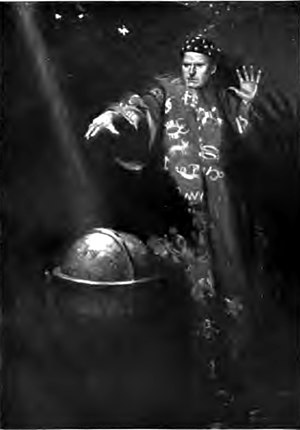
"See how the aural light seeks it."
“Oh, I say!” murmured he of the monocle. “Weird, you know! Quite gets on one’s nerves. Quite!”
“Sh-h-h-h!” reproved Preston Jax. “Silence is the fitting medium of the higher stellar mysteries. Madam, your life is a pathway between happiness and grief. Loss, like a speeding comet, has crossed it here. Happiness, like the soft moon glow, has beamed upon it, and will again beam, in fuller effulgence.”
With beautifully modulated intonations he proceeded, while one of his visitors regarded him with awestruck reverence, and the other waited with patience—but unimpressed, so the orator felt, by his gifts. His voice sank, by deep-toned gradations into silence. The ray winked out. Then the woman spoke.
“Is it possible for your stars to guide me to an object which I have lost?”
“Nothing is hidden from the stars,” declared their master. “Their radiance shines not alone upon the broad expanses of existence, but also into the smallest crevices of life. You seek jewels, madam?” (Kent had let this much out, as if by accident, in the morning’s conversation.)
“Yes.”
“Your birth stone is the bloodstone. Unhappy, indeed, would be the omen if you lost one of those gems.” (He was fishing and came forward toward her, almost brushing Kent.)
“But I say,” cried Kent in apparently uncontrollable agitation; “did your stars tell you that she had lost some jewelry? Tell me, is that how you knew?”
In his eagerness he caught at the astrologer’s arm, the right one, and his long fingers, gathering in the ample folds of the gown, pressed nervously upon the wrist. Preston Jax winced away. All the excited vapidity passed from Kent’s speech at once.
“The jewels which this lady has lost,” he said very quietly, “are a set of unique rose-topazes. I thought—in fact, I felt that you could, with or without the aid of your stars, help her to recover them.”
Blackness, instant and impenetrable, was the answer to this. There was a subdued flowing sound of drapery, as if some one were brushing along the wall. Kent raised his voice the merest trifle.
“Unless you wish to be arrested, I advise you not to leave this place. Not by either exit.”
“Arrested on what charge?” came half-chokingly out of the darkness.
“Theft.”
“I didn’t take them.”
“Murder, then.”
“My God!” So abject was the terror and misery in the cry that Kent felt sorry for the wretch. Then, with a certain dogged bitterness: “I don’t care what you know; I didn’t kill her.”
“That is very likely true,” replied Kent soothingly. “But it is what I must know in detail. Find your foot lever and turn on the light.”
The two visitors could hear him grope heavily. As the light flashed on, they saw, with a shock, that he was on all fours. It was as if Kent’s word had felled him. Instantly he was up, however, and faced around upon Marjorie Blair.
“Who was she?” he demanded. “Your sister?”
Mrs. Blair was very pale, but her eyes were steady and her voice under control as she answered:
“I do not know.”
“You must know! Don’t torture me! I’m a rat in a trap.”
“I’m sorry,” she said gently, “that I can’t help you. But I do not know.”
“You, then.” The Star-master turned upon Kent. “What am I up against? How did you find me?”
Thrusting his hand in his pocket the scientist brought out a little patch of black cloth, with a single star skilfully embroidered on it.
“Wild blackberry has long thorns and sharp,” he said. “You left this tatter on Hawkill Cliffs.”
At the name, the man’s chin muscle throbbed with his effort to hold his teeth steady against chattering.
“At first I suspected an army officer. When I found that the cloth was below grade, the only other starred profession I could think of was astrology. As the highest class astrologer now advertising, you seemed likely to be the man. When I found, first, that you were out of town on July fifth, and, just now, by a somewhat rough experiment, that you had suffered a wound of the right wrist, I was certain.”
“What do you want?”
“A fair exchange. My name is Chester Kent.”
The Star-master’s chin worked convulsively. “The Kent that broke up the Coordinated Spiritism Circle?”
“Yes.”
“It’s ill bargaining with the devil,” observed Preston Jax grimly. “What’s the exchange?”
“I do not believe that you are guilty of murder. Tell me the whole story, plainly and straight, and I’ll clear you in so far as I can believe you innocent.”
For the first time the seer’s chin was at peace.
“You want me to begin with this lady’s necklace?”
“Why, yes. But after that, begin at the beginning.”
“The topazes are cached under a rock near the cliff. I couldn’t direct you, but I could show you.”
“In time you shall. One moment. As you realize, you are under presumption of murder. Do you know the identity of the victim?”
“Of Astræa? That’s all I know about her. I don’t even know her last name.”
“Why Astræa?”
“That’s the way she signed herself. She seemed to think I knew all about her, without being told.”
“And you played up to that belief?”
“Well—of course I did.”
“Yes, you naturally would. But if you had no name to write to, how could you answer the letters?”
“Through personal advertisements. She had made out a code. She was a smart one in some ways, I can tell you.”
“Have you any of the letters here?”
“Only the last one.”
“Bring it to me.”
Obediently as an intimidated child, the astrologer left the room, presently returning with a plain sheet of paper with handwriting on one side. Kent, who almost never made a mistake, had forgotten in his absorption in the matter of the document, the presence, even the existence, of Marjorie Blair. He was recalled to himself, with a shock, as he felt her shoulder touch his. Involuntarily he whirled the sheet behind him.
“Let me see the rest of it, please,” she said calmly enough.
Kent nodded. With drooping head, and chin a-twitch, the Master of Stars stood studying them, while they read the letter together. It was in two handwritings, the date, address and body of the letter being in a clear running character, while the signature, “Astræa,” was in very fine, minute, detached lettering. The note read:
“All is now ready. You have but to carry out our arrangements implicitly. The place is known to you. There can be no difficulty in your finding it. At two hours after sundown of July the fifth we shall be there. Our ship will be in waiting. All will be as before. Fail me not. Your reward shall be greater than you dream. Astræa.”
Kent looked askance at Mrs. Blair. She was very white, and her sensitive lips quivered a little, but she contrived, with an effort of courage which he marked with a flashing access of admiration, to smile reassuringly.
“Don’t fear for me,” she said. “We Dorrances are of firm fiber.”
“So I see,” he said warmly. He folded and pocketed the letter.
“Had you ever been to this place before?” Kent asked of Jax.
“No.”
“Then how did you expect to find it?”
“She sent me a map. I lost it—that night.”
“What about the ship?”
“I wish you’d tell me. There wasn’t any ship that I could see.”
“And the reference to all being as it was before?”
“You’ve got me again, there. In most every letter there was something about things I didn’t understand. She seemed to think we used to know each other. Maybe we did. Hundreds of ’em come to me. I can’t remember ’em all. Sometimes she called me Hermann. My name ain’t Hermann. Right up to the time I saw her on the Heights I was afraid she was taking me for somebody else and that the whole game would be queered as soon as we came face to face.”
“It seems quite probable,” said Kent with a faint smile, “that you were taken for some one else. Your personal appearance would hardly betray the error, however.”
“Well, if I was taken for another man,” said the puzzled astrologist, “why didn’t she say so when she saw me?”
“What did she say when she saw you?”
“Why, she seemed just as tickled to set eyes on me as if I were her Hermann twice over.”
“Exactly,” replied Kent with satisfaction.
“Well, how do you account for that?”
Passing over the query, the other proceeded: “Now, as I understand it, you put yourself in my hands unreservedly.”
“What else can I do?” cried Preston Jax.
“Nothing that would be so wise. So do not try. I shall want you to come to Martindale Center on call. Pack up and be ready.”
“But the police!” quavered Jax. “You said the place was guarded, and I’d be pinched if I tried to get out.”
“Oh, no,” retorted Kent, with a smile. “That wouldn’t have been true, and I never lie. You inferred that, and wrongly, from my little ruse to keep you from running away. That you would be arrested eventually, if you attempted escape was true. It still is true.”
“I believe it,” replied Preston Jax fervently, “with you on my trail.”
“Come, Mrs. Blair,” said Kent. “Remember, Jax: fair play, and we shall pull you through yet.”
In the taxi, Marjorie Blair turned to Kent. “You are a very wonderful person,” she said—Kent shook his head—“and, I think, a very kind one.” Kent shook his head again. “Be kind to me, and leave me to go home alone.”
Kent stopped the cab, stepped out and raised his hat. She leaned toward him.
“Just a moment,” she said. “Perhaps I ought not to ask; but it is too strong for me. Will you tell me who the woman was?”
Kent fell back a step, his eyes widening.
“You don’t see it yet?” he asked.
“Not a glimmer of light. Unless she was some—some unacknowledged member of the family.”
“No. Not that.”
“And you can’t tell me who she was?”
“Yes; but not just now. Try to be patient for a little, Mrs. Blair.”
“Very well. Your judgment is best, doubtless. Of course you know whose hand wrote the body of that letter?”
“Yes; try not to think of it,” advised Kent. “It isn’t nearly so ugly as it seems.”
She looked at him with her straight, fearless, wistful glance.
“He had left me nothing to love,” she said sadly; “but to find disgrace and shame even to the end of his life! That is hard. That it should have been my husband who gave the thing most precious to me to another woman! But why did he write the letter to Preston Jax for her to sign?”
Chester Kent shook his head.
Midnight found Kent in the throes of literary effort. He was striving to compose a letter to Sedgwick that should, in turn, compose the recipient’s perturbed feelings. It concluded, with some acerbity:
“You’ve made a pretty complete idiot of yourself once. Don’t try to eclipse your own record.”
By which he purposed to convey to the artist the fact that his presence in Boston was neither desirable nor advisable. As he was about to affix his signature, a knock brought him to the door of his hotel room.
“Letter for you,” announced the messenger boy.
Kent signed the book and received a broad thin envelope sealed in golden hued wax with the impress of a star, and addressed in typewriting to his own name.
“Confound all fools who sign their letters on the outside!” said Kent, scowling at the seal. “What has that planetary lunatic got to say that won’t keep?”
What Preston Jax had to say was, first, in the form of a very brief note; secondly, in the shape of a formidable-looking document. The note began “Esteemed sir,” concluded “Yours remorsefully,” and set forth, in somewhat exotic language, that the writer, fearing a lapse of courage that might confuse his narrative when he should come to give it, had “taken pen in hand” to commit it to writing, and would the recipient “kindly pardon haste?” Therewith, twenty-one typed pages.
“Haste!” cried Chester Kent grievously. “Why, he’s written me the story of his life!”
Indeed, at a cursory glance, it appeared so. The initial paragraph opened, “I was born of poor but honest parents.” Chester Kent groaned. A little farther down the page the phrase, “Oh, that those innocent days of my happy childhood might return!” rose and smote him in the eyes. Chester Kent snorted. A desperate leap landed him in the midst of page five, where he encountered this gem, “With these fateful words the kind old minister laid a faltering hand upon my head. But enough!”
“Quite enough!” agreed Chester Kent, and kicked the Star-master’s document into a corner.
It fell in a crumpled heap with one sheet, curving in upward protuberance, conspicuous to the eye. On this sheet there was handwriting, and the handwriting was the same as that of the note Marjorie Blair had identified. Kent retrieved the paper, laid it on his desk, selected a likely spot for one more plunge, and dived into the turbid flood of words. And behold! as he turned, so to speak, the corner of the narrative, the current became suddenly clear. The muddled eloquence fell away; and the style crystallized into the tense quick testimony of the prime actor in a drama, intensely and shudderingly felt.
The reader ran through it with increasing absorption. Then, pencil in hand, he attacked the first part of the precious screed and emerged from a scene of literary carnage with one brief paragraph in hand and the slaughtered bodies of many eloquent pages strewing the floor. That one paragraph stated that Preston Jax, whose real name was John Preston, had, after a rebellious boyhood, run away to sea, lived two years before the mast, picked up a smattering of education, been assistant and capper for a magnetic healer, and had finally formulated a system of astrological prophecy that won him a slow but increasing renown. The gist of the system was to assign some particular and often imaginary star to every subject, and, by a natural aptitude for worming out secrets from the credulous, lead them along the celestial paths of mysticism to a point where he could reach their pocketbooks. He had been specially successful with women. One bit of his philosophy Kent had preserved unaltered.
“They bite slower than men; but when they do take hold, they swallow the hook so deep that you’re lucky to get it back at all.”
An hour’s work with a pencil that should have been blue resolved the document, under Kent’s skilful and remorseless editorship, into its salient elements. Obviously it was impossible to put it into alien hands for copying. Kent ordered up a typewriter and copied it himself. The duplicate he enclosed in his letter to Sedgwick. The original he put aside to sleep upon. Thus it ran:
“This Astræa affair looked good from the first,” so began Preston Jax’s confession, as beheaded and stripped down by its editor. “It looked like one of the best. You could smell money in it with half a nose. She bit first on one of the occult ads—the number four of the old series, a double-column with display in heavy-faced italics and leaded out strong. That ad always was a good woman-fetcher. Her first letter came in on a Monday, I recollect. It was a big mail. There were a lot of Curiositys and a couple of Suspiciouses, and this was one of half a dozen in the True Believers’ pile. Irene, my assistant, had put the red pencil on it, when she sorted out the mail, to show it was something special. But don’t get her into this, Professor Kent. If you do, it’s all off, jewels and all. Irene has always been for the straight star business and forecast game, and no extras or side lines. Besides, we were married last week.
“What attracted Irene’s red pencil, and caught me right away, was the style of the thing. The handwriting was classy. The paper was elegant. There was something rich about it all. This was no Biddy, pinching out the missis’ stationery to make a play with. She quoted poetry, swell poetry. First off she signed herself ‘An Adept’. I gave her the Personal, No. 3, and followed it up with the Special Friendly, No. 5. Irene never liked that No. 5. She says it’s spoony. Just the same, it fetches them. But not this one. She began to get personal and warm-hearted, all right, and answered up with the kindred-soul racket. But come to Boston? Not a move! Said she couldn’t. There were reasons. It looked like the old game—flitter-headed wife and jealous husband. Nothing in that game, unless you go in for the straight holdup. And blackmail was always too strong for my taste. So I did the natural thing; gave her special readings and doubled on the price. She paid like a lamb.
“Then, blame if it didn’t slip out she wasn’t married at all! I lost that letter. It was kind of endearing. Irene put up a howl. It was getting too personal for her taste. I told her I would cut it out. Then I gave my swell lady another address and wrote her for a picture. Nothing doing. But she began to hint around at a meeting. One day a letter came with a hundred-dollar bill in it. Loose, too, just like you or me might send a two-cent stamp. ‘For expenses’, she wrote, and I was to come at once. Our souls had returned to recognize and join each other, she said. Here is the only part of the letter I could dig up from the waste basket:
Here the specimen of handwriting that had caught Kent’s eye was pasted upon the document.
“‘You have pointed out to me that our stars, swinging in mighty circles, are rushing on to a joint climax. Together we may force open the doors to the past, and sway the world as we sought to do in bygone days.’
“And so on and cetera,” continued the narrative. “Well, of course, she was nutty, that is, about the star business. But that don’t prove anything. The dippiest star-chaser I ever worked was the head of a department in one of the big stores, and the fiercest little business woman in business hours, you ever knew. It’s the romantic in the sex that sets them skidding when it comes to stars, and such like. And Astræa was not a patch on some of them that has been paying me good sane money for years. That was the letter she first called me Hermann in and signed Astræa to. Said there was no use pretending to conceal her identity any longer from me. Seemed to think I knew all about it. That jarred me some. And, with the change of writing in the signature, it all looked pretty queer. You remember the last letter with the copperplate-writing name at the bottom? Well, they all came that way after this; the body of the letter very bold and careless; signature written in an entirely different hand. I took it to Chorio, the character-reader, and he said so, too. What’s more, he advised me to quit the game. Said there was trouble back of that handwriting. Those character fellows ain’t such fools, either!
“But hundred-dollar bills loose in letters mean a big stake. I wrote her I would come, and I signed it ‘Hermann’, just to play up to her lead. Irene got on and threw a fit. She said her woman’s intuition told her there was danger in it. Truth is, she was stuck on me herself, and I was on her; but we did not find it out until after the crash. So I was all for prying Astræa loose from her money, if I had to marry her to do it. She wrote some slush about the one desperate plunge together and then the glory that was to be ours. That looked like marriage to me.
“You saw the last letter. It had me rattled, but not rattled enough to quit. There was a map in it of the place for the meeting. That was plain enough. But the ‘our’ and ‘we’ business in it bothered me. It looked a bit like a third person. I had not heard anything about any third person. What is more, I did not have any use for a third person in this business. The stars forbade it. I wrote and told her so, and said if there was any outsider rung in, the stellar courses would have a sudden change of heart. Then I put my best robe in a bag and bought a ticket for Carr’s Junction. You can believe that while I was going through the woods I was keeping a bright eye out for any third party. Well, he was not there; not when I arrived, anyway. Where he was all the time, I do not know. I never saw him. But I heard him later. I can hear him yet at night, God help me!
“She was leaning against a little tree at the edge of the thicket when I first saw her. There was plenty of light from the moon and it sifted down through the trees and fell across her head and neck. As neat a bit of stage-setting for my business as I could have fixed up myself; and I am some hand at that. You have seen my place, and you know. I noticed a queer circlet around her neck. The stones were like soft pink fires. I had not ever seen any like them before and I stood there trying to figure whether they were rubies and how much they might be worth. While I was wondering about it, she half turned and I got my first good look at her face.
“She was younger than I had reckoned on, and not bad to look at, but queer, queer! Something about her struck me all wrong; gave me a sort of ugly shiver. Another thing struck me all right, though. That was that she had jewels on pretty much all her fingers. In one of my letters to her I gave her a hint about that: told her that gems gave the stars a stronger hold on the wearer, and she had taken it all in. She certainly was an easy subject.
“A bundle done up in paper was on the ground near her. I ducked back, very still, and got into my robe. The arrangement in her letter was for me to whistle when I got there. I whistled. She straightened up.
“‘Come,’ she said. ‘I am waiting.’
“Her voice was rather deep and soft. But it wasn’t a pleasant softness. Some way I did not like it any better than I liked her looks. It was too late to back out, though. I stepped out into the open and gave her the grand bow.
“‘The Master of the Stars, at your command,’ I said.
“‘You are not as I expected to see you,’ she said.
“That was a sticker. It might mean most anything. I took a chance.
“‘Oh, well,’ I said, ‘we all change.’
“It went. ‘We change as life changes,’ she said. ‘They never found you, did they?’
“From the way she said it I saw she expected me to say ‘No’. So I said ‘No’.
“‘That was left for me to return and do,’ she went on with a kind of queer joy that gave me the shivers again.
“‘Yes,’ I agreed, wishing I knew what she was driving at, but sticking to my text. ‘And here we are.’
“‘Together,’ says she. ‘Isn’t it wonderful! After all these years. The instant I saw your statement in the newspaper I knew it was your soul calling to mine across the ages.’
“You know, Professor Kent, I thought that was so good I made a note of it for future business use. While I was saying it over to myself she gave me a jar:
“‘Our boat is at the shore,’ she said.
“In that last letter she mentioned a ship. And, now, here was this boat business. (Afterward I looked for a sign of either, but could not find any. I thought perhaps it would explain the other part of the ‘we’ and ‘our’.) If I was going to elope by sea I wanted to know it, and I said as much.
“‘Are you steadfast?’ she asked.
“Well, there was only one answer to that. I said I was. She opened her package and took out a coil of rope. It was this gray-white rope, sort of clothes-line, and it looked strong.
“‘What now?’ I asked her.
“‘To bind us together,’ she said. ‘Close, close together, and then the plunge! This time there shall be no failure. They shall not find one of us without the other. You are not afraid?’
“Afraid! My neck was bristling. The woman was proposing, as near as I could make out, that we go out in a boat, tie ourselves together, and jump overboard. She seemed to think it was an encore to some previous performance.
“‘Go slow,’ I said, thinking mighty hard. ‘I don’t quite see the point of this.’
“‘All, all is as it is foreordained in the stars; the curve of the astral courses, the illimitable, unchangeable curve that has made us what we are, and shall draw us on and on to our mighty destiny. You, you have pointed out the way.’
“That is what she gave me, waving her arms in the air.
“Didn’t I curse myself for not remembering what I had written her? No clue, except that the poor soul was plumb dippy—too dippy for me to marry at any price. It wouldn’t have held in the courts. Yet, there might have been five thousand dollars of diamonds on her. It was a tight place. I wanted to duck the whole thing; but the rings held me. I have always been dotty about diamonds. I suppose she felt me weakening. Women are queer, that way.
“‘You dare to break our pact?’ she says in a voice like a woman on the stage. Then she changed and spoke very gently. ‘You are looking at these gewgaws,’ she said, and took a diamond circlet from her finger. ‘What do these count for?’ And she put it in my hand. Another ring dropped at my feet. Mind, she was giving them to me. I do not know if it would hold in law, she being a lunatic; but I was going to take all I could, on the chance, and watch for a getaway. The diamonds had me hypnotized.
“‘These are as nothing compared to what we shall have,’ she went on, ‘after the plunge. Wait!’
“She had dropped the rope, and now she went into her paper parcel again, kneeling at my side. I had stooped to look for the fallen ring, when I felt her hand slide up my wrist, and then a quick little snap of something cold and close. A bracelet, I thought. And it was a bracelet!
“‘Forever! Together!’ she said, and stood up beside me, chained to me by the handcuffs she had slipped on my right wrist and her left. Never you think your nerve is sound till you have felt something like that. I thought mine was—and I squalled aloud like a child at a ghost.
“‘Hush!’ she said, and her free arm pressed across my mouth.
“‘How much to let me off?’ I asked as soon as I could get breath. You see, it flashed on me that it was a trap. You can never tell, in our line, when the detectives may be after you, or what kind of a game they’ll put up. I looked around for the rest of the bunch to come and jump me, but I didn’t see a thing. Her next words put me on.
“‘The stars! The stars!’ she whispered. ‘See ours, how they light our pathway across the sea. The sea that awaits us!’
“More breath came back to me. It wasn’t a trap, then. She was only a crazy woman, that I had to get rid of. I looked down at the handcuff. It was of iron, and had dull rusted edges. A hammer would have made short work of it; but I did not have any hammer. I did not even have a stone. There would be stones in the broken land beyond the thicket. I thought I saw a way.
“‘Yes. Let’s go,’ I said.
“We set out. At the edge of the thicket was a flattish rock with small stones near it. Here I pretended to slip. I fell with my right wrist across a rock, and caught up a cobblestone with my left hand. At the first crack of the stone on the handcuff I could feel the old iron weaken. I got no chance for a second blow. Her hands were at my throat. They bit in. Then I knew it was a fight for my life.
“She was light; but she was strong like a panther. If her dress bound her, I was as bad off in my robe. At the first grip I was forced back into a bush, and sprawled there, in a tangle of branches and flying cloth. Somehow, I twisted her fingers from my throat. We struggled out into the moonlight again. I got a fair look at her face, and I guess I went mad myself, with the terror of it. The next thing I remember clearly she was quiet on the ground and I was hammering, hammering, hammering at my wrist with a blood-stained stone. I do not know if it was her blood or mine. Both, maybe, for my wrist was like pulp when the iron finally cracked open and I was free. I caught a glimpse of blood on her temple. I suppose I had hit her there with the stone. She looked dead.
“All I wanted was to think—to think—to think. How could I think with her lying there? I crept out of sight of her and kneeled down. Her star, the star I had faked for hers, was shining in my eyes like a cold glare. That very minute a wisp of cloud blew across and wiped it out, and I heard myself squeal again. I was pretty much dotty, I guess.
“While I was trying to think she came alive. She didn’t stir slow and moan like I have seen men, in my sea days, when they were knocked out. She was on her feet before I knew it, and off at a dead run. The broken handcuff went jerking and jumping around her as she ran. That was an awful night full of awful things. But the one worst sight of all—worse, even, than the finding of her afterward—was that mad figure leaping over the broken ground toward the cliff’s edge.
“Even if I had tried to follow I never could have caught her. And she was going straight for her death. She dropped down out of sight into a hollow and came up on the rise beyond. I yelled to her to stop, for God’s sake to stop. Then I held my breath to listen for her scream when she went over. I never heard it.
“But I heard something else. I heard a man’s voice. It was clear and strong and high. There was death in it, I tell you, Mr. Kent, living horror gripped at the throat that gave that cry. Then there was a rush of little stones and gravel down the face of the cliff. That was all.
“Beyond me the ground rose. I ran up on it. It gave me a clear view of the cliff-top. I thought sure I would see the man who had cried out, from there. Not a sight of him! Nothing moved in the moonlight. I thought he must have gone over the cliff, too. I threw myself down and buried my face.
“How long I lay on the ground I do not know. The wisp of cloud had blotted out the woman’s star, now, and by that I knew she was dead. But the moon was shining high. It gave me light enough to see my way into the gully, and I stumbled and slid down through to the beach.
“I found her body right away. It lay with the head against a rock. But there was no sign of the man’s body, the man who had yelled. So I thought perhaps he had not gone over the cliff, and I sat and waited to see if he would come and care for her. It was quite clear to me what I must do, if he did not come. Perhaps my own brain was queer from the shock and the beating she had given me with her manacled wrist; but I felt that before I went away from there I must conceal the cause of her death, and everything about it that I could. If it was known how she was killed, they would be more likely to suspect me.
“I went back and got the rope. I got an old grating from the shore. I dragged the body into the sea and let it soak. I lashed it to the grating. I stripped the jewelry from her. But I could not take it. That would have made me a murderer.
“There is a rock in the gully that I marked. Nobody else would ever notice it. Under it I hid the jewelry. I can take you to it, and I will.
“I got on my coat and sunk my robe in a creek, and got myself to the railroad station for a morning train. And when I got home I married Irene, and I am through with the crooked work forever.
“This is the whole truth. I did not kill her. I do not know to-day who or what she is. I have looked in the papers, and there is nothing, and that is so strange that I would think it was all a fearful dream, if it was not for my smashed-up wrist. But if any human being knows more about the death of Astræa, it must be the man who shouted as she fell from the cliff, and who went away and did not come back.
“And may God have no mercy for me if this is not all a true statement, so far as I know the truth.
“(Signed) Preston Jax, S-M."
“Annalaka, July 15.
“To Hotel Eyrie, Martindale Center: Dust 571 and send up seven chairs. Chester Kent.”
“Now I wonder what that might mean?” mused the day-clerk of the Eyrie, as he read the telegram through for the second time. “Convention in the Room of Mystery, maybe?”
To satisfy his curiosity he went up to the room himself. Its white bareness confirmed a suspicion of long standing.
“Any man,” he remarked to the scrub woman, “who would pay five a day for a room just to put nothing at all in it, has sure got a kink in his cogs.”
Nor did the personnel of the visitors who, in course of the late afternoon, arrived with requests to be shown to 571, serve to efface this impression. First came the sheriff from Annalaka. He was followed by a man of unmistakably African derivation, who gave the name of Jim and declined to identify himself more specifically. While the clerk was endeavoring, with signal lack of success, to pump him, Lawyer Adam Bain arrived, and so emphatically vouched for his predecessor as to leave the desk-lord no further excuse for obstructive tactics. Shortly afterward Alexander Blair came in, with a woman heavily veiled, and was deferentially conducted aloft. Finally, Chester Kent himself appeared, accompanied by Sedgwick and a third man, unknown to the clerk, pompously arrayed in frock coat and silk hat, and characterized by a painfully twitching chin.
“Who have come?” Kent asked the clerk.
That functionary ran over the list. “Looks like something to do with the woman found in Lonesome Cove last week,” he essayed hopefully.
Kent glanced out of the window. “It looks like rain,” he observed, “and it looks like wind. And it looks like a number of things that are anybody’s business. Furthermore, I may mention that we shall not need, in 571, ice-water, stationery, casual messages, calling-cards, or any other form of espionage.” He favored the wilting clerk with a sunny smile and led his companions to the elevator.
Sedgwick put a hand on his arm. “The woman with Blair?” he asked under his breath.
Kent nodded. “I rather hoped that she wouldn’t come,” he said. “Blair might better have told her—so far as he knows.”
“Then he doesn’t know all?”
“No. And perhaps she would be content with nothing else. It is her right. And she is a brave woman, is Marjorie Blair, as Jax here can testify. We have seen her under fire.”
“She is that,” confirmed the man with the twitching chin.
“This, then, is the final clear-up?” asked Sedgwick.
“Final and complete.”
“Thank God! It will be a weight off my shoulders.”
“Off many shoulders,” said Kent. “Here we are.”
Greetings among the little group, so strangely and harshly thrown together by the dice-cast of the hand of Circumstance, were brief and formal. Only Preston Jax was named by Kent, with the comment that his story would be forthcoming. The seven guests seated themselves, the Blairs at one end of the half-circle, Sedgwick and the astrologer at the other. Kent, leaning against the wall, fumbled uncertainly at his ear.
“I hardly know where to begin,” he said, his eyes roving along the intent line. “Not that the case isn’t perfectly clear; but there are certain startling phases which—which—” He glanced toward the Blairs.
Marjorie Blair smiled bravely at him. “Don’t be alarmed for me, Professor Kent,” she said. “What I most want is to have everything cleared up—everything!”
“First, your jewels, then.”
Kent turned to Preston Jax, who handed him a package. Opening it, Kent displayed the wonderful Grosvenor rose-topazes, with a miscellaneous lot of rings sparkling amid their coils. With a cry, Marjorie caught up the necklace.
“Are all the remainder of the lost valuables there, Mrs. Blair?” asked Kent.
She glanced carelessly at the rings. “I think so. Yes. But this is what matters to me.”
“These are all that Preston Jax found on the body.”
Alexander Blair leaned from his seat the better to take Preston Jax, at the other end of the crescent, under consideration.
“It was you who found the body?” he demanded.
“Yes,” said the astrologer uneasily.
“Were you alone when you found it?”
“Yes. No. I don’t know. There was a man somewheres near. I heard him, but I never saw him.”
“Was Mr. Francis Sedgwick with you that night?” pursued Mr. Blair in measured tones.
“I never saw Mr. Sedgwick until to-day.”
There was a little soft sigh of relief from where Marjorie Blair sat.
“That may or may not be true,” said Alexander Blair sternly. “It is the word of a man who has robbed a dead body, if, indeed, he did not also kill—”
“Steady, Mr. Blair,” broke in Chester Kent. “Perhaps, considering who is present, we would better approach this in a somewhat calmer spirit.”
“I didn’t kill or rob any one.”
The words seemed to be jerked out from between Preston Jax’s teeth by the spasmodic quiverings of his chin.
“How came you by my daughter’s jewels, then, if you did not take them from the body?”
“Who ever said I didn’t take ’em from the body?” retorted the other. “I did take ’em. But it wasn’t robbery. And what I want to know is, how did they come to be on the body, anyhow? What was that Astræa woman doing with your daughter’s rings and necklace? Tell me that!”
“Wait a moment,” put in Kent. “Explain to Mr. Blair, Jax, what your purpose was in taking the jewels.”
“To hide ’em. I thought the less there was on the body to identify it, the better chance I’d have of getting away. I was so scared that I guess I was half crazy, anyway. And now, I hear, she never has been identified. Is that right?”
Sheriff Schlager half rose from his chair. “Ain’t you told ’em, Professor Kent?”
Kent shook his head.
“Nor you, Mr. Blair?”
“No.”
“Then I don’t see why we can’t keep it amongst ourselves,” said the sheriff. “Gansett Jim’s tight as a clam. Nobody’ll ever get anything out of him. And, Lord knows, the less that’s known of it the better I’m suited. I ain’t none too proud of my part in it.”
“There is no reason why it should ever be known outside of this room,” said Kent, and, at the words, Alexander Blair exhaled a pent-up breath of relief. “But it is due to one person here that she should know everything. The question is how to make it clear in the best and—and kindest way.”
“If it will make it easier for any one here to speak,” said Marjorie Blair, “I can say that I understand certain phases of my husband’s past life, thoroughly. There is no need to spare me on that ground.”
“But this pertains to a phase that you do not understand at all.”
“Yes, I think so,” she persisted gently. “This dead woman had some hold over my husband. To maintain it she came to live near Hedgerow House, and while she was blackmailing Wilfrid, she got into communication with Mr. Jax.”
“Perhaps they were in collusion,” suggested Lawyer Bain.
“Oh, no, no!” broke in Alexander Blair impatiently. “You’re wide of the truth.”
“I understand,” persisted the young woman, “that the woman persuaded or compelled Wilfrid to write the letter to Mr. Jax, which she signed Astræa. And that, when she went to keep the rendezvous, she took my jewels, which, I suppose, she forced poor Wilfrid to steal for her. Am I not right, Professor Kent?”
“No. Far from it.”
“Why not?” cried Sedgwick eagerly. “She certainly had the jewels on when she met me. And the handcuffs must have been in the bundle. I heard them clink.”
“Exactly; the handcuffs,” said Kent dryly. “What use, to your mind, would a woman of that sort have for manacles, in those circumstances?”
“Yes,” put in Adam Bain: “they fit in about as nice as a pink silk hat at a funeral.”
“I know what use she had for ’em,” muttered Preston Jax, caressing his wrist. “It’s simply a case of crazy woman; isn’t it, Professor Kent?”
“No. Not if you mean that your assailant was a crazy woman,” said Kent patiently.
“Then who, in heaven’s name, is or was Astræa?” cried Sedgwick.
“Astræa is, I take it, a lady long since dead. A very strange and interesting lady who adopted that name for her own peculiar pursuits along our friend Jax’s lines of interest.”
“They call themselves all sorts of things,” observed the astrologer philosophically. “I had a follower once that used to sign herself Carrie Nation, and she wasn’t the real Carrie at all. No name is sacred to ’em when they go dippy over the stars.”
“Then the woman of Lonesome Cove borrowed that name from some old record?” asked Sedgwick.
“Follow me through a page of unwritten local history,” said Chester Kent, straightening up. “The beginning of this story goes back some seventy-five years, when there lived, not far from Hogg’s Haven, in a house which has since been destroyed, an older sister of Captain Hogg, who married into the Grosvenor family. She was, from the evidence of the Grosvenor family historian, who, by the way, has withheld all this from his pages, a woman of the most extraordinary charm and magnetism. Not beautiful, in the strict sense of the word, she had a gift beyond beauty, and she led men in chains. Her husband appears to have been a weakling who counted for nothing in her life after the birth of her children. Seeking distraction, she flung herself into mysticism and became the priestess of a cult of star-worshipers, which included many of the more cultivated people of this region. Among them was a young German mystic and philosopher, who had fled to this country to escape punishment for political offenses. Hermann von Miltz was his name.”
“That’s why she called me Hermann,” broke in Preston, in an awed half whisper.
“Don’t jump to wild conclusions,” said Kent smilingly. “Some of their correspondence is still extant. She signed herself Astræa, in handwriting similar to the signature of that note of yours, Jax. There seems to have been no guilt between them, as the law judges guilt. The bond was a mystic one. But it was none the less fatal. It culminated in a tragedy of which the details are lost. Perhaps it was an elopement that they planned; perhaps a double suicide, with the idea that their souls would be united in death. There are hints of that in the old letters in the historian’s possession and in the library at Hedgerow House. This much is known: The couple embarked together in a small boat. Von Miltz was never again heard of. Camilla Grosvenor’s body came ashore in Lonesome Cove. She was the Cove’s earliest recorded victim. The sketch which that mischief-monger, Elder Dennett, left at your door, Sedgwick, supposing it to be a likeness of the unfortunate creature he had seen on the road to your house, is a Charles Elliott sketch for the portrait of Camilla Grosvenor.”
“My God!” Jax burst out, “was it a ghost I met up with that night on Hawkill Heights?”
“As near a ghost as you are ever likely to encounter, probably,” answered Kent.
“But, see here,” said Adam Bain, “I’m a lawyer. The law doesn’t deal with ghosts or near-ghosts. Are you trying to tell us, Professor Kent, that the soul of this long-dead Astræa-Camilla Grosvenor, came back to inhabit the body of the Jane Doe of Lonesome Cove?”
“Not precisely that, either. Everything is strictly within the limits of the law’s cognizance, Mr. Bain, as you will see. Now I’m going to make a long jump down to the present. If I fail to keep the trail clear, anywhere, you are any of you at liberty to interrupt me. First, then, I want you to follow with me the course of a figure that leaves Hedgerow House on the late afternoon of July fifth. By chance, the figure is not seen, except at a distance by Gansett Jim, who suspected nothing, then. Otherwise it would have been stopped, as it wears Mrs. Blair’s necklace and rings.”
“Dressing the part of Astræa,” guessed Lawyer Bain.
“Precisely. Our jeweled figure, in a dress that is an old one of Mrs. Blair’s, and with a package in hand, makes its way across country to the coast.”
“To join me,” said Preston Jax.
“To join you. Chance brings the wayfarer face to face with that gentleman of the peekaboo mind, Elder Dennett. They talk. The stranger asks—quite by chance, though the Elder assumed it was otherwise—about the home of Francis Sedgwick. At the entrance to Sedgwick’s place the pair met. There was a curious encounter, ending in Sedgwick’s demanding an explanation of the rose-topazes, which he knew to be Mrs. Blair’s.”
“How did he know that?” demanded Alexander Blair.
“Because I had worn them when I sat to him,” said Marjorie Blair quietly.
“You sat to Sedgwick? For your picture? Why didn’t you tell me of this?”
“No explanation was due you. It was a matter of chance, our acquaintance. Mr. Sedgwick did not even know who I was.”
“Nor who his other visitor was, I suppose!” said Blair with a savage sneer.
“No,” said Sedgwick, “nor do I know to this day.”
“The stranger,” continued Kent, “refused to give Sedgwick any explanation, and when he threatened to follow, stunned him with a rock, and escaped. Some distance down the road the wayfarer encountered Simon P. Groot, the itinerant merchant. Sedgwick afterward met him and made inquiries, but obtained no satisfaction.”
“Why was Mr. Sedgwick so eager to recover the trail, if he had not murder in his mind?” demanded Blair.
“You are proceeding on the theory that Sedgwick, knowing who Mrs. Blair was, and who the strange visitor was, deliberately killed the latter for motives of his own. But Sedgwick can prove that he was back in his house by nine o’clock, and we have a witness here who was talking with the wearer of the necklace at that hour. Jax, let us have your statement.”
Holding the copy of the confession in his hand, in case of confusion of memory, the Star-master told of his rendezvous, of the swift savage attack, of the appalling incident of the manacles, of the wild race across the heights, and of the final tragedy.
“I’ve thought and wondered and figured, day and night,” he said, in conclusion, “and I can’t get at what that rope and the handcuffs meant.”
“The handcuffs must have come from that dreadful collection of Captain Hogg’s things, in the big hallway at Hedgerow House,” said Marjorie Blair.
“Yes,” assented Kent, “and the dim clue to their purpose goes back again, I fancy, to the strange mysticism of the original Astræa. The disordered mind, with which we have to deal, seems to have been guarding against any such separation as divided, in death, Astræa from her Hermann.”
“But, Chester,” objected Sedgwick, “you speak of a disordered mind, and yet you’ve told us that it isn’t a case of insanity.”
“Never,” contradicted Kent. “You’ve misinterpreted what I said. In the early stages of the affair I told you, if you remember, that a very bizarre situation indicated a very bizarre motive. What could be more bizarre than insanity?”
“Was it suicidal insanity, then?” asked Bain.
“Not in the ordinary and intentional sense.”
“Then it was the other man that killed her,” said Preston Jax; “the man I heard yell, when she went over. But what became of him?”
“Simon P. Groot spoke of hearing that man’s scream, too,” confirmed Bain. “Have you got any clue to him, Professor Kent?”
“The other man was Francis Sedgwick,” declared Alexander Blair doggedly.
Chester Kent shook his head.
“I’ve got a witness against that theory, from your own side, Mr. Blair,” said he. “Gansett Jim at first thought as you do. In that belief he tried to kill Mr. Sedgwick. Now he knows his mistake. Isn’t that so, Jim?”
“Yeh,” grunted the half-breed.
“You were out through the countryside that night trying to trace the wanderer.”
“Yeh.”
“And later when I showed you the footprints at the scene of the struggle, you saw that they were not Mr. Sedgwick’s?”
“Yeh.”
“You examined the cliff for footprints. Do you think any one pushed or pursued the victim over the brink?”
“No.”
“Whose were the footprints, that you found, Jim?” demanded Alexander Blair.
The half-breed pointed, in silence, to Preston Jax.
“Of course. His and—and the other’s. But there were the marks of a third person, weren’t there?”
“No.”
“There must have been,” insisted Mr. Blair. “Are you positive?”
“Yeh.”
“Then did the other man, the man whom Jax heard cry out, walk without leaving any trace?”
“There was no other man,” said Chester Kent. “Don’t you understand, Mr. Blair,” he added with significant emphasis, “the source of that cry in the night, heard by Jax and Simon Groot?”
A flash of enlightenment swept Blair’s face. “Ah-h-h!” he said in a long-drawn breath. Then: “I was wrong. I beg Mr. Sedgwick’s pardon.”
Sedgwick bowed. Marjorie Blair’s hand went out, and her fingers closed softly on the tense hand of her father-in-law.
“No third person had any part whatsoever in the drama which Jax has recounted to us,” pursued Kent. “In the morning the body was discovered. Sheriff Schlager was sent for. He found in the pocket something that betrayed the connection of the body with Hedgerow House.”
“A bit of writing-paper, with the heading still legible,” said the sheriff.
“With this he accosted Gansett Jim, who after a night-long search had come out on the cliff. Jim, assuming that the sheriff knew all, told him of the identity of the body. The sheriff saw a chance for money in it—if I do you an injustice, Schlager, you’ll correct me.”
“Go right ahead. Don’t mind me. I’ll take my medicine.”
“Very well. Schlager adopted the ready-made theory which Mr. Jax had prepared for him, so to speak, that the body was washed ashore; and arranged, with the connivance of Doctor Breed, the medical officer, to bury it as an unknown. For this perversion of their duty, Mr. Blair rewarded them handsomely. As I understand it, he dreaded any publicity attaching itself to Hedgerow House and his family.”
“God knows I had suffered enough of that!” murmured Blair.
“Let us hope it is now ended. To avoid this, Mr. Blair was willing even to let the supposed murderer, whom he believed to be Sedgwick, go unscathed of justice. By chance, however, I saw the body on the beach. The most important discovery of all, I missed at that time very stupidly—the more so in that I had a clue, in the character of the assault upon Sedgwick—but I could not overlook the fact that the corpse had not been washed ashore. Moreover, the matter of the manacles stimulated my interest. Not until the inquest, however, did I realize the really startling and unique feature of the case. There is where you and Doctor Breed made your fatal error, Mr. Sheriff.”
“That’s right. You saw the face when we lifted the lid, I s’pose.”
“No. You were too quick in replacing it.”
“Then how did you get on to the thing?”
“From seeing the face after the body was returned to the court room.”
“Hold on a bit,” interrupted Lawyer Bain. “I remember there was a fuss about the corpse not being publicly shown for identification. Some of us insisted. The sheriff gave in. The coffin lid wasn’t quarter off when Breed gave a yell and clapped it on again, and they took the body back to his house and shut themselves in with it for half an hour before they took it to the hall again. Naturally being suspicious, I looked at it pretty close; but I didn’t see anything queer.”
“Possibly you didn’t notice a cut on the cheek?” suggested Kent.
“Yes. Dennett spoke of it and the sheriff shut him up. But what of it? It might have been done in any one of a dozen ways.”
“But it wasn’t there when the body lay on the beach.”
“In the rolling and tossing of the journey there might easily be minor scarifications,” said Sedgwick.
“True. But, Frank, what did you suppose that sudden shift on the part of the officers of the law meant?”
“Perhaps that the body was not in fit condition to be viewed.”
“In that case what could they have done to make it more fit?”
“Nothing, I suppose. I didn’t consider that.”
“I rather opined,” said Lawyer Bain, “that some one had changed bodies on ’em.”
“That’s what made you so cussed curious, was it, Adam?” barked the sheriff.
“There was no exchange of bodies,” said Kent. “But there was a change in the body itself.”
“What kind of a change?” asked Sedgwick.
“Has it ever occurred to you to think that, after death, the hair grows fast?”
“I’ve heard it said,” said Lawyer Bain, “that it grows faster than in life.”
“And that it grows, not only on the head, but on the face as well?”
“The face! A woman’s face?” exclaimed Sedgwick.
“No; a man’s.”
“What man?”
“The man in the coffin.”
“Have you lost your mind, Chet? The body in the coffin was that of the woman who met me at the entrance to the Nook.”
“No. It was the body of the man who, dressed in woman’s clothing, met you at the Nook, and knocked you down with a stone flung overhand as not one woman in a thousand could have thrown it. That, in itself, ought to have suggested the secret to me, long before I discovered it.”
“But how did you discover it?” inquired Sedgwick in bewilderment; “since you didn’t see the growth of beard on the dead face yourself?”
“By the cut on the cheek. You see, the sheriff had failed to foresee that telltale beard. So, when in deference to Mr. Bain’s protest against burial without a formal view of the body, they opened up the casket and saw the obvious change in the face, there was nothing for the officials to do but remedy their carelessness. They had the body taken to the house, and did the best they could. That cut on the cheek was a razor cut. Having realized that much, I had to deal thenceforth with the mystery of a dead man masquerading as a woman, and being abetted in the deception by the officers of the law—”
“Astræa a man!” broke in Preston Jax, his chin in a spasm. “No wonder she—he put up such a fight. Who was he?”
“My son, Wilfrid Blair,” said Alexander Blair.
Sedgwick took a swift involuntary step toward Marjorie, but Kent was before him, setting a firm hand on his shoulder.
“Not now, Frank,” he said. Then, turning to the girl-widow, “You see, Mrs. Blair,” he said very gently, “it isn’t so bad as you feared. There was no other woman in the case, no disgrace, no shame. You need feel nothing but pity for an unhappy wrecked mind, for which death was the happiest refuge.”
Marjorie Blair sat very still and white. “Let me think!” she whispered. “Let me think!”
“But the man’s voice!” exclaimed Jax. “The voice of the man on the cliff!”
“Wilfrid Blair’s,” said Kent. “In the final moment he came to himself. At last he resumed his voice. Up to then he had been, in voice, manner, thought, purpose, unconsciously playing a part.”
“Astræa!” said Sedgwick and Jax in a breath.
“Yes. It was one of those strange and complete assumptions of personality which puzzle the alienists. Wilfrid Blair’s diseased mind had fastened upon the strange history of his ancestress, and brooded on it until he became convinced that her spirit was reincarnated in himself. Undoubtedly his striking likeness to the portrait of Camilla Grosvenor powerfully aided the obsession. There were her letters, in the library, to give color to his unconscious imitation. As is common in this form of dementia, he was secretive. But there can be no doubt that from the time when he recognized in Preston Jax’s advertisement, the call of Astræa’s kindred soul, Hermann von Miltz, his one overwhelming desire was to reenact the drama of the last century, in his own assumed personality. Jax has told us how cleverly and secretly the plan for the double suicide was matured. This obsession must have been of long standing.”
“We thought it melancholia,” said Alexander Blair. “As you say, he had been very secretive. Very silent, too. We kept Gansett Jim with him as a sort of body-guard.”
Marjorie Blair got to her feet. She was ghost-white; but her voice and eyes were steady, as she faced Kent.
“I must understand this all,” she said. “Wilfrid’s body is where?”
“In Annalaka churchyard.”
“Then who—what is buried in his grave at Hedgerow House?”
“Nothing,” said Alexander Blair.
“A mock funeral!”
“My dear,” said the man—he seemed to have grown suddenly old under the unspoken arraignment—“I could not tell you what I thought the truth. I thought then that Wilfrid had encountered Mr. Sedgwick, and that—that there had been a fight in which he was killed. Rather than face the scandal of a murder trial, a scandal in which the family name would have been dragged through the mire of the public prints again, I chose the part of deceit. I’d have bribed a hundred officers of the law rather than have had you dragged to the witness-stand, and have been compelled to give testimony myself. There has been enough of public shame in my life.”
“But you made me believe that Mr. Sedgwick killed Wilfrid!” she accused.
“I believed it myself,” he retorted.
“But what basis had you for suspecting me of the crime?” cried Sedgwick, turning to Marjorie Blair. “You didn’t know of his visit to me in women’s clothes. You knew nothing of the quarrel, it seems, until just now. For what possible reason, in your belief, should I have killed him?”
She flushed to her temples. “I—I—thought,” she murmured, “that he might have known of our acquaintance, and have misconstrued: that he might have gone to find you, and attacked you, and that you killed him. In self-defense, I mean.”
“Thank you for that last, at least,” said Sedgwick rather bitterly. Then, as he saw her wince, “Forgive me!” he added in a low tone. “But, to be suspected by you, even though you were misled—” He stopped, catching Kent’s frowning glance.
“Who discovered that the burial was a false one?” she asked, after a pause.
“Professor Kent,” said Blair. “He and Mr. Sedgwick exhumed the coffin.”
“That was the night—” her eyes questioned Sedgwick.
“That I found you at Hedgerow House. Yes,” he said gently.
“And that my father-in-law charged you with being my husband’s murderer.”
“My dear Mrs. Blair!” said Kent uncomfortably. “Remember what justification he thought he had.”
She considered a moment. “You are right,” she said with an effort. “I don’t mean to be unjust.” Her head dropped in thought. “Whatever Wilfrid may have been,” she continued, after a moment’s silence, “he was my husband. I bear his name. And to leave him in a nameless grave is to dishonor not him alone, but myself.”
“You would claim the body?” cried Alexander Blair.
“What else is there for us to do?” she countered.
“And bring down upon us unavoidably the publicity which we have escaped at so bitter a price?” cried the elder Blair. “Have we not suffered enough from the scandal of his life, that we should be further involved in the scandal of his death?”
“He’s right, miss. It won’t do,” said the sheriff kindly.
“Silence is best,” said Sedgwick.
“What the papers would do with this,” opined Preston Jax, “would be a plenty.”
“My advice is to let be,” proffered Lawyer Bain.
“Yeh,” grunted the half-breed.
“Oh, are you all against me?” she cried. “Mr. Kent, you, too? Do you think me wrong?”
“No,” said Kent.
“Will you drag our name, hers as well as mine, in the mud?” cried the head of the house of Blair.
“No,” said Kent again.
“But how, then—tell me what you intend—”
“No,” said Kent, and with such absolute flat finality that the others looked at him in blank silence.
The silence was broken by a tremendous sigh. All eyes turned to Preston Jax, who had risen and was leaning against the wall, his chin jerking galvanically.
“Well?” said Kent.
“What about me?” asked the Star-master miserably.
Kent’s fingers twitched at his ear lobe. “Well, what about you?” he repeated.
“What are you going to do with me?”
“You? Oh! You go back to Irene,” said Kent, with his half smile. “That’s your sentence, if Mrs. Blair approves.”
The astrologer drew a quick breath. The light of a great relief softened his hard little eyes. A startled look widened them as Marjorie Blair, her own trouble forgotten for the moment, rose and went over to him, the reflection of another’s happiness shining in her face and making it doubly lovely. A ring glinted in her outstretched hand.
“Take this,” she said softly, “for your Irene. May you be very, very happy together!”
For the space of five seconds Preston Jax’s chin was motionless. Then a minor cataclysm convulsed it. Speech emerged from that facial quake, in a half-stutter, half-blubber, wholly absurd and laughter-provoking and heart-moving.
“Wh-wh-whut’ll I say? Whut’ll I do, to thank you, ma’am? I—I—I’ll just tell you this. It’s me for the straight-and-narrow from now on. And if ever you or Professor Kent or any of you want an A-1, special charted, extra-celestial star-reading for self or friends, you—you—you c-c-c-come—” He made a rush for the hallway, and the door banged a period to his emotion.
“I think,” said Chester Kent gravely, “that lesson will last.”
As Marjorie Blair stood smiling, soft-eyed, at the door whence the overcome Star-master had disappeared, Sedgwick started to pass. With quick and unexpected tact, Alexander Blair drew the sheriff and the lawyer aside, giving to the young people their moment. She looked up at Sedgwick with lifted eyebrows.
“Are you not going to speak to me?” she said sorrowfully.
“What is there to say, except one thing—and that I may not say now.”
“No, no!” she whispered, in affright. “But say you forgive me.”
“You! For what?”
“For having believed, even for an instant, what Father Blair said, that you were the murderer.”
Sedgwick smiled bravely. “That is all past.”
“And you’ll think of me at least kindly?”
“I’ll think of you with every beat of my heart,” he said passionately.
Across her face passed the look of fairy wistfulness that was all her own. “No,” she said, “it would be better—for both of us—that you should forget, for the time.”
He leaned over her:
“‘What shall assuage the unforgotten pain
And teach the unforgetful to forget?’”
he quoted very low.
“And yet,” she persisted, “it would be easier, now that I am going away.”
“Going away! For long?”
She nodded with compressed lips. Sedgwick turned very white.
“Oh, don’t look like that!” she faltered. “I can’t bear it! Can’t you see that, after what has happened, I must go? I must have time to forget. There is so much to forget! Surely you can be patient—and trust.”
Again he smiled at her, with a courage shining through his pain that brought the quick tears to her eyes.
“Yes. I can wait and trust—and love.” Again he leaned to her:
“‘And think how she, far from me, with like eyes
Sees, through the untuneful bough the wingless skies.’”
He drew her gaze to his own, held it for the space of a heart-beat, and was gone.
Summer had waned from the coast and with it had passed the keenness of local interest in the strangest victim of Lonesome Cove. Even the indefatigable tongue of Elder Dennett had almost ceased to clack on the topic, by the fall of the first snow. Other subjects of absorbing interest supervened during the long winter: the wreck of the schooner yacht off Dead Men’s Eddy; the coming of the new Presbyterian minister at Martindale Center whose wife was reported to be a suffragette; the mysterious benefaction that had befallen old Mrs. Orcutt late in February, enabling her to leave her home next to Annalaka churchyard and take her asthma southward in search of a cure; the rumor that Hedgerow House was to be sold before summer.
“And young Blair’s body along with it, I expect,” remarked the Elder malevolently. “Seems to me, if I was a millionaire like Alexander Blair, I wouldn’t sell my own flesh and blood, dead or alive.”
Of Alexander Blair himself, nothing had been seen in the neighborhood since mid-July, nor of his daughter-in-law. Hedgerow House was in charge of Gansett Jim as caretaker. Professor Kent had left about the same time as the Blairs. But Francis Sedgwick had stuck to the Nook, studying first the cold grays and browns of November, and later the wonderful blazing whites and subtle blues of drift and shadow spread before him in winter’s endless panorama, with the same enthusiasm that he had devoted to October’s riot of color. Though the work prospered, the worker had paled. It was the opinion of Martindale Center and Annalaka alike that the “painter feller” was looking right peaky and piny, like one whose conscience ached. But Sedgwick had nothing worse than a heartache, and the fates were making medicine for that.
Wind-borne on the blast of a mid-March gale, Chester Kent dropped down at the door of the Nook one wild afternoon, without warning. As always, he was impeccably clad, though his stout boots showed the usage of recent hard wear. Leaving Austin that morning, with his light valise slung to his shoulder, he had footed the fifteen miles of soggy earth to Sedgwick’s place, in a luxurious tussle against the wind. Throwing open the door, he called his friend’s name.
Instantly the artist came loping down the stairs and had him by the shoulders.
“I’ve got a caller up above,” he said after the usual greetings and questionings were over.
“Yes? Have you gone in for local society?”
“Not exactly local. It’s Alexander Blair.”
“Hel-lo!” said Kent in surprise. “What brings him?”
“Why, he came down to Hedgerow House to look after certain books and papers, and ran over here to make his amende honorable in form. Chet, I hate being apologized to.”
“Of course. Every one does. Nevertheless, it’s good exercise for Mr. A. Blair, Esquire. Brings into action some muscles of his soul that might otherwise have atrophied from disuse.”
“He’s the grim-jawed, hard-bitted Blair of old. Just the same, he made his apology as handsomely as need be. I’ll bring him down here.”
The fabric magnate descended from the studio and greeted Kent briefly, then turned to his host. “You will excuse me if I ask Mr. Kent to step outside. I have some business with him.”
“Stay here,” said the artist. “I’ll go back to my studio.” Which he did.
“When a man once declines employment with me,” said Alexander Blair to Kent, “I never give him a second chance. That rule I am going to break. I need your assistance.”
“Honored, indeed!” murmured Kent.
“Will you accept the commission?”
“Not if it is like your former offer.”
“It is not. It is bona fide. Some one has been tampering with my son’s grave.”
“You mean the grave at Hedgerow House?”
“Yes. Gansett Jim reports that there are signs of recent digging. It looks as if ghouls had been at work there, with the idea of getting the body and holding it for ransom. They would have had a fine surprise if they had got the coffin out!”
“Because they’d have found no body in it, you mean?”
“Certainly. But suppose they discovered that there were no remains, nothing but a punctured sand-bag. Do you see the potentialities of blackmail?”
“No.”
“Then you are stupider than I ever took you for,” growled the magnate.
“Like most things, it depends on the point of view. I don’t think that you are in any danger of blackmail. But, if I understand the matter, you want your mind relieved of anxiety on the point. Very well, I’ll take the case.”
“That is settled, then,” said the older man briskly. “Now, this being a strictly business deal, we will discuss terms.”
“Oh, there is no room for discussion as to my terms,” said Kent easily. “I make them and you accept them, that’s all.”
Alexander Blair’s eyebrows drew down in a heavy scowl.
“Do you know of an old lady named Orcutt in Annalaka?” pursued the scientist.
“No.”
“She owns the house just next to Annalaka churchyard, where your son was buried as Jane Doe. She is a very worthy old lady. But she suffers severely from asthma. In fact it keeps her awake most of the night. So some interested persons have subscribed money, and sent her south to a sanatorium. I’d like to get you interested in her case.”
“You wish me to subscribe?”
“Oh, more than that. I think it would be a good idea if you were to assume the entire expense of the proceedings.”
“You mean reimburse the subscribers?”
“Exactly.”
For a few seconds the millionaire studied Kent’s candid face. “Very well,” he agreed. “How much?”
“Sheriff Schlager can tell you. He is keeping the accounts. You see, it was necessary to get her out of the way. Her windows overlook the churchyard.”
“So you took occasion to indicate before.”
“Repetition of a really relevant point is excusable. She left, two weeks ago, very much mystified but pathetically thankful, poor old girl!”
“She has no monopoly on being mystified,” observed Mr. Blair, with pursed lips.
“Probably she never will understand. That’s where you have the advantage of her, for I think you’ll see quite clearly the reason for her trip, and the propriety of your footing the bills.”
“Go on.”
“When she was safely out of the way, and no longer overlooking Annalaka churchyard by night, from her window, Schlager, Adam Bain and I paid a visit to the place. Technically, what we did there amounts to grave robbery, I suppose. But we covered our tracks well, and I don’t think anybody will ever discover what has been done.”
“Well?” queried his hearer, with twitching jaw.
“What lay, nameless, in Annalaka churchyard,” said Kent gravely, “now rests in its own place at Hedgerow House. The marks found by Gansett Jim were made by us. So your alarm is groundless. But I wish that you might have heard the little prayer made by that simple country lawyer over your son’s grave. Once in a while I meet with a really, through-and-through good man like Adam Bain, and then I have to reconstruct my whole formula of the average cussedness of human nature.”
Alexander Blair’s clenched hands went to his temples in a singular gesture, and dropped again. “What interest did Schlager and Bain have in the matter?” he added in a low tone.
“Why, Schlager had done some dirty work for you, and wanted to even accounts with his own conscience. As for Bain, we needed a third man we could trust. I asked him and got him. It was no small risk for him. If you felt that his risk is worth some reward, you might—”
“Yes, yes!” interrupted the other eagerly. “Do you think a thousand—or perhaps more—”
Kent smiled. “By thinking hard I could think a thousand,” he said. “But not more, in this case. It wouldn’t be safe. Bain might not survive the shock. Thank you very much, Mr. Blair.”
“And now,” said the older man, “I am still in the dark as to your interest in the matter.”
“Mine? Why, for one thing, I dislike to leave any affair unfinished. I have the satisfaction of knowing now that this is forever settled and done with. Besides there was a promise—practically a promise—as near a promise as I often permit myself to go, in a world of accidents, errors, and uncertainties—made to Mrs. Blair. Is she back from Europe?”
“She is at Hedgerow House.” Blair communed with himself for a time, then said abruptly, “By the way, do you think your friend Mr. Sedgwick would come over to a pick-up dinner before we leave?”
Kent’s face lighted up. “Ask him,” said he heartily, “and see!”
“I will, as soon as I get home. Good day.” Blair hesitated. He seemed to have difficulty in going and embarrassment in staying. He coughed and cleared his throat, looked over Kent’s head and down at his feet; and finally got himself into words.
“Kent,” he blurted, “I realize now why you won’t take my money. I can always buy brains; but I can’t buy the bigger better thing. It isn’t in the market. Thank you!” He caught the scientist’s hand in a swift hard grip, and strode off down the road.
Chester Kent went back into the house with a glow at his heart. He shouted up-stairs to Sedgwick, “Go on with your work, Frank. I want to loaf and invite my soul for an hour. Where’s your reading matter?”
“Shelf in the corner,” answered the artist. “You’ll find a few things in your line,—Darwin’s Origin of Species, Le Conte’s—”
“The devil take Darwin!” cried Kent impiously. “I want Bab Ballads, or Through the Looking-Glass, or something like that, really fit for an aspiring intellect. Never mind. I’ll forage for myself.”
Three minutes later he was stretched luxuriously on the divan, with the window-shade pulled down and the big electric chandelier glowing, immersed in the joyous nonsense of Rhyme and Reason. The wind alternately shouted profane protests at the window because it couldn’t get in, and then fell silent, waiting for an answer. In one of these lulls Kent heard footsteps outside.
He dropped his book. The footsteps approached the window. Then the gale rose again, and the loose end of a garment flapped softly against the glass. He half rose, listening. There was silence outside.
“Have I fallen into another mystery?” groaned Kent. “Is there no rest for the weary?”
The footsteps mounted the side porch. Kent awaited a knock. None came.
“Odd!” he observed to his pillow. “Few people find the outside of a door so fascinating that they stand for two minutes in a wet gale admiring it.”
Tiptoeing to the door, he threw it open. There was a startled cry from without and an equally startled grunt from within. Chester Kent and Marjorie Blair stood face to face.
“I—I—I beg your pardon,” gibbered Kent, whelmed instantly in a morass of embarrassment. “I—I didn’t mean to frighten you.”
Feminine-wise she built up her self-possession on the ruins of his. “I wonder,” she said with a smile, “whether I’m the worse-frightened one of us.”
“You see,” he said lamely, “it was so sudden, your—your coming that way. I didn’t expect you.”
“And for that reason you intend to bar me from the house? It’s quite disgustingly wet out here.”
With a muttered apology Kent stepped aside, and she entered. Even amid his ill-ease he could not but note how the girlish loveliness had ripened and warmed, yet without forfeiting anything of that quaint appealing wistfulness which made her charm unique. But there glinted now in her deep eyes an elfish spirit of mischief, partly inspired by the confusion of the helpless male creature before her, partly the reaction from the mingled dread and desire of the prospective meeting with Sedgwick; for she had come on a sudden uncontrollable impulse to see him, and would have turned and fled at the last minute had not Kent surprised her. Perhaps there was a little flavor of revenge for this, too, in her attitude toward him.
“What a surprise to find you here, Mrs. Kent!” she remarked sweetly. “Or are you calling yourself Mr. Blair nowadays? And how is your poor ear?”
Chester Kent immediately seized that unoffending member and clung to it with much the lost and anguished expression of the pale martyr in the once popular Rock of Ages chromo. His tormentor considered him with malicious eyes.
“Did any woman ever say ‘Boo!’ to him suddenly, I wonder?” she mused aloud.
Like a saving grace, there came into Kent’s mind a fragment of The Hunting of the Snark, in which he had just been reveling. Said he gravely:
“He would answer to ‘Hi!’ or to any loud cry
Such as ‘Fry me’ or ‘Fritter my wig’!”
She caught up the stanza:
“To ‘What-you-may-call-um’ or ‘What-was-his-name!’
But especially ‘Thing-um-a-jig.’”
“So you know Lewis Carroll. How really human of you!”
“It is better to be humane than human,” murmured Kent, relinquishing his aural grip as he began to touch bottom.
“Is that a plea? Very well. I shall be very gentle and soothing. But, oh,” she burst out irrepressibly, “may the kindly fates give me to be among those present when you fall in love!”
Kent favored her with an elaborate bow. “Your presence would be the one essential.”
“Really,” she approved, “you’re progressing. I begin to feel repaid for my visit, already.”
This time Kent looked her in the eye. “You’re not very demanding in the matter of returns for your trouble,” he remarked. “To come through all this wind and rain and then be content merely to contemplate the outside of a door—that argues an humble spirit. To be sure, however, it’s a very good door; one of the most interesting features of our local architecture, and may lead to—all sorts of things.”
It was her turn to grow red.
“You haven’t asked me about Sedgwick,” he continued.
“Is he well?” she inquired formally, but with quickened breath.
“He is more than that. He is cured—and a man. A man,” he added meaningly, “for any woman to be proud of.”
There was a step on the floor above. Marjorie Blair’s hand went to her heart.
“I didn’t know he was here,” she panted affrightedly. “I came just to—look at the place. Then I saw the light, and I wanted so to come in; but I didn’t dare. I can’t see him now! I must go! Don’t tell—”
Chester Kent raised his voice. “Frank!” he called. “Come down here! Quick!”
Not twice in his life had Sedgwick heard that tone in his friend’s voice. The bungalow shook to his long tread across the floor. The studio door opened and flew shut behind him. He took the stairs at a leap, and on the landing stopped dead.
“Marjorie!” he whispered.
She shrank back a little from the light in his eyes.
“What do you do here?” he said very low.
Still she did not speak, but stood, tremulous, her face half panic, half passion.
Unobtrusively Kent slid along the wall, like a shadow, and vanished into the night.
“Where have you been?” Sedgwick asked the woman of his love.
“Everywhere. Nowhere. What does it matter?” she faltered. “I’ve come back.”
He went forward and took her hands in his; cold little hands that clung as they touched.
“Why did you never write me?” he asked gently.
“I don’t know. I couldn’t. Don’t ask me to explain. It was just that I—I felt I must come back to you as I had come to you first, unexpected and without a word. Can you understand?”
“No,” he said.
“No; I suppose not. A man couldn’t.”
“Good God!” he burst out. “Do you realize what it is to live in such a hell of uncertainty and longing as I’ve lived in since you left; to wait, and hope, and lose hope, and hope and wait again for a word that never comes; to eat your heart out with waiting?”
A slow wonderful smile trembled on her lips. “My dear,” she said; “I have waited for you all my life.”
Suddenly her arms were around him; her cheek was pressed to his own; the breath of her whisper was at his ear.
“Oh, forgive me! I will make it up to you, my dear; my dearest!”
Out in the wind and the rain Chester Kent drew in the deep breath of satisfied and rounded achievement. He had beheld, against the wide window-shade two shadows, which, standing motionless for a moment, a few feet apart, had drawn slowly together as by some irresistible magnetism, and suddenly merged into one. The unintentional eavesdropper nodded, in grave gratulation to the house, then turned away.
“Finished!” he said. “C’est conclu. Finis. Telos. Das Ende. And any or all other words of whatever language, meaning a sound conclusion!”
Half an hour later he entered, with due preliminary stamping of mud from clogged feet. Instantly Marjorie went over to him.
“Why, you’re wet as a rag!” she cried with a sweetly unconscious assumption of proprietary interest. “You must go and change at once!” she added, patting his shoulder.
Kent reached for his ear, changed his mind midway, and scratched his nose. “All right,” he said meekly. Over his rather stern-set face there came a singularly winning smile. “You two—” he said: “that’s as it should be. That’s worth everything.”
“No other congratulations will ever sound so good as that, Chet,” said Sedgwick in a low voice; “or so unselfish. You’ve had all the heat and toil of the great game, and I have all the happiness.”
“Not quite all, I fancy,” returned Kent, smiling at Marjorie.
She took his wet hand between her own. “But it doesn’t seem quite fair,” she protested. “Frank and I have found each other. But you, who have fought our battle for us so splendidly, what reward do you have?”
Chester Kent shook his head. “My dear,” he said gently, “the great game isn’t played for prizes.”
THE END
| This article uses material from the Wikipedia article Metasyntactic variable, which is released under the Creative Commons Attribution-ShareAlike 3.0 Unported License. |
- ”