THE PURSUIT
XX

They did not look round, and he kept them just within sight, getting down if he chanced to draw closely upon them round a corner. By riding vigorously he kept quite conveniently near them, for they made but little hurry. He grew hot indeed, and his knees were a little stiff to begin with, but that was all. There was little danger of losing them, for a thin chalky dust lay upon the road, and the track of her tire was milled like a shilling, and his was a chequered ribbon along the way. So they rode by Cobden's monument and through the prettiest of villages, until at last the downs rose steeply ahead. There they stopped awhile at the only inn in the place, and Mr. Hoopdriver took up a position which commanded the inn door, and mopped his face and thirsted and smoked a Red Herring cigarette. They remained in the inn for some time. A number of chubby innocents returning home from school, stopped and formed a line in front of him, and watched him quietly but firmly for the space of ten minutes or so. "Go away," said he, and they only seemed quietly interested. He asked them all their names then, and they answered indistinct murmurs. He gave it up at last and became passive on his gate, and so at length they tired of him.
The couple under observation occupied the inn so long that Mr. Hoopdriver at the thought of their possible employment hungered as well as thirsted. Clearly, they were lunching. It was a cloudless day, and the sun at the meridian beat down upon the top of Mr. Hoopdriver's head, a shower bath of sunshine, a huge jet of hot light. It made his head swim. At last they emerged, and the other man in brown looked back and saw him. They rode on to the foot of the down, and dismounting began to push tediously up that long nearly vertical ascent of blinding white road, Mr. Hoopdriver hesitated. It might take them twenty minutes to mount that. Beyond was empty downland perhaps for miles. He decided to return to the inn and snatch a hasty meal.
At the inn they gave him biscuits and cheese and a misleading pewter measure of sturdy ale, pleasant under the palate, cool in the throat, but leaden in the legs, of a hot afternoon. He felt a man of substance as he emerged in the blinding sunshine, but even by the foot of the down the sun was insisting again that his skull was too small for his brains. The hill had gone steeper, the chalky road blazed like a magnesium light, and his front wheel began an apparently incurable squeaking. He felt as a man from Mars would feel if he were suddenly transferred to this planet, about three times as heavy as he was wont to feel. The two little black figures had vanished over the forehead of the hill. "The tracks'll be all right," said Mr. Hoopdriver.
That was a comforting reflection. It not only justified a slow progress up the hill, but at the crest a sprawl on the turf beside the road, to contemplate the Weald from the south. In a matter of two days he had crossed that spacious valley, with its frozen surge of green hills, its little villages and townships here and there, its copses and cornfields, its ponds and streams like jewelery of diamonds and silver glittering in the sun. The North Downs were hidden, far away beyond the Wealden Heights. Down below was the little village of Cocking, and half-way up the hill, a mile perhaps to the right, hung a flock of sheep grazing together. Overhead an anxious peewit circled against the blue, and every now and then emitted its feeble cry. Up here the heat was tempered by a pleasant breeze. Mr. Hoopdriver was possessed by unreasonable contentment; he lit himself a cigarette and lounged more comfortably. Surely the Sussex ale is made of the waters of Lethe, of poppies and pleasant dreams. Drowsiness coiled insidiously about him.
He awoke with a guilty start, to find himself sprawling prone on the turf with his cap over one eye. He 
He mounted and rode as rapidly as the heat and a lingering lassitude permitted. Now and then he had to dismount to examine the surface where the road forked. He enjoyed that rather. "Trackin'," he said aloud, and decided in the privacy of his own mind that he had a wonderful instinct for 'spoor.' So he came past Goodwood station and Lavant, and approached Chichester towards four o'clock. And then came a terrible thing. In places the road became hard, in places were the crowded indentations of a recent flock of sheep, and at last in the throat of the town cobbles and the stony streets branching east, west, north, and south, at a stone cross under the shadow of the cathedral the tracks vanished. "O Cricky!" said Mr. Hoopdriver, dismounting in dismay and standing agape. "Dropped anything?" said an inhabitant at the kerb. "Yes," said Mr. Hoopdriver, "I've lost the spoor," and walked upon his way, leaving the inhabitant marvelling what part of a bicycle a spoor might be. Mr. Hoopdriver, abandoning tracking, began asking people if they had seen a Young Lady in Grey on a bicycle. Six casual people hadn't, and he began to feel the inquiry was conspicuous, and desisted. But what was to be done?
Hoopdriver was hot, tired, and hungry, and full of the first gnawings of a monstrous remorse. He decided to get himself some tea and meat, and in the Royal George he meditated over the business in a melancholy frame enough. They had passed out of his world—vanished, and all his wonderful dreams of some vague, crucial interference collapsed like a castle of cards. What a fool he had been not to stick to them like a leech! He might have thought! But there!—what was the good of that sort of thing now? He thought of her tears, of her helplessness, of the bearing of the other man in brown, and his wrath and disappointment surged higher. "What can I do?" said Mr. Hoopdriver aloud, bringing his fist down beside the teapot.
What would Sherlock Holmes have done? Perhaps, after all, there might be such things as clues in the world, albeit the age of miracles was past. But to look for a clue in this intricate network of cobbled streets, to examine every muddy interstice! There was a chance by looking about and inquiry at the various inns. Upon that he began. But of course they might have ridden straight through and scarcely a soul have marked them. And then came a positively brilliant idea. "'Ow many ways are there out of Chichester?" said Mr. Hoopdriver. It was really equal to Sherlock Holmes—that. "If they've made tracks, I shall find those tracks. If not—they're in the town." He was then in East Street, and he started at once to make the circuit of the place, discovering incidentally that Chichester is a walled city. In passing, he made inquiries at the Black Swan, the Crown, and the Red Lion Hotel. At six o'clock in the evening, he was walking downcast, intent, as one who had dropped money, along the road towards Bognor, kicking up the dust with his shoes and fretting with disappointed pugnacity. A thwarted, crestfallen Hoopdriver it was, as you may well imagine. And then suddenly there jumped upon his attention—a broad line ribbed like a shilling, and close beside it one chequered, that ever and again split into two. "Found!" said Mr. Hoopdriver and swung round on his heel at once, and back to the Royal George, helter skelter, for the bicycle they were minding for him. The ostler thought he was confoundedly imperious, considering his machine.
AT BOGNOR
XXI
That seductive gentleman, Bechamel, had been working up to a crisis. He had started upon this elopement in a vein of fine romance, immensely proud of his wickedness, and really as much in love as an artificial oversoul can be, with Jessie. But either she was the profoundest of coquettes or she had not the slightest element of Passion (with a large P) in her composition. It warred with all his ideas of himself and the feminine mind to think that under their flattering circumstances she really could be so vitally deficient. He found her persistent coolness, her more or less evident contempt for himself, exasperating in the highest degree. He put it to himself that she was enough to provoke a saint, and tried to think that was piquant and enjoyable, but the blisters on his vanity asserted themselves. The fact is, he was, under this standing irritation, getting down to the natural man in himself for once, and the natural man in himself, in spite of Oxford and the Junior Reviewers' Club, was a Palæolithic creature of simple tastes and violent methods. "I'll be level with you yet," ran like a plough through the soil of his thoughts.
Then there was this infernal detective. Bechamel had told his wife he was going to Davos to see Carter. To that he had fancied she was reconciled, but how she would take this exploit was entirely problematical. She was a woman of peculiar moral views, and she measured marital infidelity largely by its proximity to herself. Out of her sight, and more particularly out of the sight of the other women of her set, vice of the recognised description was, perhaps, permissible to those contemptible weaklings, men, but this was Evil on the High Roads. She was bound to make a fuss, and these fusses invariably took the final form of a tightness of money for Bechamel. Albeit, and he felt it was heroic of him to resolve so, it was worth doing if it was to be done. His imagination worked on a kind of matronly Valkyrie, and the noise of pursuit and vengeance was in the air. The idyll still had the front of the stage. That accursed detective, it seemed, had been thrown off the scent, and that, at any rate, gave a night's respite. But things must be brought to an issue forthwith.
By eight o'clock in the evening, in a little dining-room in the Vicuna Hotel, Bognor, the crisis had come, and Jessie, flushed and angry in the face and with her heart sinking, faced him again for her last struggle with him. He had tricked her this time, effectually, and luck had been on his side. She was booked as Mrs. Beaumont. Save for her refusal to enter their room, and her eccentricity of eating with unwashed hands, she had so far kept up the appearances of things before the waiter. But the dinner was grim enough. Now in turn she appealed to his better nature and made extravagant statements of her plans to fool him.
He was white and vicious by this time, and his anger quivered through his pose of brilliant wickedness.
"I will go to the station," she said. "I will go back—"
"The last train for anywhere leaves at 7.42."
"I will appeal to the police—"
"You don't know them."
"I will tell these hotel people."
"They will turn you out of doors. You're in such a thoroughly false position now. They don't understand—unconventionally, down here."
She stamped her foot. "If I wander about the streets all night—" she said.
"You who have never been out alone after dusk? Do you know what the streets of a charming little holiday resort are like—"
"I don't care," she said. "I can go to the clergyman here."
"He 's a charming man. Unmarried. And men are really more alike than you think. And anyhow—"
"Well?"
"How can you explain the last two nights to anyone now? The mischief is done, Jessie."
"You cur," she said, and suddenly put her hand to her breast. He thought she meant to faint, but she stood, with the colour gone from her face.
"No," he said. "I love you."
"Love!" said she.
Yes—love."
"There are ways yet," she said, after a pause.
"Not for you. You are too full of life and hope yet for, what is it?—not the dark arch nor the black flowing river. Don't you think of it. You'll only shirk it when the moment comes, and turn it all into comedy."
She turned round abruptly from him and stood looking out across the parade at the shining sea over which the afterglow of day fled before the rising moon. He maintained his attitude. The blinds were still up, for she had told the waiter not to draw them. There was silence for some moments.
At last he spoke in as persuasive a voice as he could summon. "Take it sensibly, Jessie. Why should we, who have so much in common, quarrel into melodrama? I swear I love you. You are all that is bright and desirable to me. I am stronger than you, older; man to your woman. To find you too—conventional!"
She looked at him over her shoulder, and he noticed with a twinge of delight how her little chin came out beneath the curve of her cheek.
"Man!" she said. "Man to my woman! Do men lie? Would a man use his five and thirty years' experience to outwit a girl of seventeen? Man to my woman indeed ! That surely is the last insult!"
"Your repartee is admirable, Jessie. I should say they do, though—all that and more also when their hearts were set on such a girl as yourself. For God's sake drop this shrewishness ! Why should you be so—difficult to me? Here am I with my reputation, my career, at your feet. Look here, Jessie—on my honour, I will marry you—"
"God forbid," she said, so promptly that she never learnt he had a wife, even then. It occurred to him then for the first time, in the flash of her retort, that she did not know he was married.
"'Tis only a pre-nuptial settlement," he said, following that hint.
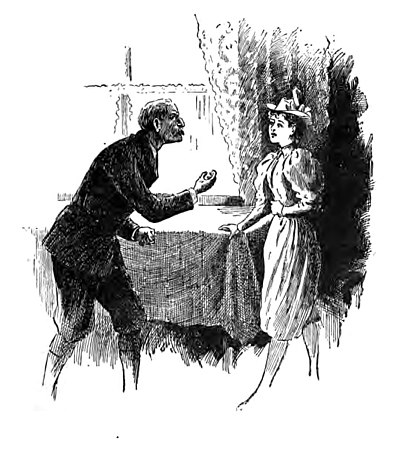
"You must be sensible. The thing's your own doing. Come out on the beach now—the beach here is splendid, and the moon will soon be high."
"I won't," she said, stamping her foot.
"Well, well—"
"Oh! leave me alone. Let me think—"
"Think," he said, "if you want to. It's your cry always. But you can't save yourself by thinking, my dear girl. You can't save yourself in any way now. If saving it is—this parsimony—"
"Oh, go—go."
"Very well. I will go. I will go and smoke a cigar. And think of you, dear. . . . But do you think I should do all this if I did not care?"
"Go," she whispered, without glancing round. She continued to stare out of the window. He stood looking at her for a moment, with a strange light in his eyes. He made a step towards her. "I have you," he said. "You are mine. Netted—caught. But mine." He would have gone up to her and laid his hand upon her, but he did not dare to do that yet. "I have you in my hand," he said, "in my power. Do you hear—Power!"
She remained impassive. He stared at her for half a minute, and then, with a superb gesture that was lost upon her, went to the door. Surely the instinctive abasement of her sex before Strength was upon his side. He told himself that his battle was won. She heard the handle move and the catch click as the door closed behind him.
XXII
And now without in the twilight behold Mr. Hoopdriver, his cheeks hot, his eye bright! His brain is in a tumult. The nervous, obsequious Hoopdriver, to whom I introduced you some days since, has undergone a wonderful change. Ever since he lost that 'spoor' in Chichester, he has been tormented by the most horrible visions of the shameful insults that may be happening. The strangeness of new surroundings has been working to strip off the habitual servile from him. Here was moonlight rising over the memory of a red sunset, dark shadows and glowing orange lamps, beauty somewhere mysteriously rapt away from him, tangible wrong in a brown suit and an unpleasant face, flouting him. Mr. Hoopdriver for the time was in the world of Romance and Knight-errantry, divinely forgetful of his social position or hers; forgetting, too, for the time any of the wretched timidities that had tied him long since behind the counter in his proper place. He was angry and adventurous. It was all about him, this vivid drama he had fallen into, and it was eluding him. He was far too grimly in earnest to pick up that lost thread and make a play of it now. The man was living. He did not pose when he alighted at the coffee tavern even, nor when he made his hasty meal.
As Bechamel crossed from the Vicuna towards the esplanade, Hoopdriver, disappointed and exasperated, came hurrying round the corner from the Temperance Hotel. At the sight of Bechamel, his heart jumped, and the tension of his angry suspense exploded into, rather than gave place to, an excited activity of mind. They were at the Vicuna, and she was there now alone. It was the occasion he sought. But he would give Chance no chance against him. He went back round the corner, sat down on the seat, and watched Bechamel recede into the dimness up the esplanade, before he got up and walked into the hotel entrance. "A lady cyclist in grey," he asked for, and followed boldly on the waiter's heels. The door of the dining-room was opening before he felt a qualm. And then suddenly he was nearly minded to turn and run for it, and his features seemed to him to be convulsed.
She turned with a start, and looked at him with something between terror and hope in her eyes.
"Can I—have a few words—with you, alone?" said Mr. Hoopdriver, controlling his breath with difficulty. She hesitated, and then motioned the waiter to withdraw.
Mr. Hoopdriver watched the door shut. He had intended to step out into the middle of the room, fold his arms and say, "You are in trouble. I am a Friend. Trust me." Instead of which he stood panting and then spoke with sudden familiarity, hastily, guiltily: "Look here. I don't know what the Juice is up, but I think there's something wrong. Excuse my intruding—if it isn't so. I'll do anything you like to help you out of the scrape—if you're in one. That's my meaning, I believe. What can I do? I would do anything to help you."
Her brow puckered, as she watched him make, with infinite emotion, this remarkable speech. "You!" she said. She was tumultuously weighing possibilities in her mind, and he had scarcely ceased when she had made her resolve.
She stepped a pace forward. "You are a gentleman," she said.
"Yes," said Mr. Hoopdriver.
"Can I trust you?"
She did not wait for his assurance. "I must leave this hotel at once. Come here."
She took his arm and led him to the window. "You can just see the gate. It is still open. Through that are our bicycles. Go down, get them out, and I will come down to you. Dare you?"
"Get your bicycle out in the road?"
"Both. Mine alone is no good. At once. Dare you?"
"Which way?"
"Go out by the front door and round. I will follow in one minute."
"Right!" said Mr. Hoopdriver, and went.
He had to get those bicycles. Had he been told to go out and kill Bechamel he would have done it. His head was a Maëlstrom now. He walked out of the hotel, along the front, and into the big, black-shadowed coach yard. He looked round. There were no bicycles visible. Then a man emerged from the dark, a short man in a short, black, shiny jacket. Hoopdriver was caught. He made no attempt to turn and run for it. "I've been giving your machines a wipe over, sir," said the man, recognising the suit, and touching his cap. Hoopdriver's intelligence now was a soaring eagle; he swooped on the situation at once. "That's right," he said, and added, before the pause became marked, "Where is mine? I want to look at the chain."
The man led him into an open shed, and went fumbling for a lantern. Hoopdriver moved the lady's machine out of his way to the door, and then laid hands on the man's machine and wheeled it out of the shed into the yard. The gate stood open and beyond was the pale road and a clump of trees black in the twilight. He stooped and examined the chain with trembling fingers. How was it to be done? Something behind the gate seemed to flutter. The man must be got rid of anyhow.
"I say," said Hoopdriver, with an inspiration, "can you get me a screwdriver?"
The man simply walked across the shed, opened and shut a box, and came up to the kneeling Hoopdriver with a screwdriver in his hand. Hoopdriver felt himself a lost man. He took the screwdriver with a tepid "Thanks," and incontinently had another inspiration.
"I say," he said again.
"Well?"
"This is Miles too big."
The man lit the lantern, brought it up to Hoopdriver and put it down on the ground. "Want a smaller screwdriver?" he said.
Hoopdriver had his handkerchief out and sneezed a prompt atichew. It is the orthodox thing when you wish to avoid recognition. "As small as you have," he said, out of his pocket handkerchief.
"I ain't got none smaller than that," said the ostler.
"Won't do, really," said Hoopdriver, still wallowing in his handkerchief.
"I'll see wot they got in the 'ouse, if you like, sir," said the man. "If you would," said Hoopdriver. And as the man's heavily nailed boots went clattering down the yard, Hoopdriver stood up, took a noiseless step to the lady's machine, laid trembling hands on its handle and saddle, and prepared for a rush.
The scullery door opened momentarily and sent a beam of warm, yellow light up the road, shut again behind the man, and forthwith Hoopdriver rushed the machines towards the gate. A dark grey form came fluttering to meet him. "Give me this," she said, "and bring yours."
He passed the thing to her, touched her hand in the darkness, ran back, seized Bechamel's machine, and followed.
The yellow light of the scullery door suddenly flashed upon the cobbles again. It was too late now to do anything but escape. He heard the ostler shout behind him, and came into the road. She was up and dim already. He got into the saddle without a blunder. In a moment the ostler was in the gateway with a full-throated "Hi! sir! That ain't allowed;" and Hoopdriver was overtaking the Young Lady in Grey. For some moments the earth seemed alive with shouts of, "Stop 'em!" and the shadows with ambuscades of police. The road swept round, and they were riding out of sight of the hotel, and behind dark hedges, side by side.
She was weeping with excitement as he overtook her. "Brave," she said, "brave!" and he ceased to feel like a hunted thief. He looked over his shoulder and about him, and saw that they were already out of Bognor—for the Vicuna stands at the very westernmost extremity of the sea front—and riding on a fair wide road.
XXIII

"It wasn't that one at all, miss," said the ostler, "I'd swear."
"Well, that's Mr. Beaumont," said the barmaid, "—anyhow."
Their conversation hung comatose in the air, switched up by Bechamel. They listened together. His feet stopped. Turned. Went out of the dining-room. Down the passage to the bedroom. Stopped again.
"Poor chap!" said the barmaid. "She's a wicked woman!"
"Sssh!" said Stephen.
After a pause Bechamel went back to the dining-room. They heard a chair creak under him. Interlude of conversational eyebrows.
"I'm going up," said Stephen, "to break the melancholy news to him."
Bechamel looked up from a week-old newspaper as, without knocking, Stephen entered. Bechamel's face suggested a different expectation. "Beg pardon, sir," said Stephen, with a diplomatic cough.
"Well?" said Bechamel, wondering suddenly if Jessie had kept some of her threats. If so, he was in for an explanation. But he had it ready. She was a monomaniac. "Leave me alone with her," he would say; "I know how to calm her."
"Mrs. Beaumont," said Stephen.
"Well?"
"Has gone."
He rose with a fine surprise. "Gone!" he said with a half laugh.
"Gone, sir. On her bicycle."
"On her bicycle! Why?"
"She went, sir, with Another Gentleman."
This time Bechamel was really startled. "An—other Gentlemen! Who?"
"Another gentleman in brown, sir. Went into the yard, sir, got out the two bicycles, sir, and went off, sir about twenty minutes ago."
Bechamel stood with his eyes round and his knuckle on his hips. Stephen, watching him with immense enjoyment, speculated whether this abandoned husband would weep or curse, or rush off at once in furious pursuit. But as yet he seemed merely stunned.
"Brown clothes?" he said. "And fairish?"
"A little like yourself, sir,—in the dark. The ostler, sir, Jim Duke—"
Bechamel laughed awry. Then, with infinite fervour, he said—But let us put in blank cartridge—he said, " !"
"I might have thought!"
He flung himself into the armchair.
"Damn her," said Bechamel, for all the world like a common man. "I'll chuck this infernal business! They've gone, eigh?"
"Yessir."
"Well, let 'em go," said Bechamel, making a memorable saying. "Let 'em go. Who cares? And I wish him luck. And bring me some Bourbon as fast as you can, there's a good chap. I'll take that, and then I'll have another look round Bognor before I turn in."
Stephen was too surprised to say anything but "Bourbon, sir?"
"Go on," said Bechamel. "Damn you!"
Stephen's sympathies changed at once. "Yessir," he murmured, fumbling for the door handle, and left the room, marvelling. Bechamel, having in this way satisfied his sense of appearances, and comported himself as a Pagan should, so soon as the waiter's footsteps had passed, vented the cream of his feelings in a stream of blasphemous indecency. Whether his wife or her stepmother had sent the detective, she had evidently gone off with him, and that little business was over. And he was here, stranded and sold, an ass, and as it were, the son of many generations of asses. And his only ray of hope was that it seemed more probable, after all, that the girl had escaped through her stepmother. In which case the business might be hushed up yet, and the evil hour of explanation with his wife indefinitely postponed. Then abruptly the image of that lithe figure in grey knickerbockers went frisking across his mind again, and he reverted to his blasphemies. He started up in a gusty frenzy with a vague idea of pursuit, and incontinently sat down again with a concussion that stirred the bar below to its depths. He banged the arms of the chair with his fist, and swore again. "Of all the accursed fools that were ever spawned," he was chanting, "I, Bechamel—" when with an abrupt tap and prompt opening of the door, Stephen entered with the Bourbon.
THE MOONLIGHT RIDE
XXIV
And so the twenty minutes' law passed into an infinity. We leave the wicked Bechamel clothing himself with cursing as with a garment,—the wretched creature has already sufficiently sullied our modest but truthful pages,—we leave the eager little group in the bar of the Vicuna Hotel, we leave all Bognor as we have left all Chichester and Midhurst and Haslemere and Guildford and Ripley and Putney, and follow this dear fool of a Hoopdriver of ours and his Young Lady in Grey out upon the moonlight road. How they rode! How their hearts beat together and their breath came fast, and how every shadow was anticipation and every noise pursuit! For all that flight Mr. Hoopdriver was in the world of Romance. Had a policeman intervened because their lamps were not lit, Hoopdriver had cut him down and ridden on, after the fashion of a hero born. Had Bechamel arisen in the way with rapiers for a duel, Hoopdriver had fought as one to whom Agincourt was a reality and drapery a dream. It was Rescue, Elopement, Glory! And she by the side of him! He had seen her face in shadow, with the morning sunlight tangled in her hair, he had seen her sympathetic with that warm light in her face, he had seen her troubled and her eyes bright with tears. But what light is there lighting a face like hers, to compare with the soft glamour of the midsummer moon?
The road turned northward, going round through the outskirts of Bognor, in one place dark and heavy under a thick growth of trees, then amidst villas again, some warm and lamplit, some white and sleeping in the moonlight; then between hedges, over which they saw broad wan meadows shrouded in a low-lying mist. They scarcely heeded whither they rode at first, being only anxious to get away, turning once westward when the spire of Chichester cathedral rose suddenly near them out of the dewy night, pale and intricate and high. They rode, speaking little, just a rare word now and then, at a turning, at a footfall, at a roughness in the road.
She seemed to be too intent upon escape to give much thought to him, but after the first tumult of the adventure, as flight passed into mere steady riding, his mind became an enormous appreciation of the position. The night was a warm white silence save for the subtile running of their chains. He looked sideways at her as she sat beside him with her ankles gracefully ruling the treadles. Now the road turned westward, and she was a dark grey outline against the shimmer of the moon; and now they faced northwards, and the soft cold light passed caressingly over her hair and touched her brow and cheek.
There is a magic quality in moonshine; it touches all that is sweet and beautiful, and the rest of the night is hidden. It has created the fairies, whom the sunlight kills, and fairyland rises again in our hearts at the sight of it, the voices of the filmy route, and their faint, soul-piercing melodies. By the moonlight every man, dull clod though he be by day, tastes something of Endymion, takes something of the youth and strength of Endymion, and sees the dear white goddess shining at him from his Lady's eyes. The firm substantial daylight things become ghostly and elusive, the hills beyond are a sea of unsubstantial texture, the world a visible spirit, the spiritual within us rises out of its darkness, loses something of its weight and body, and swims up towards heaven. This road that was a mere rutted white dust, hot underfoot, blinding to the eye, is now a soft grey silence, with the glitter of a crystal grain set starlike in its silver here and there. Overhead, riding serenely through the spacious blue, is the mother of the silence, she who has spiritualised the world, alone save for two attendant steady shining stars. And in silence under her benign influence, under the benediction of her light, rode our two wanderers side by side through the transfigured and transfiguring night.
Nowhere was the moon shining quite so brightly as in Mr. Hoopdriver's skull. At the turnings of the road he made his decisions with an air of profound promptitude (and quite haphazard). "The Right," he would say. Or again "The Left," as one who knew. So it was that in the space of an hour they came abruptly down a little lane, full tilt upon the sea. Grey beach to the right of them and to the left, and a little white cottage fast asleep inland of a sleeping fishing-boat. "'Ullo!" said Mr. Hoopriver, sotto voce. They dismounted abruptly. Stunted oaks and thorns rose out of the haze of moonlight that was tangled in the hedge on either side.
"You are safe," said Mr. Hoopdriver, sweeping off his cap with an air and bowing courtly.
"Where are we?"
"Safe."
"But where?"
"Chichester Harbour." He waved his arm seaward as though it was a goal.
"Do you think they will follow us?"
"We have turned and turned again."
It seemed to Hoopdriver that he heard her sob. She stood dimly there, holding her machine, and he, holding his, could go no nearer to her to see if she sobbed for weeping or for want of breath. "What are we to do now?" her voice asked.
"Are you tired?" he asked.
"I will do what has to be done."
The two black figures in the broken light were silent for a space. "Do you know," she said, "I am not afraid of you. I am sure you are honest to me. And I do not even know your name!"
He was taken with a sudden shame of his homely patronymic. "It's an ugly name," he said. "But you are right in trusting me. I would I would do anything for you. . . . This is nothing."
She caught at her breath. She did not care to ask why. But compared with Bechamel!—"We take each other on trust," she said. "Do you want to know—how things are with me?
"That man," she went on, after the assent of his listening silence, "promised to help and protect me. I was unhappy at home—never mind why. A stepmother—Idle, unoccupied, hindered, cramped, that is enough, perhaps. Then he came into my life, and talked to me of art and literature, and set my brain on fire. I wanted to come out into the world, to be a human being—not a thing in a hutch. And he—"
"I know," said Hoopdriver.
"And now, here I am—"
"I will do anything," said Hoopdriver.
She thought. "You cannot imagine my stepmother. No! I could not describe her—"
"I am entirely at your service. I will help you with all my power."
"I have lost an Illusion and found a Knight-errant." She spoke of Bechamel as the Illusion.
Mr. Hoopdriver felt flattered. But he had no adequate answer.
"I'm thinking," he said, full of a rapture of protective responsibility, "what we had best be doing. You are tired, you know. And we can't wander all night—after the day we've had."
"That was Chichester we were near?" she asked.
"If," he meditated, with a tremble in his voice, "you would make me your brother, Miss Beaumont."
"Yes?"
"We could stop there together—"
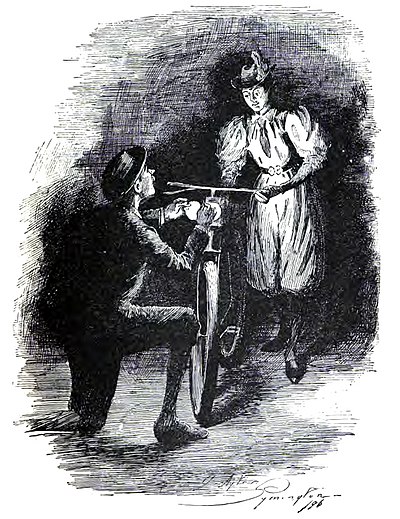
She took a minute to answer. "I am going to light these lamps," said Hoopdriver. He bent down to his own, and struck a match on his shoe. She looked at his face in its light, grave and intent. How could she ever have thought him common or absurd?
"But you must tell me your name—brother," she said.
"But the Christian name?"
"Christian name? My Christian name. Well—Chris." He snapped his lamp and stood up. "If you will hold my machine, I will light yours," he said.
She came round obediently and took his machine, and for a moment they stood face to face. "My name, brother Chris," she said, "is Jessie."
He looked into her eyes, and his excitement seemed arrested. "Jessie," he repeated slowly. The mute emotion of his face affected her strangely. She had to speak. "It's not such a very wonderful name, is it?" she said, with a laugh to break the intensity.
He opened his mouth and shut it again, and, with a sudden wincing of his features, abruptly turned and bent down to open the lantern in front of her machine. She looked down at him, almost kneeling in front of her, with an unreasonable approbation in her eyes. It was, as I have indicated, the hour and season of the full moon.
XXV
Mr. Hoopdriver conducted the rest of that night's journey with the same confident dignity as before, and it was chiefly by good luck and the fact that most roads about a town converge thereupon, that Chichester was at last attained. It seemed at first as though everyone had gone to bed, but the Red Hotel still glowed yellow and warm. It was the first time Hoopdriver had dared the mysteries of a 'first-class' hotel. But that night he was in the mood to dare anything.
"So you found your Young Lady at last," said the ostler of the Red Hotel; for it chanced he was one of those of whom Hoopdriver had made inquiries in the afternoon.
"Quite a misunderstanding," said Hoopdriver, with splendid readiness. "My sister had gone to Bognor But I brought her back here. I've took a fancy to this place. And the moonlight's simply dee-vine."
"We've had supper, thenks, and we're tired," said Mr. Hoopdriver. "I suppose you won't take anything,—Jessie?"
The glory of having her, even as a sister! and to call her Jessie like that! But he carried it off splendidly, as he felt himself bound to admit. "Good-night, Sis," he said, "and pleasant dreams. I'll just 'ave a look at this paper before I turn in." But this was living indeed! he told himself.
So gallantly did Mr. Hoopdriver comport himself up to the very edge of the Most Wonderful Day of all. It had begun early, you will remember, with a vigil in a little sweetstuff shop next door to the Angel at Midhurst. But to think of all the things that had happened since then! He caught himself in the middle of a yawn, pulled out his watch, saw the time was half-past eleven, and marched off, with a fine sense of heroism, bedward.
THE SURBITON INTERLUDE
XXVI
And here, thanks to the glorious institution of sleep, comes a break in the narrative again. These absurd young people are safely tucked away now, their heads full of glowing nonsense, indeed, but the course of events at any rate is safe from any fresh developments through their activities for the next eight hours or more. They are both sleeping healthily you will perhaps be astonished to hear. Here is the girl—what girls are coming to nowadays only Mrs. Lynn Linton can tell!—in company with an absolute stranger, of low extraction and uncertain accent, unchaperoned and unabashed; indeed, now she fancies she is safe, she is, if anything, a little proud of her own share in these transactions. Then this Mr. Hoopdriver of yours, roseate idiot that he is! is in illegal possession of a stolen bicycle, a stolen young lady, and two stolen names, established with them in an hotel that is quite beyond his means, and immensely proud of himself in a somnolent way for these incomparable follies. There are occasions when a moralising novelist can merely wring his hands and leave matters to take their course. For all Hoopdriver knows or cares he may be locked up the very first thing to-morrow morning for the rape of the cycle. Then in Bognor, let alone that melancholy vestige, Bechamel (with whom our dealings are, thank Goodness! over), there is a Coffee Tavern with a steak Mr. Hoopdriver ordered, done to a cinder long ago, his American-cloth parcel in a bedroom, and his own proper bicycle, by way of guarantee, carefully locked up in the hayloft. To-morrow he will be a Mystery, and they will be looking for his body along the sea front. And so far we have never given a glance at the desolate home in Surbiton, familiar to you no doubt through the medium of illustrated interviews, where the unhappy stepmother—
That stepmother, it must be explained, is quite well known to you. That is a little surprise I have prepared for you. She is 'Thomas Plantagenet, ' the gifted authoress of that witty and daring book, "A Soul Untrammelled," and quite an excellent woman in her way,—only it is such a crooked way. Her real name is Milton. She is a widow and a charming one, only ten years older than Jessie, and she is always careful to dedicate her more daring works to the 'sacred memory of my husband' to show that there's nothing personal, you know, in the matter. Considering her literary reputation (she was always speaking of herself as one 'martyred for truth,' because the critics advertised her written indecorums in column long 'slates '),—considering her literary reputation, I say, she was one of the most respectable women it is possible to imagine. She furnished correctly, dressed correctly, had severe notions of whom she might meet, went to church, and even at times took the sacrament in some esoteric spirit. And Jessie she brought up so carefully that she never even let her read "A Soul Untrammelled." Which, therefore, naturally enough, Jessie did, and went on from that to a feast of advanced literature. Mrs. Milton not only brought up Jessie carefully, but very slowly, so that at seventeen she was still a clever schoolgirl (as you have seen her) and quite in the background of the little literary circle of unimportant celebrities which 'Thomas Plantagenet' adorned. Mrs. Milton knew Bechamel's reputation of being a dangerous man; but then bad men are not bad women, and she let him come to her house to show she was not afraid—she took no account of Jessie. When the elopement came, therefore, it was a double disappointment to her, for she perceived his hand by a kind of instinct. She did the correct thing. The correct thing, as you know, is to take hansom cabs, regardless of expense, and weep and say you do not know what to do, round the circle of your confidential friends. She could not have ridden nor wept more had Jessie been her own daughter—she showed the properest spirit. And she not only showed it, but felt it.
Mrs. Milton, as a successful little authoress and still more successful widow of thirty-two,—"Thomas Plantagenet is a charming woman," her reviewers used to write invariably, even if they spoke ill of her,—found the steady growth of Jessie into womanhood an unmitigated nuisance and had been willing enough to keep her in the background. And Jessie—who had started this intercourse at fourteen with abstract objections to stepmothers—had been active enough in resenting this. Increasing rivalry and antagonism had sprung up between them, until they could engender quite a vivid hatred from a dropped hairpin or the cutting of a book with a sharpened knife. There is very little deliberate wickedness in the world. The stupidity of our selfishness gives much the same results indeed, but in the ethical laboratory it shows a different nature. And when the disaster came, Mrs. Milton's remorse for their gradual loss of sympathy and her share in the losing of it, was genuine enough.
You may imagine the comfort she got from her friends, and how West Kensington and Notting Hill and Hampstead, the literary suburbs, those decent penitentiaries of a once Bohemian calling, hummed with the business. Her 'Men'—as a charming literary lady she had, of course, an organised corps—were immensely excited, and were sympathetic; helpfully energetic, suggestive, alert, as their ideals of their various dispositions required them to be. "Any news of Jessie?" was the pathetic opening of a dozen melancholy but interesting conversations. To her Men she was not perhaps so damp as she was to her women friends, but in a quiet way she was even more touching. For three days, Wednesday that is, Thursday, and Friday, nothing was heard of the fugitives. It was known that Jessie, wearing a patent costume with button-up skirts, and mounted on a diamond frame safety with Dunlops, and a loofah covered saddle, had ridden forth early in the morning, taking with her about two pounds seven shillings in money, and a grey touring case packed, and there, save for a brief note to her stepmother,—a declaration of independence, it was said, an assertion of her Ego containing extensive and very annoying quotations from "A Soul Untrammelled," and giving no definite intimation of her plans—knowledge ceased. That note was shown to few, and then only in the strictest confidence.
But on Friday evening late came a breathless Man Friend, Widgery, a correspondent of hers, who had heard of her trouble among the first. He had been touring in Sussex,—his knapsack was still on his back,—and he testified hurriedly that at a place called Midhurst, in the bar of an hotel called the Angel, he had heard from a barmaid a vivid account of a Young Lady in Grey. Descriptions tallied. But who was the man in brown? "The poor, misuided girl! I must go to her at once," she said, choking, and rising with her hand to her heart.
"It's impossible to-night. There are no more trains. I looked on my way."
"A mother's love," she said. "I bear her that."
"I know you do." He spoke with feeling, for no one admired his photographs of scenery more than Mrs. Milton. "It's more than she deserves."
"Oh, don't speak unkindly of her! She has been misled."
It was really very friendly of him. He declared he was only sorry his news ended there. Should he follow them, and bring her back? He had come to her because he knew of her anxiety. "It is good of you," she said, and quite instinctively took and pressed his hand. "And to think of that poor girl—to-night! It's dreadful." She looked into the fire that she had lit when he came in, the warm light fell upon her dark purple dress, and left her features in a warm shadow. She looked such a slight, frail thing to be troubled so. "We must follow her." Her resolution seemed magnificent. "I have no one to go with me."
"He must marry her," said the man.
"She has no friends. We have no one. After all—Two women. So helpless."
And this fair-haired little figure was the woman that people who knew her only from her books, called bold, prurient even! Simply because she was great-hearted—intellectual. He was overcome by the unspeakable pathos of her position.
"Mrs. Milton," he said. "Hetty!"
She glanced at him. The overflow was imminent. "Not now," she said, "not now. I must find her first."
"Yes," he said with intense emotion. (He was one of those big, fat men who feel deeply.) "But let me help you. At least let me help you."
"But can you spare time?" she said. "For me."
"For you—"
"But what can I do? what can we do?"
"Go to Midhurst. Follow her on. Trace her. She was there on Thursday night, last night. She

cycled out of the town. Courage!" he said. "We will save her yet!"
She put out her hand and pressed his again.
"Courage!" he repeated, finding it so well received.
There were alarms and excursions without. She turned her back to the fire, and he sat down suddenly in the big armchair, which suited his dimensions admirably. Then the door opened, and the girl showed in Dangle, who looked curiously from one to the other. There was emotion here, he had heard the armchair creaking, and Mrs. Milton, whose face was flushed, displayed a suspicious alacrity to explain. "You, too," she said, "are one of my good friends. And we have news of her at last."
It was decidedly an advantage to Widgery, but Dangle determined to show himself a man of resource. In the end he, too, was accepted for the Midhurst Expedition, to the intense disgust of Widgery; and young Phipps, a callow youth of few words, faultless collars, and fervent devotion, was also enrolled before the evening was out. They would scour the country, all three of them. She appeared to brighten up a little, but it was evident she was profoundly touched. She did not know what she had done to merit such friends. Her voice broke a little, she moved towards the door, and young Phipps, who was a youth of action rather than of words, sprang and opened it—proud to be first.
"She is sorely troubled," said Dangle to Widgery.
"We must do what we can for her."
"She is a wonderful woman," said Dangle. "So subtle, so intricate, so many faceted. She feels this deeply."
Young Phipps said nothing, but he felt the more.
And yet they say the age of chivalry is dead!
But this is only an Interlude, introduced to give our wanderers time to refresh themselves by good, honest sleeping. For the present, therefore, we will not concern ourselves with the starting of the Rescue Party, nor with Mrs. Milton's simple but becoming grey dress, with the healthy Widgery's Norfolk jacket and thick boots, with the slender Dangle's energetic bearing, nor with the wonderful chequerings that set off the legs of the golf-suited Phipps. They are after us. In a little while they will be upon us. You must imagine as you best can the competitive raidings at Midhurst of Widgery, Dangle, and Phipps. How Widgery was great at questions, and Dangle good at inference, and Phipps so conspicuously inferior in everything that he felt it, and sulked with Mrs. Milton most of the day, after the manner of your callow youth the whole world over. Mrs. Milton stopped at the Angel and was very sad and charming and intelligent, and Widgery paid the bill. In the afternoon of Saturday, Chichester was attained. But by that time our fugitives—As you shall immediately hear.
THE AWAKENING OF MR. HOOPDRIVER
XXVII
Mr. Hoopdriver stirred on his pillow, opened his eyes, and, staring unmeaningly, yawned. The bed-clothes were soft and pleasant. He turned the peaked nose that overrides the insufficient moustache, up to the ceiling, a pinkish projection over the billow of white. You might see it wrinkle as he yawned again, and then become quiet. So matters remained for a space. Very slowly recollection returned to him. Then a shock of indeterminate brown hair appeared, and first one watery grey eye a-wondering, and then two; the bed upheaved, and you had him, his thin neck projecting abruptly from the clothes he held about him, his face staring about the room. He held the clothes about him, I hope I may explain, because his night-shirt was at Bognor in an American-cloth packet, derelict. He yawned a third time, rubbed his eyes, smacked his lips. He was recalling almost everything now. The pursuit, the hotel, the tremulous daring of his entry, the swift adventure of the inn yard, the moonlight—Abruptly he threw the clothes back and rose into a sitting position on the edge of the bed. Without was the noise of shutters being unfastened and doors unlocked, and the passing of hoofs and wheels in the street. He looked at his watch. Half-past six. He surveyed the sumptuous room again.
"Lord!" said Mr. Hoopdriver. "It wasn't a dream, after all."
"I wonder what they charge for these Juiced rooms!" said Mr. Hoopdriver, nursing one rosy foot.
He became meditative, tugging at his insufficient moustache. Suddenly he gave vent to a noiseless laugh. "What a rush it was! Rushed in and off with his girl right under his nose. Planned it well too. Talk of highway robbery! Talk of brigands! Up and off! How juiced sold he must be feeling! It was a shave too—in the coach yard!"
Suddenly he became silent. Abruptly his eyebrows rose and his jaw fell. "I sa—a—ay!" said Mr. Hoopdriver.
He had never thought of it before. Perhaps you will understand the whirl he had been in overnight. But one sees things clearer in the daylight. "I'm hanged if I haven't been and stolen a blessed bicycle."
"Who cares?" said Mr. Hoopdriver, presently, and his face supplied the answer.
Then he thought of the Young Lady in Grey again, and tried to put a more heroic complexion on the business. But of an early morning, on an empty stomach (as with characteristic coarseness, medical men put it) heroics are of a more difficult growth than by moonlight. Everything had seemed exceptionally fine and brilliant, but quite natural, the evening before.
Mr. Hoopdriver reached out his hand, took his Norfolk jacket, laid it over his knees, and took out the money from the little ticket pocket. "Fourteen and six-half," he said, holding the coins in his left hand and stroking his chin with his right. He verified, by patting, the presence of a pocketbook in the breast pocket. "Five, fourteen, six-half," said Mr. Hoopdriver. "Left."
With the Norfolk jacket still on his knees, he plunged into another silent meditation. "That wouldn't matter," he said. "It's the bike's the bother.
"No good going back to Bognor.
"Might send it back by carrier, of course. Thanking him for the loan. Having no further use—" Mr. Hoopdriver chuckled and lapsed into the silent concoction of a delightfully impudent letter. "Mr.

J. Hoopdriver presents his compliments." But the grave note reasserted itself.
"Might trundle back there in an hour, of course, and exchange them. My old crock's so blessed shabby. He's sure to be spiteful too. Have me run in, perhaps. Then she'd be in just the same old fix, only worse. You see, I'm her Knight-errant. It complicates things so."
His eye, wandering loosely, rested on the sponge bath. "What the juice do they want with cream pans in a bedroom?" said Mr. Hoopdriver, en passant.
"Best thing we can do is to set out of here as soon as possible, anyhow. I suppose she'll go home to her friends. That bicycle is a juicy nuisance, anyhow. Juicy nuisance!"
He jumped to his feet with a sudden awakening of energy, to proceed with his toilet. Then with a certain horror he remembered that the simple necessaries of that process were at Bognor! "Lord!" he remarked, and whistled silently for a space. "Rummy go! profit and loss; profit, one sister with bicycle complete, wot offers?—cheap for tooth and 'air brush, vests, night-shirt, stockings, and sundries.
"Make the best of it," and presently, when it came to hair-brushing, he had to smooth his troubled locks with his hands. It was a poor result. "Sneak out and get a shave, I suppose, and buy a brush and so on. Chink again! Beard don't show much."
He ran his hand over his chin, looked at himself steadfastly for some time, and curled his insufficient moustache up with some care. Then he fell a-meditating on his beauty. He considered himself, three-quarter face, left and right. An expression of distaste crept over his features. "Looking won't alter it, Hoopdriver," he remarked. "You're a weedy customer, my man. Shoulders narrow. Skimpy, anyhow."
He put his knuckles on the toilet table and regarded himself with his chin lifted in the air. "Good Lord!" he said. "What a neck! Wonder why I got such a thundering lump there."
He sat down on the bed, his eye still on the glass. "If I'd been exercised properly, if I'd been fed reasonable, if I hadn't been shoved out of a silly school into a silly shop—But there! the old folks didn't know no better. The schoolmaster ought to have. But he didn't, poor old fool!—Still, when it comes to meeting a girl like this—It's 'ard.
"I wonder what Adam 'd think of me—as a specimen. Civilisation, eigh? Heir of the ages! I'm nothing. I know nothing. I can't do anything—sketch a bit. Why wasn't I made an artist?
"Beastly cheap, after all, this suit does look, in the sunshine."
"No good, Hoopdriver. Anyhow, you don't tell yourself any lies about it. Lovers ain't your game,—anyway. But there's other things yet. You can help the young lady, and you will—I suppose she'll be going home—And that business of the bicycle's to see to, too, my man. Forward, Hoopdriver! If you ain't a beauty, that's no reason why you should stop and be copped, is it?"
And having got back in this way to a gloomy kind of self-satisfaction, he had another attempt at his hair preparatory to leaving his room and hurrying on breakfast, for an early departure. While breakfast was preparing he wandered out into South Street and refurnished himself with the elements of luggage again. "No expense to be spared," he murmured, disgorging the half-sovereign.
THE DEPARTURE FROM CHICHESTER
XXVIII
He caused his 'sister' to be called repeatedly, and when she came down, explained with a humorous smile his legal relationship to the bicycle in the yard. "Might be disagreeable, y' know." His anxiety was obvious enough. "Very well," she said (quite friendly); "hurry breakfast, and we'll ride out. I want to talk things over with you." The girl seemed more beautiful than ever after the night's sleep; her hair in comely dark waves from her forehead, her ungauntleted finger-tips pink and cool. And how decided she was! Breakfast was a nervous ceremony, conversation fraternal but thin; the waiter overawed him, and he was cowed by a multiplicity of forks. But she called him "Chris." They discussed their route over his sixpenny county map for the sake of talking, but avoided a decision in the presence of the attendant. The five-pound note was changed for the bill, and through Hoopdriver's determination to be quite the gentleman, the waiter and chambermaid got half a crown each and the ostler a florin. "'Olidays," said the ostler to himself, without gratitude. The public mounting of the bicycles in the street was a moment of trepidation. A policeman actually stopped and watched them from the opposite kerb. Suppose him to come across and ask: "Is that your bicycle, sir?" Fight? Or drop it and run? It was a time of bewildering apprehension, too, going through the streets of the town, so that a milk cart barely escaped destruction under Mr. Hoopdriver's chancy wheel. That recalled him to a sense of erratic steering, and he pulled himself together. In the lanes he breathed freer, and a less formal conversation presently began.
"You've ridden out of Chichester in a great hurry," said Jessie.
"Well, the fact of it is, I'm worried, just a little bit. About this machine."
"Of course," she said. "I had forgotten that. But where are we going?"
"Jest a turning or two more, if you don't mind," said Hoopdriver. "Jest a mile or so. I have to think of you, you know. I should feel more easy. If we was locked up, you know—Not that I should mind on my own account—"
They rode with a streaky, grey sea coming and going on their left hand. Every mile they put between themselves and Chichester Mr. Hoopdriver felt a little less conscience-stricken, and a little more of the gallant desperado. Here he was riding on a splendid machine with a Slap-up girl beside him. What would they think of it in the Emporium if any of them were to see him? He imagined in detail the astonishment of Miss Isaacs and of Miss Howe. "Why! It's Mr. Hoopdriver," Miss Isaacs would say. "Never!" emphatically from Miss Howe. Then he played with Briggs, and then tried the 'G. V.' in a shay. "Fancy introjuicing 'em to her—My sister pro tem." He was her brother Chris—Chris what?—Confound it! Harringon, Hartington—something like that. Have to keep off that topic until he could remember. Wish he'd told her the truth now—almost. He glanced at her. She was riding with her eyes straight ahead of her. Thinking. A little perplexed, perhaps, she seemed. He noticed how well she rode and that she rode with her lips closed—a thing he could never manage.
Mr. Hoopdriver's mind came round to the future. What was she going to do? What were they both going to do? His thoughts took a graver colour. He had rescued her. This was fine, manly rescue work he was engaged upon. She ought to go home, in spite of that stepmother. He must insist gravely but firmly upon that. She was the spirited sort, of course, but still—Wonder if she had any money? Wonder what the second-class fare from Havant to London is? Of course he would have to pay that—it was the regular thing, he being a gentleman. Then should he take her home? He began to rough in a moving sketch of the return. The stepmother, repentant of her indescribable cruelties, would be present,—even these rich people have their troubles,—probably an uncle or two. The footman would announce, Mr.—(bother that name!) and Miss Milton. Then two women weeping together, and a knightly figure in the background dressed in a handsome Norfolk jacket, still conspicuously new. He would conceal his feeling until the very end. Then, leaving, he would pause in the doorway in such an attitude as Mr. George Alexander might assume, and say, slowly and dwindlingly: "Be kind to her—be kind to her," and so depart, heartbroken to the meanest intelligence. But that was a matter for the future. He would have to begin discussing the return soon. There was no traffic along the road, and he came up beside her (he had fallen behind in his musing). She began to talk. "Mr. Denison," she began, and then, doubtfully, "That is your name? I'm very stupid—"
"It is," said Mr. Hoopdriver. (Denison, was it? Denison, Denison, Denison. What was she saying?)
"I wonder how far you are willing to help me?"
Confoundedly hard to answer a question like that on the spur of the moment, without steering wildly. "You may rely—" said Mr. Hoopdriver, recovering from a violent wabble. "I can assure you—I want to help you very much. Don't consider me at all. Leastways, consider me entirely at your service." (Nuisance not to be able to say this kind of thing right.)
"You see, I am so awkwardly situated."
"If I can only help you—you will make me very happy—" There was a pause. Round a bend in the road they came upon a grassy space between hedge and road, set with yarrow and meadowsweet, where a felled tree lay among the green. There she dismounted, and propping her machine against a stone, sat down. "Here, we can talk," she said.
"Yes," said Mr. Hoopdriver, expectant.
She answered after a little while, sitting, elbow on knee, with her chin in her hand, and looking straight in front of her. "I don't know—I am resolved to Live my Own Life."
"Of course," said Mr. Hoopdriver. "Naturally."
"I want to Live, and I want to see what life means. I want to learn. Everyone is hurrying me, everything is hurrying me; I want time to think."
Mr. Hoopdriver was puzzled, but admiring. It

was wonderful how clear and ready her words were. But then one might well speak well with a throat and lips like that. He knew he was inadequate, but he tried to meet the occasion. "If you let them rush you into anything you might repent of, of course you'd be very silly," he said.
"Don't you want to learn?" she asked.
"I was wondering only this morning," he began, and stopped.
She was too intent upon her own thoughts to notice this insufficiency. "I find myself in life, and it terrifies me. I seem to be like a little speck whirling on a wheel, suddenly caught up. 'What am I here for?' I ask. Simply to be here a time—I asked it a week ago, I asked it yesterday, and I ask it to-day. And little things happen and the days pass. My stepmother takes me shopping, people come to tea, there is a new play to pass the time, or a concert, or a novel. The wheels of the world go on turning, turning. It is horrible. I want to do a miracle like Joshua and stop the whirl until I have fought it out. At home—It's impossible."
Mr. Hoopdriver stroked his moustache. "It is so," he said in a meditative tone. "Things will go on." The faint breath of summer stirred the trees, and a bunch of dandelion puff lifted among the meadowsweet and struck and broke into a dozen separate threads against his knee. They flew on apart, and sank, as the breeze fell, among the grass: some to germinate, some to perish. His eye followed them until they had vanished.
"I can't go back to Surbiton," said the Young Lady in Grey.
"Eigh?" said Mr. Hoopdriver, catching at his moustache. This was an unexpected development.
"I want to write, you see," said the Young Lady in Grey, "to write Books and alter things. To do Good. I want to lead a Free Life and Own myself. I can't go back. I want to obtain a position as a Journalist. I have been told—But I know no one to help me at once. No one that I could go to. There is one person—She was a mistress at my school. If I could write to her—But then, how could I get her answer?"
"H'mp," said Mr. Hoopdriver, very grave.
"I can't trouble you much more. You have come—you have risked things—"
"That don't count," said Mr. Hoopdriver. "It's double pay to let me do it, so to speak."
"It is good of you to say that. Surbiton is so Conventional. I am resolved to be Unconventional—at any cost. But we are so hampered. If I could only burgeon out of all that hinders me ! I want to struggle, to take my place in the world. I want to be my own mistress, to shape my own career. But my stepmother objects so. She does as she likes herself, and is strict with me to ease her conscience. And if I go back now, go back owning myself beaten " She left the rest to his imagination.
"I see that," agreed Mr. Hoopdriver. He must help her. Within his skull he was doing some intricate arithmetic with five pounds six and twopence. In some vague way he inferred from all this that Jessie was trying to escape from an undesirable marriage, but was saying these things out of modesty. His circle of ideas was so limited.
"You know, Mr.—I've forgotten your name again."
Mr. Hoopdriver seemed lost in abstraction. "You can't go back of course, quite like that," he said thoughtfully. His ears were suddenly red and his cheeks flushed.
"But what is your name?"
"Name!" said Mr. Hoopdriver. "Why!—Benson, of course."
"Mr. Benson—yes—it's really very stupid of me. But I can never remember names. I must make a note on my cuff." She clicked a little silver pencil and wrote the name down. "If I could write to my friend. I believe she would be able to help me to an independent life. I could write to her—or telegraph. Write, I think. I could scarcely explain in a telegram. I know she would help me."
Clearly there was only one course open to a gentleman under the circumstances. "In that case," said Mr. Hoopdriver, "if you don't mind trusting yourself to a stranger, we might continue as we are perhaps. For a day or so. Until you heard." (Suppose thirty shillings a day, that gives four days, say four thirties is hun' and twenty, six quid, well, three days, say; four ten.)
"You are very good to me."
His expression was eloquent.
"Very well, then, and thank you. It's wonderful—it's more than I deserve that you—" She dropped the theme abruptly. "What was our bill at Chichester?"
"Eigh?" said Mr. Hoopdriver, feigning a certain stupidity. There was a brief discussion. Secretly he was delighted at her insistence in paying. She carried her point. Their talk came round to their immediate plans for the day. They decided to ride easily, through Havant, and stop, perhaps, at Fareham or Southampton. For the previous day had tried them both. Holding the map extended on his knee, Mr. Hoopdriver's eye fell by chance on the bicycle at his feet. "That bicycle," he remarked, quite irrelevantly, "wouldn't look the same machine if I got a big, double Elarum instead of that little bell."
"Why?"
"Jest a thought." A pause.
"Very well, then,—Havant and lunch," said Jessie, rising.
"I wish, somehow, we could have managed it without stealing that machine," said Hoopdriver. "Because it is stealing it, you know, come to think of it."
"Nonsense. If Mr. Bechamel troubles you—I will tell the whole world—if need be."
"I believe you would," said Mr. Hoopdriver, admiring her. "You're plucky enough—goodness knows."
Discovering suddenly that she was standing, he, too, rose and picked up her machine. She took it and wheeled it into the road. Then he took his own. He paused, regarding it. "I say!" said he. "How'd this bike look, now, if it was enamelled grey?"
She looked over her shoulder at his grave face. "Why try and hide it in that way?"
"It was jest a passing thought," said Mr. Hoopdriver, airily. "Didn't mean anything, you know."
As they were riding on to Havant it occurred to Mr. Hoopdriver in a transitory manner that the interview had been quite other than his expectation. But that was the way with everything in Mr. Hoopdriver's experience. And though his Wisdom looked grave within him, and Caution was chinking coins, and an ancient prejudice in favour of Property shook her head, something else was there too, shouting in his mind to drown all these saner considerations, the intoxicating thought of riding beside Her all to-day, all to-morrow, perhaps for other days after that. Of talking to her familiarly, being brother of all her slender strength and freshness, of having a golden, real, and wonderful time beyond all his imaginings. His old familiar fancyings gave place to anticipations as impalpable and fluctuating and beautiful as the sunset of a summer day.
At Havant he took an opportunity to purchase, at a small hairdresser's in the main street, a toothbrush, a pair of nail scissors, and a little bottle of stuff to darken the moustache, an article the shopman introduced to his attention, recommended highly, and sold in the excitement of the occasion.
THE UNEXPECTED ANECDOTE OF THE LION
XXIX
They rode on to Cosham and lunched lightly but expensively there. Jessie went out and posted her letter to her school friend. Then the green height of Portsdown Hill tempted them, and leaving their machines in the village they clambered up the slope to the silent red-brick fort that crowned it. Thence they had a view of Portsmouth and its cluster of sister towns, the crowded narrows of the harbour, the Solent and the Isle of Wight like a blue cloud through the hot haze. Jessie by some miracle had become a skirted woman in the Cosham inn. Mr. Hoopdriver lounged gracefully on the turf, smoked a Red Herring cigarette, and lazily regarded the fortified towns that spread like a map away there, the inner line of defence like toy fortifications, a mile off perhaps; and beyond that a few little fields and then the beginnings of Landport suburb and the smoky cluster of the multitudinous houses. To the right at the head of the harbour shallows the town of Porchester rose among the trees. Mr. Hoopdriver's anxiety receded to some remote corner of his brain and that florid half-voluntary imagination of his shared the stage with the image of Jessie. He began to speculate on the impression he was creating. He took stock of his suit in a more optimistic spirit, and reviewed, with some complacency, his actions for the last four and twenty hours. Then he was dashed at the thought of her infinite perfections.
She had been observing him quietly, rather more closely during the last hour or so. She did not look at him directly because he seemed always looking at her. Her own troubles had quieted down a little, and her curiosity about the chivalrous, worshipping, but singular gentleman in brown, was awakening. She had recalled, too, the curious incident of their first encounter. She found him hard to explain to herself. You must understand that her knowledge of the world was rather less than nothing, having been obtained entirely from books. You must not take a certain ignorance for foolishness.
She had begun with a few experiments. He did not know French except 'sivverplay,' a phrase he seemed to regard as a very good light table joke in itself. His English was uncertain, but not such as books informed her distinguished the lower classes. His manners seemed to her good on the whole, but a trifle over-respectful and out of fashion. He called her 'Madam' once. He seemed a person of means and leisure, but he knew nothing of recent concerts, theatres, or books. How did he spend his time? He was certainly chivalrous, and a trifle simple-minded. She fancied (so much is there in a change of costume) that she had never met with such a man before. What could he be?
"Mr. Benson," she said, breaking a silence devoted to landscape.
He rolled over and regarded her, chin on knuckles.
"At your service."
"Do you paint? Are you an artist?"
"Well." Judicious pause. "I should hardly call myself a Nartist, you know. I do paint a little. And sketch, you know—skitty kind of things."
He plucked and began to nibble a blade of grass. It was really not so much lying as his quick imagination that prompted him to add, "In Papers, you know, and all that."
"I see," said Jessie, looking at him thoughtfully. Artists were a very heterogeneous class certainly, and geniuses had a trick of being a little odd. He avoided her eye and bit his grass. "I don't do much, you know."
"It's not your profession?"
"Oh, no," said Hoopdriver, anxious now to hedge. "I don't make a regular thing of it, you know. Jest now and then something comes into my head and down it goes. No—I'm not a regular artist."
"Then you don't practise any regular profession?"
Mr. Hoopdriver looked into her eyes and saw their quiet unsuspicious regard. He had vague ideas of resuming the detective rôle. "It's like this," he said, to gain time. "I have a sort of profession. Only there's a kind of reason—nothing much, you know—"
"I beg your pardon for cross-examining you."
"No trouble," said Mr. Hoopdriver. "Only I can't very well—I leave it to you, you know. I don't want to make any mystery of it, so far as that goes." Should he plunge boldly and be a barrister? That anyhow was something pretty good. But she might know about barristry.
"I think I could guess what you are."
"Well—guess," said Mr. Hoopdriver.
"You come from one of the colonies?"
"Dear me!" said Mr. Hoopdriver, veering round to the new wind. "How did you find out that?" (the man was born in a London suburb, dear Reader.)
"I guessed," she said.
He lifted his eyebrows as one astonished, and clutched a new piece of grass.
"You were educated up country."
"Good again," said Hoopdriver, rolling over again into her elbow. "You're a clairvoy ant." He bit at the grass, smiling. "Which colony was it?"
"That I don't know."
"You must guess," said Hoopdriver.
"South Africa," she said. "I strongly incline to South Africa."
"South Africa's quite a large place," he said.
"But South Africa is right?"
"You're warm," said Hoopdriver, "anyhow," and the while his imagination was eagerly exploring this new province.
"South Africa is right?" she insisted.
He turned over again and nodded, smiling reassuringly into her eyes.
"What made me think of South Africa was that novel of Olive Schreiner's, you know—'The Story of an African Farm.' Gregory Rose is so like you."
"I never read 'The Story of an African Farm,'" said Hoopdriver. "I must. What's he like?"
"You must read the book. But it's a wonderful place, with its mixture of races, and its brand-new civilisation jostling the old savagery. Were you near Khama?"
"He was a long way off from our place," said Mr. Hoopdriver. "We had a little ostrich farm, you know—Just a few hundred of 'em, out Johannesburg way."
"On the Karroo was it called?"
"That's the term. Some of it was freehold though. Luckily. We got along very well in the old days.—But there's no ostriches on that farm now." He had a diamond mine in his head, just at the moment, but he stopped and left a little to the girl's imagination. Besides which it had occurred to him with a kind of shock that he was lying.
"What became of the ostriches?"
"We sold 'em off, when we parted with the farm. Do you mind if I have another cigarette? That was when I was quite a little chap, you know, that we had this ostrich farm."
"Did you have Blacks and Boers about you?"
"Lots," said Mr. Hoopdriver, striking a match on his instep and beginning to feel hot at the new responsibility he had brought upon himself.
"How interesting! Do you know, I've never been out of England except to Paris and Mentone and Switzerland."
"One gets tired of travelling (puff) after a bit, of course."
"You must tell me about your farm in South Africa. It always stimulates my imagination to think of these places. I can fancy all the tall ostriches being driven out by a black herd to—graze, I suppose. How do ostriches feed?"
"Well," said Hoopdriver. "That's rather various. They have their fancies, you know. There's fruit, of course, and that kind of thing. And chicken food, and so forth. You have to use judgment."
"Did you ever see a lion?"
"They weren't very common in our district," said Hoopdriver, quite modestly. "But I've seen them, of course. Once or twice."
"Fancy seeing a lion! Weren't you frightened?"
Mr. Hoopdriver was now thoroughly sorry he had accepted that offer of South Africa. He puffed his cigarette and regarded the Solent languidly as he settled the fate on that lion in his mind. "I scarcely had time," he said. "It all happened in a minute."
"Go on," she said.
"I was going across the inner paddock where the fatted ostriches were."
"Did you eat ostriches, then? I did not know—"
"Eat them!—often. Very nice they are too, properly stuffed. Well, we—I, rather—was going across this paddock, and I saw something standing up in the moonlight and looking at me." Mr. Hoopdriver was in a hot perspiration now. His invention seemed to have gone limp. "Luckily I had my father's gun with me. I was scared, though, I

can tell you. (Puff.) I just aimed at the end that I thought was the head. And let fly. (Puff.) And over it went, you know."
"Dead?"
"As dead. It was one of the luckiest shots I ever fired. And I wasn't much over nine at the time, neither."
"I should have screamed and run away."
"There's some things you can't run away from," said Mr. Hoopdriver. "To run would have been Death."
"I don't think I ever met a lion-killer before," she remarked, evidently with a heightened opinion of him.
There was a pause. She seemed meditating further questions. Mr. Hoopdriver drew his watch hastily. "I say," said Mr. Hoopdriver, showing it to her, "don't you think we ought to be getting on?"
His face was flushed, his ears bright red. She ascribed his confusion to modesty. He rose with a lion added to the burthens of his conscience, and held out his hand to assist her. They walked down into Cosham again, resumed their machines, and went on at a leisurely pace along the northern shore of the big harbour. But Mr. Hoopdriver was no longer happy. This horrible, this fulsome lie, stuck in his memory. Why had he done it? She did not ask for any more South African stories, happily—at least until Porchester was reached—but talked instead of Living One's Own Life, and how custom hung on people like chains. She talked wonderfully, and set Hoopdriver's mind fermenting. By the Castle, Mr. Hoopdriver caught several crabs in little shore pools. At Fareham they stopped for a second tea, and left the place towards the hour of sunset, under such invigorating circumstances as you shall in due course hear.
THE RESCUE EXPEDITION
XXX
And now to tell of those energetic chevaliers, Widgery, Dangle, and Phipps, and of that distressed beauty, 'Thomas Plantagenet,' well known in society, so the paragraphs said, as Mrs. Milton. We left them at Midhurst station, if I remember rightly, waiting, in a state of fine emotion, for the Chichester train. It was clearly understood by the entire Rescue Party that Mrs. Milton was bearing up bravely against almost overwhelming grief. The three gentlemen outdid one another in sympathetic expedients; they watched her gravely—almost tenderly. The substantial Widgery tugged at his moustache, and looked his unspeakable feelings at her with those dog-like, brown eyes of his; the slender Dangle tugged at his moustache, and did what he could with unsympathetic grey ones. Phipps, unhappily, had no moustache to run any risks with, so he folded his arms and talked in a brave, indifferent, bearing-up tone about the London, Brighton, and South Coast Railway, just to cheer the poor woman up a little. And even Mrs. Milton really felt that exalted melancholy to the very bottom of her heart, and tried to show it in a dozen little, delicate, feminine ways.
"There is nothing to do until we get to Chichester," said Dangle. "Nothing."
"Nothing," said Widgery, and aside in her ear: "You really ate scarcely anything, you know."
"Their trains are always late," said Phipps, with his fingers along the edge of his collar.
Dangle, you must understand, was a sub-editor and reviewer, and his pride was to be Thomas Plantagenet's intellectual companion. Widgery, the big man, was manager of a bank and a mighty golfer, and his conception of his relations to her never came into his mind without those charming old lines, "Douglas, Douglas, tender and true," falling hard upon its heels. His name was Douglas—Douglas Widgery. And Phipps, Phipps was a medical student still, and he felt that he laid his heart at her feet, the heart of a man of the world. She was kind to them all in her way, and insisted on their being friends together, in spite of a disposition to reciprocal criticism they displayed. Dangle thought Widgery a Philistine, appreciating but coarsely the merits of "A Soul Untrammelled," and Widgery thought Dangle lacked humanity—would talk insincerely to say a clever thing. Both Dangle and Widgery thought Phipps a bit of a cub, and Phipps thought both Dangle and Widgery a couple of Thundering Bounders.
"They would have got to Chichester in time for lunch," said Dangle, in the train. "After, perhaps. And there's no sufficient place in the road. So soon as we get there, Phipps must inquire at the chief hotels to see if any one answering to her description has lunched there."
"Oh, I'll inquire," said Phipps. "Willingly. I suppose you and Widgery will just hang about—"
He saw an expression of pain on Mrs. Milton's gentle face, and stopped abruptly.
"No," said Dangle, "we shan't hang about, as you put it. There are two places in Chichester where tourists might go—the cathedral and a remarkably fine museum. I shall go to the cathedral and make an inquiry or so, while Widgery—"
"The museum. Very well. And after that there's a little thing or two I've thought of myself," said Widgery.
To begin with they took Mrs. Milton in a kind of procession to the Red Hotel and established her there with some tea. "You are so kind to me," she said. "All of you." They signified that it was nothing, and dispersed to their inquiries. By six they returned, their zeal a little damped, without news. Widgery came back with Dangle. Phipps was the last to return. "You're quite sure," said Widgery, "that there isn't any flaw in that inference of yours?"
"Quite," said Dangle, rather shortly.
"Of course," said Widgery, "their starting from Midhurst on the Chichester road doesn't absolutely bind them not to change their minds."
"My dear fellow! It does. Really it does. You must allow me to have enough intelligence to think of cross-roads. Really you must. There aren't any cross-roads to tempt them. Would they turn aside here? No. Would they turn there? Many more things are inevitable than you fancy."
"We shall see at once," said Widgery, at the window. "Here comes Phipps. For my own part—"
"Phipps!" said Mrs. Milton. "Is he hurrying? Does he look—" She rose in her eagerness, biting her trembling lip, and went towards the window.
"No news," said Phipps, entering.
"Ah!" said Widgery.
"None?" said Dangle.
"Well," said Phipps. "One fellow had got hold of a queer story of a man in bicycling clothes, who was asking the same question about this time yesterday."
"What question?" said Mrs. Milton, in the shadow of the window. She spoke in a low voice, almost a whisper.
"Why—Have you seen a young lady in a grey bicycling costume?"
Dangle caught at his lower lip. "What's that?" he said. "Yesterday! A man asking after her then! What can that mean?"
"Heaven knows," said Phipps, sitting down wearily. "You'd better infer."
"What kind of man?" said Dangle.
"How should I know?—in bicycling costume, the fellow said."
"But what height?—What complexion?"
"Didn't ask," said Phipps.
"Didn't ask! Nonsense," said Dangle.
"Ask him yourself," said Phipps. "He's an ostler chap in the White Hart,—short, thick-set fellow, with a red face and a crusty manner. Leaning up against the stable door. Smells of whiskey. Go and ask him."
"Of course," said Dangle, taking his straw hat from the shade over the stuffed bird on the chiffonier and turning towards the door. "I might have known."
Phipps' mouth opened and shut.
"You're tired, I'm sure, Mr. Phipps," said the lady, soothingly. "Let me ring for some tea for you." It suddenly occurred to Phipps that he had lapsed a little from his chivalry. "I was a little annoyed at the way he rushed me to do all this business," he said. "But I'd do a hundred times as much if it would bring you any nearer to her." Pause. "I would like a little tea."
"I don't want to raise any false hopes," said Widgery. "But I do not believe they even came to Chichester. Bangle's a very clever fellow, of course, but sometimes these Inferences of his—"
"Tchak!" said Phipps, suddenly.
"What is it?" said Mrs. Milton.
"Something I've forgotten. I went right out from here, went to every other hotel in the place, and never thought—But never mind. I'll ask when the waiter comes."
"You don't mean—"
A tap, and the door opened. "Tea, m'm? yes, m'm," said the waiter.
"One minute," said Phipps. "Was a lady in grey, a cycling lady—"
"Stopped here yesterday? Yessir. Stopped the night. With her brother, sir—a young gent."
"Brother!" said Mrs. Milton, in a low tone. "Thank God!"
The waiter glanced at her and understood everything. "A young gent, sir," he said, "very free with his money. Give the name of Beaumont." He proceeded to some rambling particulars, and was cross-examined by Widgery on the plans of the young couple.
"Havant! Where's Havant?" said Phipps. "I seem to remember it somewhere."
"Was the man tall?" said Mrs. Milton, intently, "distinguished looking? with a long, flaxen moustache? and spoke with a drawl?"
"Well," said the waiter, and thought. "His moustache, m'm, was scarcely long—scrubby more, and young looking."
"About thirty-five, he was?"
"No, m'm. More like five and twenty. Not that."
"Dear me!" said Mrs. Milton, speaking in a curious, hollow voice, fumbling for her salts, and showing the finest self-control. "It must have been her younger brother—must have been."
"That will do, thank you," said Widgery, officiously, feeling that she would be easier under this new surprise if the man were dismissed. The waiter turned to go, and almost collided with Dangle, who was entering the room, panting excitedly and with a pocket handkerchief held to his right eye. "Hullo!" said Dangle. "What's up?"
"What's up with you?" said Phipps.
"Nothing—an altercation merely with that 
"Did the man hit you?" asked Widgery.
Mrs. Milton rose and approached Dangle. "Cannot I do anything?"
Dangle was heroic. "Only tell me your news," he said, round the corner of the handkerchief.
"It was in this way," said Phipps, and explained rather sheepishly. While he was doing so, with a running fire of commentary from Widgery, the waiter brought in a tray of tea. "A time table," said Dangle, promptly, "for Havant." Mrs. Milton poured two cups, and Phipps and Dangle partook in passover form. They caught the train by a hair's breadth. So to Havant and inquiries.
Dangle was puffed up to find that his guess of Havant was right. In view of the fact that beyond Havant the Southampton road has a steep hill continuously on the right-hand side, and the sea on the left, he hit upon a magnificent scheme for heading the young folks off. He and Mrs. Milton would go to Fareham, Widgery and Phipps should alight one each at the intermediate stations of Cosham and Porchester, and come on by the next train if they had no news. If they did not come on, a wire to the Fareham post office was to explain why. It was Napoleonic, and more than consoled Dangle for the open derision of the Havant street boys at the handkerchief which still protected his damaged eye.
Moreover, the scheme answered to perfection. The fugitives escaped by a hair's breadth. They were outside the Golden Anchor at Fareham, and preparing to mount, as Mrs. Milton and Dangle came round the corner from the station. "It's her!" said Mrs. Milton, and would have screamed. "Hist!" said Dangle, gripping the lady's arm, removing his handkerchief in his excitement, and leaving the piece of meat over his eye, an extraordinary appearance which seemed unexpectedly to calm her. "Be cool!" said Dangle, glaring under the meat. "They must not see us. They will get away else. Were there flys at the station?" The young couple mounted and vanished round the corner of the Winchester road. Had it not been for the publicity of the business, Mrs. Milton would have fainted. "Save her!" she said.
"Ah! A conveyance," said Dangle. "One minute."
He left her in a most pathetic attitude, with her hand pressed to her heart, and rushed into the Golden Anchor. Dog cart in ten minutes. Emerged. The meat had gone now, and one saw the cooling puffiness over his eye. "I will conduct you back to the station," said Dangle; "hurry back here, and pursue them. You will meet Widgery and Phipps and tell them I am in pursuit."
She was whirled back to the railway station and left there, on a hard, blistered, wooden seat in the sun. She felt tired and dreadfully ruffled and agitated and dusty. Dangle was, no doubt, most energetic and devoted; but for a kindly, helpful manner commend her to Douglas Widgery.
Meanwhile Dangle, his face golden in the evening sun, was driving (as well as he could) a large, black horse harnessed into a thing called a gig, northwestward towards Winchester. Dangle, barring his swollen eye, was a refined-looking little man, and he wore a deerstalker cap and was dressed in dark grey. His neck was long and slender. Perhaps you know what gigs are,—huge, big, wooden things and very high; and the horse, too, was huge and big and high, with knobby legs, a long face, a hard mouth, and a whacking trick of pacing. Smack, smack, smack, smack it went along the road, and hard by the church it shied vigorously at a hooded perambulator.
The history of the Rescue Expedition now becomes confused. It appears that Widgery was extremely indignant to find Mrs. Milton left about upon the Fareham platform. The day had irritated him somehow, though he had started with the noblest intentions, and he seemed glad to find an outlet for justifiable indignation. "He's such a spasmodic creature," said Widgery. "Rushing off! And I suppose we're to wait here until he comes back! It's likely. He's so egotistical, is Dangle. Always wants to mismanage everything himself."
"He means to help me," said Mrs. Milton, a little reproachfully, touching his arm.
Widgery was hardly in the mood to be mollified all at once. "He need not prevent me," he said, and stopped. "It's no good talking, you know, and you are tired."
"I can go on," she said brightly; "if only we find her."
"While I was cooling my heels in Cosham I bought a county map." He produced and opened it. "Here, you see, is the road out of Fareham." He proceeded with the calm deliberation of a business man to develop a proposal of taking train forthwith to Winchester. "They must be going to Winchester," he explained. It was inevitable. To-morrow Sunday, Winchester a cathedral town, road going nowhere else of the slightest importance.
"But Mr. Dangle?"
"He will simply go on until he has to pass something, and then he will break his neck. I have seen Dangle drive before. It's scarcely likely a dog-cart, especially a hired dog-cart, will overtake bicycles in the cool of the evening. Rely upon me, Mrs. Milton—"
"I am in your hands," she said, with pathetic littleness, looking up at him, and for the moment he forgot the exasperation of the day.
Phipps, during this conversation, had stood in a somewhat depressed attitude, leaning on his stick, feeling his collar, and looking from one speaker to the other. The idea of leaving Dangle behind seemed to him an excellent one. "We might leave a message at the place where he got the dog-cart," he suggested, when he saw their eyes meeting. There was a cheerful alacrity about all three at the proposal.
But they never got beyond Botley. For even as their train ran into the station, a mighty rumbling was heard, there was a shouting overhead, the guard stood astonished on the platform, and Phipps, thrusting his head out of the window, cried, "There he goes!" and sprang out of the carriage. Mrs. Milton, following in alarm, just saw it. From Widgery it was hidden. Botley station lies in a cutting, overhead was the roadway, and across the lemon yellows 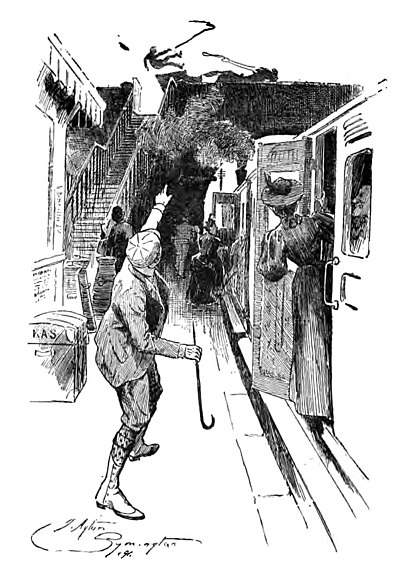
"Better get out," said Phipps to Mrs. Milton, who stood fascinated in the doorway.
In another moment all three were hurrying up the steps. They found Dangle, hatless, standing up with cut hands extended, having his hands brushed by an officious small boy. A broad, ugly road ran downhill in a long vista, and in the distance was a little group of Botley inhabitants holding the big, black horse. Even at that distance they could see the expression of conscious pride on the monster's visage. It was as wooden-faced a horse as you can imagine. The beasts in the Tower of London, on which the men in armour are perched, are the only horses I have ever seen at all like it. However, we are not concerned now with the horse, but with Dangle. "Hurt?" asked Phipps, eagerly, leading.
"Mr. Dangle!" cried Mrs. Milton, clasping her hands.
"Hullo!" said Dangle, not surprised in the slightest. "Glad you've come. I may want you. Bit of a mess I'm in—eigh? But I've caught 'em. At the very place I expected, too."
"Caught them!" said Widgery. "Where are they?"
"Up there," he said, with a backward motion of his head. "About a mile up the hill. I left 'em. I had to."
"I don't understand," said Mrs. Milton, with that rapt, painful look again. "Have you found Jessie?"
"I have. I wish I could wash the gravel out of my hands somewhere. It was like this, you know. Came on them suddenly round a corner. Horse shied at the bicycles. They were sitting by the roadside botanising flowers. I just had time to shout; 'Jessie Milton, we've been looking for you,' and then that confounded brute bolted. I didn't dare turn round. I had all my work to do to save myself being turned over, as it was—so long as I did, I mean. I just shouted, 'Return to your friends. All will be forgiven.' And off I came, clatter, clatter. Whether they heard—"
"Take me to her," said Mrs. Milton, with intensity, turning towards Widgery.
"Certainly," said Widgery, suddenly becoming active. "How far is it, Dangle?"
"Mile and a half or two miles. I was determined to find them, you know. I say though—Look at my hands! But I beg your pardon, Mrs. Milton." He turned to Phipps. "Phipps, I say, where shall I wash the gravel out? And have a look at my knee?"
"There's the station," said Phipps, becoming helpful. Dangle made a step, and a damaged knee became evident. "Take my arm," said Phipps.
"Where can we get a conveyance?" asked Widgery of two small boys.
The two small boys failed to understand. They looked at one another.
"There's not a cab, not a go-cart, in sight," said Widgery. "It's a case of a horse, a horse, my kingdom for a horse."
"There's a harse all right," said one of the small boys with a movement of the head.
"Don't you know where we can hire traps?" asked Widgery.
"Or a cart or—anything?" asked Mrs. Milton.
"John Ooker's gart a cart, but no one can't 'ire'n," said the larger of the small boys, partially averting his face and staring down the road and making a song of it. "And so's my feyther, for's leg us broke."
"Not a cart even! Evidently. What shall we do?"
It occurred to Mrs. Milton that if Widgery was the man for courtly devotion, Dangle was infinitely readier of resource. "I suppose—" she said, timidly. "Perhaps if you were to ask Mr. Dangle—"
And then all the gilt came off Widgery. He answered quite rudely. "Confound Dangle! Hasn't he messed us up enough? He must needs drive after them in a trap to tell them we're coming, and now you want me to ask him—"
Her beautiful blue eyes were filled with tears. He stopped abruptly. "I'll go and ask Dangle," he said, shortly. "If you wish it." And went striding into the station and down the steps, leaving her in the road under the quiet inspection of the two little boys, and with a kind of ballad refrain running through her head, "Where are the Knights of the Olden Time?" and feeling tired to death and hungry and dusty and out of curl, and, in short, a martyr woman.
XXXI
It goes to my heart to tell of the end of that day, how the fugitives vanished into Immensity; how there were no more trains; how Botley stared unsympathetically with a palpable disposition to derision, denying conveyances; how the landlord of the Heron was suspicious, how the next day was Sunday, and the hot summer's day had crumpled the collar of Phipps and stained the skirts of Mrs. Milton, and dimmed the radiant emotions of the whole party. Dangle, with sticking-plaster and a black eye, felt the absurdity of the pose of the Wounded Knight, and abandoned it after the faintest efforts. Recriminations never, perhaps, held the foreground of the talk, but they played like summer lightning on the edge of the conversation, and deep in the hearts of all was a galling sense of the ridiculous. Jessie, they thought, was most to blame. Apparently, too, the worst, which would have made the whole business tragic, was not happening. Here was a young woman—young woman do I say? a mere girl!—had chosen to leave a comfortable home in Surbiton, and all the delights of a refined and intellectual circle, and had rushed off, trailing us after her, posing hard, mutually jealous, and now tired and weather-worn, to flick us off at last, mere mud from her wheel, into this detestable village beer-house on a Saturday night! And she had done it, not for Love and Passion, which are serious excuses one may recognise even if one must reprobate, but just for a Freak, just for a fantastic Idea; for nothing, in fact, but the outraging of Common Sense. Yet withal, such was our restraint, that we talked of her still as one much misguided, as one who burthened us with anxiety, as a lamb astray, and Mrs. Milton having eaten, continued to show the finest feelings on the matter.
She sat, I may mention, in the cushioned basket-chair, the only comfortable chair in the room, and we sat on incredibly hard, horsehair things having antimacassars tied to their backs by means of lemon-coloured bows. It was different from those dear old talks at Surbiton, somehow. She sat facing the window, which was open (the night was so tranquil and warm), and the dim light—for we did not use the lamp—suited her admirably. She talked in a voice that told you she was tired, and she seemed inclined to state a case against herself in the matter of "A Soul Untrammelled." It was such an evening as might live in a sympathetic memoir, but it was a little dull while it lasted.
"I feel," she said, "that I am to blame. I have Developed. That first book of mine—I do not go back upon a word of it, mind, but it has been misunderstood, misapplied."
"It has," said Widgery, trying to look so deeply sympathetic as to be visible in the dark. "Deliberately misunderstood."
"Don't say that," said the lady. "Not deliberately. I try and think that critics are honest. After their lights. I was not thinking of critics. But she, I mean—" She paused, an interrogation.
"It is possible," said Dangle, scrutinising his sticking-plaster.
"I write a book and state a case. I want people to think as I recommend, not to do as I recommend. It is just Teaching. Only I make it into a story. I want to Teach new Ideas, new Lessons, to promulgate Ideas. Then when the Ideas have been spread abroad—Things will come about. Only now it is madness to fly in the face of the established order. Bernard Shaw, you know, has explained that with regard to Socialism. We all know that to earn all you consume is right, and that living on invested capital is wrong. Only we cannot begin while we are so few. It is Those Others."
"Precisely," said Widgery. "It is Those Others. They must begin first."
"And meanwhile you go on banking—"
"If I didn't, some one else would."
"And I live on Mr. Milton's Lotion while I try to gain a footing in Literature."
"Try!" said Phipps. "You have done so." And, "That's different," said Dangle, at the same time.
"You are so kind to me. But in this matter. Of course Georgina Griffiths in my book lived alone in a flat in Paris and went to life classes and had men visitors, but then she was over twenty-one."
"Jessica is only seventeen, and girlish for that," said Dangle.
"It alters everything. That child! It is different with a woman. And Georgina Griffiths never flaunted her freedom—on a bicycle, in country places. In this country. Where every one is so particular. Fancy, sleeping away from home. It's dreadful—If it gets about it spells ruin for her."
"Ruin, "said Widgery.
"No man would marry a girl like that," said Phipps.
"It must be hushed up," said Dangle.
"It always seems to me that life is made up of individuals, of individual cases. We must weigh each person against his or her circumstances. General rules don't apply—"
"I often feel the force of that," said Widgery.
"Those are my rules. Of course my books—"
"It's different, altogether different," said Dangle. "A novel deals with typical cases."
"And life is not typical," said Widgery, with immense profundity.
Then suddenly, unintentionally, being himself most surprised and shocked of any in the room, Phipps yawned. The failing was infectious, and the gathering having, as you can easily understand, talked itself weary, dispersed on trivial pretences. But not to sleep immediately. Directly Dangle was alone he began, with infinite disgust, to scrutinise his darkling eye, for he was a neat-minded little man in spite of his energy. The whole business—so near a capture—was horribly vexatious. Phipps sat on his bed for some time examining, with equal disgust, a collar he would have thought incredible for Sunday twenty-four hours before. Mrs. Milton fell a-musing on the mortality of even big, fat men with dog-like eyes, and Widgery was unhappy because he had been so cross to her at the station, and because so far he did not feel that he had scored over Dangle. Also he was angry with Dangle. And all four of them, being souls living very much upon the appearances of things, had a painful, mental middle distance of Botley derisive and suspicious, and a remoter background of London humorous, and Surbiton speculative. Were they really, after all, behaving absurdly?
MR. HOOPDRIVER, KNIGHT ERRANT
XXXII
As Mr. Dangle had witnessed, the fugitives had been left by him by the side of the road about two miles from Botley. Before Mr. Bangle's appearance, Mr. Hoopdriver had been learning with great interest that mere roadside flowers had names,—star-flowers, wind-stars, St. John's wort, willow herb, lords and ladies, bachelor's buttons,—most curious names, some of them. "The flowers are all different in South Africa, y'know," he was explaining with a happy fluke of his imagination to account for his ignorance. Then suddenly, heralded by clattering sounds and a gride of wheels, Dangle had flared and thundered across the tranquillity of the summer evening; Dangle, swaying and gesticulating behind a corybantic black horse, had hailed Jessie by her name, had backed towards the hedge for no ostensible reason, and vanished to the accomplishment of the Fate that had been written down for him from the very beginning of things. Jessie and Hoopdriver had scarcely time to stand up and seize

their machines, before this tumultuous, this swift and wonderful passing of Dangle was achieved. He went from side to side of the road,—worse even than the riding forth of Mr. Hoopdriver it was,—and vanished round the corner.
"He knew my name," said Jessie. "Yes—it was Mr. Dangle."
"That was our bicycles did that," said Mr. Hoopdriver simultaneously, and speaking with a certain complacent concern. "I hope he won't get hurt."
"That was Mr. Dangle," repeated Jessie, and Mr. Hoopdriver heard this time, with a violent start. His eyebrows went up spasmodically.
"What! someone you know?"
"Yes."
"Lord!"
"He was looking for me," said Jessie. "I could see. He began to call to me before the horse shied. My stepmother has sent him."
Mr. Hoopdriver wished he had returned the bicycle after all, for his ideas were still a little hazy about Bechamel and Mrs. Milton. Honesty is the best policy—often, he thought. He turned his head this way and that. He became active. "After us, eigh? Then he'll come back. He's gone down that hill, and he won't be able to pull up for a bit, I'm certain."
Jessie, he saw, had wheeled her machine into the road and was mounting. Still staring at the corner that had swallowed up Dangle, Hoopdriver followed suit. And so, just as the sun was setting, they began another flight together,—riding now towards Bishops Waltham, with Mr. Hoopdriver in the post of danger—the rear—ever and again looking over his shoulder and swerving dangerously as he did so. Occasionally Jessie had to slacken her pace. He breathed heavily, and hated himself because his mouth fell open. After nearly an hour's hard riding, they found themselves uncaught at Winchester. Not a trace of Dangle nor any other danger was visible as they rode into the dusky, yellow-lit street. Though the bats had been fluttering behind the hedges and the evening star was bright while they were still two miles from Winchester, Mr. Hoopdriver pointed out the dangers of stopping in such an obvious abiding- place, and gently but firmly insisted upon replenishing the lamps and riding on towards Salisbury. From Winchester, roads branch in every direction, and to turn abruptly westward was clearly the way to throw off the chase. As Hoopdriver saw the moon rising broad and yellow through the twilight, he thought he should revive the effect of that ride out of Bognor; but somehow, albeit the moon and all the atmospheric effects were the same, the emotions were different. They rode in absolute silence, and slowly after they had cleared the outskirts of Winchester. Both of them were now nearly tired out,—the level was tedious, and even a little hill a burden; and so it came about that in the hamlet of Wallenstock they were beguiled to stop and ask for accommodation in an exceptionally prosperous-looking village inn. A plausible landlady rose to the occasion.
Now, as they passed into the room where their suppers were prepared, Mr. Hoopdriver caught a glimpse through a door ajar and floating in a reek of smoke, of three and a half faces—for the edge of the door cut one down—and an American cloth-covered table with several glasses and a tankard. And he also heard a remark. In the second before he heard that remark, Mr. Hoopdriver had been a proud and happy man,—to particularize, a baronet's heir incognito. He had surrendered their bicycles to the odd man of the place with infinite easy dignity, and had bowingly opened the door for Jessie. "Who's that, then?" he imagined people saying; and then, "Some'n pretty well orf—judge by the bicycles." Then the imaginary spectators would fall a-talking of the fashionableness of bicycling,—how judges and stockbrokers and actresses and, in fact, all the best people rode, and how that it was often the fancy of such great folk to shun the big hotels, the adulation of urban crowds, and seek, incognito, the cosy quaintnesses of village life. Then, maybe, they would think of a certain nameless air of distinction about the lady who had stepped across the doorway, and about the handsome, flaxen-moustached, blue-eyed Cavalier who had followed her in, and they would look one to another. "Tell you what it is," one of the village elders would say—just as they do in novels—voicing the thought of all, in a low, impressive tone: "There's such a thing as entertaining barranets unawares—not to mention no higher things"
Such, I say, had been the filmy, delightful stuff in Mr. Hoopdriver's head the moment before he heard that remark. But the remark toppled him headlong. What the precise remark was need not concern us. It was a casual piece of such satire as Strephon delights in. Should you be curious, dear lady, as to its nature, you have merely to dress yourself in a really modern cycling costume, get one of the feeblest-looking of your men to escort you, and ride out, next Saturday evening, to any public house where healthy, homely people gather together. Then you will hear quite a lot of the kind of thing Mr. Hoopdriver heard. More, possibly, than you will desire.
The remark, I must add, implicated Mr. Hoopdriver. It indicated an entire disbelief in his social standing. At a blow, it shattered all the gorgeous imaginative fabric his mind had been rejoicing in. All that foolish happiness vanished like a dream. And there was nothing to show for it, as there is nothing to show for any spiteful remark that has ever been made. Perhaps the man who said the thing had a gleam of satisfaction at the idea of taking a complacent-looking fool down a peg, but it 'is just as possible he did not know at the time that his stray shot had hit. He had thrown it as a boy throws a stone at a bird. And it not only demolished a foolish, happy conceit, but it wounded. It touched Jessie grossly.
She did not hear it, he concluded from her subsequent bearing; but during the supper they had in the little private dining-room, though she talked cheerfully, he was preoccupied. Whiffs of indistinct conversation, and now and then laughter, came in from the inn parlour through the pelargoniums in the open window. Hoopdriver felt it must all be in the same strain,—at her expense and his. He answered her abstractedly. She was tired, she said, and presently went to her room. Mr. Hoopdriver, in his courtly way, opened the door for her and bowed her out. He stood listening and fearing some new offence as she went upstairs, and round the bend where the barometer hung beneath the stuffed birds. Then he went back to the room, and stood on the hearthrug before the paper fireplace ornament. "Cads!" he said in a scathing undertone, as a fresh burst of laughter came floating in. All through supper he had been composing stinging repartee, a blistering speech of denunciation to be presently delivered. He would rate them as a nobleman should: "Call themselves Englishmen, indeed, and insult a woman!" he would say; take the names and addresses perhaps, threaten to speak to the Lord of the Manor, promise to let them hear from him again, and so out with consternation in his wake. It really ought to be done.
"Teach 'em better," he said fiercely, and tweaked his moustache painfully. What was it? He revived the objectionable remark for his own exasperation; and then went over the heads of his speech again.
He coughed, made three steps towards the door, then stopped and went back to the hearthrug. He wouldn't—after all. Yet was he not a Knight Errant? Should such men go unreproved, unchecked, by wandering baronets incognito? Magnanimity? Look at it in that way? Churls beneath one's notice? No; merely a cowardly subterfuge. He would—after all.
Something within him protested that he was a hot-headed ass even as he went towards the door again. But he only went on the more resolutely. He crossed the hall, by the bar, and entered the room from which the remark had proceeded. He opened the door abruptly and stood scowling on them in the doorway. "You'll only make a mess of it," remarked the internal sceptic. There were five men in the room altogether: a fat person, with a long pipe and a great number of chins, in an arm-chair by the fireplace, who wished Mr. Hoopdriver a good evening very affably; a young fellow smoking a cutty and displaying crossed legs with gaiters; a little, bearded man with a toothless laugh; a middle-aged, comfortable man with bright eyes, who wore a velveteen jacket; and a fair young man, very genteel in a yellowish-brown ready-made suit and a white tie.
"H'm," said Mr. Hoopdriver, looking very stern and harsh. And then in a forbidding tone, as one who consented to no liberties, "Good evening."
"Very pleasant day we've been 'aving," said the fair young man with the white tie.
"Very," said Mr. Hoopdriver, slowly; and taking a brown armchair, he planted it with great deliberation where he faced the fireplace, and sat down. Let's see—how did that speech begin?
"Very pleasant roads about here," said the fair young man with the white tie.
"Very," said Mr. Hoopdriver, eyeing him darkly. Have to begin somehow. "The roads about here are all right, and the weather about here is all right, but what I've come in here to say is—there's some damned unpleasant people—damned unpleasant people!"
"Oh!" said the young man with the gaiters, apparently making a mental inventory of his pearl buttons as he spoke. "How's that?"
Mr. Hoopdriver put his hands on his knees and stuck out his elbows with extreme angularity. In his heart he was raving at his idiotic folly at thus bearding these lions,—indisputably they were lions,—but he had to go through with it now. Heaven send, his breath, which was already getting a trifle spasmodic, did not suddenly give out. He fixed his eye on the face of the fat man with the chins, and spoke in a low, impressive voice. "I came here, sir," said Mr. Hoopdriver, and paused to inflate his cheeks, "with a lady."
"Very nice lady," said the man with the gaiters, putting his head on one side to admire a pearl button that had been hiding behind the curvature of his calf. "Very nice lady indeed."
"I came here," said Mr. Hoopdriver, "with a lady."
"We saw you did, bless you," said the fat man with the chins, in a curious wheezy voice. "I don't see there's anything so very extraordinary in that. One 'ud think we hadn't eyes."
Mr. Hoopdriver coughed. "I came here, sir—"
"We've 'eard that," said the little man with the beard, sharply and went off into an amiable chuckle. "We know it by 'art," said the little man, elaborating the point.
Mr. Hoopdriver temporarily lost his thread. He glared malignantly at the little man with the beard, and tried to recover his discourse. A pause.
"You were saying," said the fair young man with the white tie, speaking very politely, "that you came here with a lady."
"A lady," meditated the gaiter gazer.
The man in velveteen, who was looking from one speaker to another with keen, bright eyes, now laughed as though a point had been scored, and stimulated Mr. Hoopdriver to speak, by fixing him with an expectant regard.
"Some dirty cad," said Mr. Hoopdriver, proceeding with his discourse, and suddenly growing extremely fierce, "made a remark as we went by this door."

"Steady on!" said the old gentleman with many chins. "Steady on! Don't you go a-calling us names, please."
"One minute!" said Mr. Hoopdriver. "It wasn't I began calling names." ("Who did?" said the man with the chins.) "I'm not calling any of you dirty cads. Don't run away with that impression. Only some person in this room made a remark that showed he wasn't fit to wipe boots on, and, with all due deference to such gentlemen as are gentlemen" (Mr. Hoopdriver looked round for moral support), "I want to know which it was."
"Meanin'?" said the fair young man in the white tie.
"That I'm going to wipe my boots on 'im straight away," said Mr. Hoopdriver, reverting to anger, if with a slight catch in his throat—than which threat of personal violence nothing had been further from his thoughts on entering the room. He said this because he could think of nothing else to say, and stuck out his elbows truculently to hide the sinking of his heart. It is curious how situations run away with us.
"'Ullo, Charlie!" said the little man, and "My eye!" said the owner of the chins. "You're going to wipe your boots on 'im?" said the fair young man, in a tone of mild surprise.
"I am," said Mr. Hoopdriver, with emphatic resolution, and glared in the young man's face.
"That's fair and reasonable," said the man in the velveteen jacket; "if you can."
The interest of the meeting seemed transferred to the young man in the white tie. "Of course, if you can't find out which it is, I suppose you're prepared to wipe your boots in a liberal way on everybody in the room," said this young man, in the same tone of impersonal question. "This gentleman, the champion lightweight—"
"Own up, Charlie," said the young man with the gaiters, looking up for a moment. "And don't go a-dragging in your betters. It's fair and square. You can't get out of it."
"Was it this—gent?" began Mr. Hoopdriver.
"Of course," said the young man in the white tie, "when it comes to talking of wiping boots—"
"I'm not talking; I'm going to do it," said Mr. Hoopdriver.
He looked round at the meeting. They were no longer antagonists; they were spectators. He would have to go through with it now. But this tone of personal aggression on the maker of the remark had somehow got rid of the oppressive feeling of Hoopdriver contra mundum. Apparently, he would have to fight someone. Would he get a black eye? Would he get very much hurt? Pray goodness it wasn't that sturdy chap in the gaiters! Should he rise and begin? What would she think if he brought a black eye to breakfast to-morrow? "Is this the man?" said Mr. Hoopdriver, with a business-like calm, and arms more angular than ever.
"Eat 'im!" said the little man with the beard; "eat 'im straight orf."
"Steady on!" said the young man in the white tie. "Steady on a minute. If I did happen to say—"
"You did, did you?" said Mr. Hoopdriver.
"Backing out of it, Charlie?" said the young man with the gaiters.
"Not a bit," said Charlie. "Surely we can pass a bit of a joke—"
"I'm going to teach you to keep your jokes to yourself," said Mr. Hoopdriver.
"Bray-vo!" said the shepherd of the flock of chins.
"Charlie is a bit too free with his jokes," said the little man with the beard.
"It's downright disgusting," said Hoopdriver, falling back upon his speech. "A lady can't ride a bicycle in a country road, or wear a dress a little out of the ordinary, but every dirty little greaser must needs go shouting insults—"
"I didn't know the young lady would hear what I said," said Charlie. "Surely one can speak friendly to one's friends. How was I to know the door was open—"
Hoopdriver began to suspect that his antagonist was, if possible, more seriously alarmed at the prospect of violence than himself, and his spirits rose again. These chaps ought to have a thorough lesson. "Of course you knew the door was open," he retorted indignantly. "Of course you thought we should hear what you said. Don't go telling lies about it. It's no good your saying things like that. You've had your fun, and you meant to have your fun. And I mean to make an example of you, Sir."
"Ginger beer," said the little man with the beard, in a confidential tone to the velveteen jacket, "is regular up this 'ot weather. Bustin' its bottles it is everywhere."
"What's the good of scrapping about in a public-house?" said Charlie, appealing to the company. "A fair fight without interruptions, now, I wouldn't mind, if the gentleman's so disposed."
Evidently the man was horribly afraid. Mr. Hoopdriver grew truculent.
"Where you like," said Mr. Hoopdriver. "Jest wherever you like."
"You insulted the gent," said the man in velveteen.
"Don't be a bloomin' funk, Charlie," said the man in gaiters. "Why, you got a stone of him, if you got an ounce."
"What I say, is this," said the gentleman with the excessive chins, trying to get a hearing by banging his chair arms. "If Charlie goes saying things, he ought to back 'em up. That's what I say. I don't mind his sayin' such things 't all, but he ought to be prepared to back 'em up."
"I'll back 'em up all right," said Charlie, with extremely bitter emphasis on 'back.' "If the gentleman likes to come Toosday week—"
"Rot!" chopped in Hoopdriver. "Now."
"'Ear, 'ear," said the owner of the chins.
"Never put off till to-morrow, Charlie, what you can do to-day," said the man in the velveteen coat.
"You got to do it, Charlie," said the man in gaiters. "It's no good."
"It's like this," said Charlie, appealing to everyone except Hoopdriver. "Here's me got to take in her ladyship's dinner to-morrow night. How should I look with a black eye? And going round with the carriage with a split lip?"
"If you don't want your face sp'iled, Charlie, why don't you keep your mouth shut?" said the person in gaiters.
"Exactly," said Mr. Hoopdriver, driving it home with great fierceness. "Why don't you shut your ugly mouth?"
"It's as much as my situation's worth," protested Charlie.
"You should have thought of that before," said Hoopdriver.
"There's no occasion to be so thunderin' 'ot about it. I only meant the thing joking," said Charlie. "As one gentleman to another, I'm very sorry if the gentleman's annoyed—"
Everybody began to speak at once. Mr. Hoopdriver twirled his moustache. He felt that Charlie's recognition of his gentlemanliness was at any rate a redeeming feature. But it became his pose to ride hard and heavy over the routed foe. He shouted some insulting phrase over the tumult.
"You're regular abject," the man in gaiters was saying to Charlie.
More confusion.
"Only don't think I'm afraid,—not of a spindle-legged cuss like him!" shouted Charlie. "Because I ain't."
"Change of front," thought Hoopdriver, a little startled. "Where are we going?"
"Don't sit there and be abusive," said the man in velveteen. "He's offered to hit you, and if I was him, I'd hit you now."
"All right, then," said Charlie, with a sudden change of front and springing to his feet. "If I must, I must. Now, then!" At that, Hoopdriver, the child of Fate, rose too, with a horrible sense that his internal monitor was right. Things had taken a turn. He had made a mess of it, and now there was nothing for it, so far as he could see, but to hit the man at once. He and Charlie stood six feet apart, with a table between, both very breathless and fierce. A vulgar fight in a public-house, and with what was only too palpably a footman! Good Heavens! And this was the dignified, scornful remonstrance! How the juice had it all happened? Go round the table at him, I suppose. But before the brawl could achieve itself, the man in gaiters intervened. "Not here," he said, stepping between the antagonists. Everyone was standing up.
"Charlie's artful," said the little man with the beard.
"Buller's yard," said the man with the gaiters, taking the control of the entire affair with the easy readiness of an accomplished practitioner. "If the gentleman don't mind." Buller's yard, it seemed, was the very place. "We'll do the thing regular and decent, if you please." And before he completely realized what was happening, Hoopdriver was being marched out through the back premises of the inn, to the first and only fight with fists that was ever to glorify his life.
Outwardly, so far as the intermittent moonlight showed, Mr. Hoopdriver was quietly but eagerly prepared to fight. But inwardly he was a chaos of conflicting purposes. It was extraordinary how things happened. One remark had trod so closely on the heels of another, that he had had the greatest difficulty in following the development of the business. He distinctly remembered himself walking across from one room to the other,—a dignified, even an aristocratic figure, primed with considered eloquence, intent upon a scathing remonstrance to these wretched yokels, regarding their manners. Then incident had flickered into incident, until here he was out in a moonlit lane,—a slight, dark figure in a group of larger, indistinct figures,—marching in a quiet, business-like way towards some unknown horror at Buller's yard. Fists! It was astonishing. It was terrible! In front of him was the pallid figure of Charles, and he saw that the man in gaiters held Charles kindly but firmly by the arm.
"It's blasted rot," Charles was saying, "getting up a fight just for a thing like that; all very well for 'im. 'E's got 'is 'olidays; 'e 'asn't no blessed dinner to take up to-morrow night like I 'ave.—No need to numb my arm, is there?"
They went into Buller's yard through gates. There were sheds in Buller's yard—sheds of mystery that the moonlight could not solve—a smell of cows, and a pump stood out clear and black, throwing a clear black shadow on the whitewashed wall. And here it was his face was to be battered to a pulp. He knew this was the uttermost folly, to stand up here and be pounded, but the way out of it was beyond his imagining. Yet afterwards—? Could he ever face her again? He patted his Norfolk jacket and took his ground with his back to the gate. How did one square? So? Suppose one were to turn and run even now, run straight back to the inn and lock himself into his bedroom? They couldn't make him come out—anyhow. He could prosecute them for assault if they did. How did one set about prosecuting for assault? He saw Charles, with his face ghastly white under the moon, squaring in front of him.
He caught a blow on the arm and gave ground. Charles pressed him. Then he hit with his right and with the violence of despair. It was a hit of his own devising,—an impromptu,—but it chanced to coincide with the regulation hook hit at the head. He perceived with a leap of exultation that the thing his fist had met was the jawbone of Charles. It was the sole gleam of pleasure he experienced during the fight, and it was quite momentary. He had hardly got home upon Charles before he was struck in the chest and whirled backward. He had the greatest difficulty in keeping his feet. He felt that his heart was smashed flat. "Gord darm!" said somebody, dancing toe in hand somewhere behind him. As Mr. Hoopdriver staggered, Charles gave a loud and fear-compelling cry. He seemed to tower over Hoopdriver in the moonlight. Both his fists were whirling. It was annihilation coming—no less. Mr. Hoopdriver ducked perhaps and certainly gave ground to the right, hit, and missed. Charles swept round to the left, missing generously. A blow glanced over Mr. Hoopdriver's left ear, and the flanking movement was completed. Another blow behind the ear. Heaven and earth spun furiously round Mr. Hoopdriver, and then he became aware of a figure in a light suit shooting violently through an open gate into the night. The man in gaiters sprang forward past Mr. Hoopdriver, but too late to intercept the fugitive. There were shouts, laughter, and Mr. Hoopdriver, still solemnly squaring, realized the great and
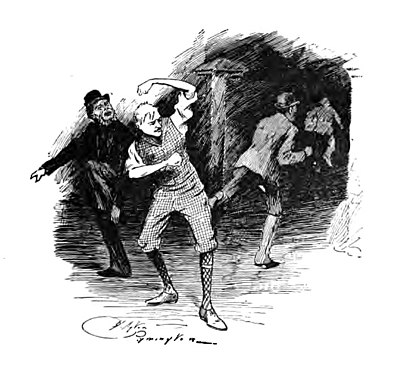
wonderful truth—Charles had fled. He, Hoopdriver, had fought and, by all the rules of war, had won.
"That was a pretty cut under the jaw you gave him," the toothless little man with the beard was remarking in an unexpectedly friendly manner.
"The fact of it is," said Mr. Hoopdriver, sitting beside the road to Salisbury, and with the sound of distant church bells in his ears, "I had to give the fellow a lesson; simply had to."
"It seems so dreadful that you should have to knock people about," said Jessie.
"These louts get unbearable," said Mr. Hoopdriver. "If now and then we didn't give them a lesson,—well, a lady cyclist in the roads would be an impossibility."
"I suppose every woman shrinks from violence," said Jessie. "I suppose men are braver—in a way—than women. It seems to me—I can't imagine—how one could bring oneself to face a roomful of rough characters, pick out the bravest, and give him an exemplary thrashing. I quail at the idea. I thought only Ouida's guardsmen did things like that."
"It was nothing more than my juty—as a gentleman," said Mr. Hoopdriver.
"But to walk straight into the face of danger!"
"It's habit," said Mr. Hoopdriver, quite modestly, flicking off a particle of cigarette ash that had settled on his knee.
THE ABASEMENT OF MR. HOOPDRIVER
XXXIII
On Monday morning the two fugitives found themselves breakfasting at the Golden Pheasant in Blandford. They were in the course of an elaborate doubling movement through Dorsetshire towards Ringwood, where Jessie anticipated an answer from her schoolmistress friend. By this time they had been nearly sixty hours together, and you will understand that Mr. Hoopdriver's feelings had undergone a considerable intensification and development. At first Jessie had been only an impressionist sketch upon his mind, something feminine, active, and dazzling, something emphatically "above" him, cast into his company by a kindly fate. His chief idea, at the outset, as you know, had been to live up to her level, by pretending to be more exceptional, more wealthy, better educated, and, above all, better born than he was. His knowledge of the feminine mind was almost entirely derived from the young ladies he had met in business, and in that class (as in military society and among gentlemen's servants) the good old tradition of a brutal social exclusiveness is still religiously preserved. He had an almost intolerable dread of her thinking him a 'bounder.' Later he began to perceive the distinction of her idiosyncracies. Coupled with a magnificent want of experience was a splendid enthusiasm for abstract views of the most advanced description, and her strength of conviction completely carried Hoopdriver away. She was going to Live her Own Life, with emphasis, and Mr. Hoopdriver was profoundly stirred to similar resolves. So soon as he grasped the tenor of her views, he perceived that he himself had thought as much from his earliest years. "Of course," he remarked, in a flash of sexual pride, "a man is freer than a woman. End in the Colonies, y'know, there isn't half the Conventionality you find in society in this country."
He made one or two essays in the display of unconventionality, and was quite unaware that he impressed her as a narrow-minded person. He suppressed the habits of years and made no proposal to go to church. He discussed church-going in a liberal spirit. "It's jest a habit," he said, "jest a custom. I don't see what good it does you at all, really." And he made a lot of excellent jokes at the chimney-pot hat, jokes he had read in the Globe 'turnovers' on that subject. But he showed his gentle breeding by keeping his gloves on all through the Sunday's ride, and ostentatiously throwing away more than half a cigarette when they passed a church whose congregation was gathering for afternoon service. He cautiously avoided literary topics, except by way of compliment, seeing that she was presently to be writing books.
It was on Jessie's initiative that they attended service in the old-fashioned gallery of Blandford church. Jessie's conscience, I may perhaps tell you, was now suffering the severest twinges. She perceived clearly that things were not working out quite along the lines she had designed. She had read her Olive Schreiner and George Egerton, and so forth, with all the want of perfect comprehension of one who is still emotionally a girl. She knew the thing to do was to have a flat and to go to the British Museum and write leading articles for the daily papers until something better came along. If Bechamel (detestable person) had kept his promises, instead of behaving with unspeakable horridness, all would have been well. Now her only hope was that liberal-minded woman, Miss Mergle, who, a year ago, had sent her out, highly educated, into the world. Miss Mergle had told her at parting to live fearlessly and truly, and had further given her a volume of Emerson's Essays and Motley's "Dutch Republic," to help her through the rapids of adolescence.
Jessie's feelings for her stepmother's household at Surbiton amounted to an active detestation. There are no graver or more solemn women in the world than these clever girls whose scholastic advancement has retarded their feminine coquetry. In spite of the advanced tone of 'Thomas Plantagenet's' anti-marital novel, Jessie had speedily seen through that amiable woman's amiable defences. The variety of pose necessitated by the corps of 'Men' annoyed her to an altogether unreasonable degree. To return to this life of ridiculous unreality—unconditional capitulation to 'Conventionality' was an exasperating prospect. Yet what else was there to do?
You will understand, therefore, that at times she was moody (and Mr. Hoopdriver respectfully silent and attentive) and at times inclined to eloquent denunciation of the existing order of things. She was a Socialist, Hoopdriver learnt, and he gave a vague intimation that he went further, intending, thereby, no less than the horrors of anarchism. He would have owned up to the destruction of the Winter Palace indeed, had he had the faintest idea where the Winter Palace was, and had his assurance amounted to certainty that the Winter Palace was destroyed. He agreed with her cordially that the position of women was intolerable, but checked himself on the verge of the proposition that a girl ought not to expect a fellow to hand down boxes for her when he was getting the 'swap' from a customer. It was Jessie's preoccupation with her own perplexities, no doubt, that delayed the unveiling of Mr. Hoopdriver all through Saturday and Sunday. Once or twice, however, there were incidents that put him about terribly—even questions that savoured of suspicion.
On Sunday night, for no conceivable reason, an unwonted wakefulness came upon him. Unaccountably he realised he was a contemptible liar. All through the small hours of Monday he reviewed the tale of his falsehoods, and when he tried to turn his mind from that, the financial problem suddenly rose upon him. He heard two o'clock strike, and three. It is odd how unhappy some of us are at times, when we are at our happiest.
XXXIV
"Good morning, Madam," said Hoopdriver, as Jessie came into the breakfast room of the Golden Pheasant on Monday morning, and he smiled, bowed, rubbed his hands together, and pulled out a chair for her, and rubbed his hands again.
She stopped abruptly, with a puzzled expression on her face. "Where have I seen that before?" she said.
"The chair?" said Hoopdriver, flushing.
"No—the attitude."
She came forward and shook hands with him, looking the while curiously into his face. "And—Madam?"
"It's a habit," said Mr. Hoopdriver, guiltily. "A bad habit. Calling ladies Madam. You must put it down to our colonial roughness. Out there—up country—y'know—the ladies—so rare—we call 'em all Madam."
"You have some funny habits, brother Chris," said Jessie. "Before you sell your diamond shares and go into society, as you say, and stand for Parliament—What a fine thing it is to be a man!—you must cure yourself. That habit of bowing as you do, and rubbing your hands, and looking expectant."
"It's a habit."
"I know. But I don't think it a good one. You don't mind my telling you?"
"Not a bit. I'm grateful."
"I'm blessed or afflicted with a trick of observation," said Jessie, looking at the breakfast table. Mr. Hoopdriver put his hand to his moustache and then, thinking this might be another habit, checked his arm and stuck his hand into his pocket. He felt juiced awkward, to use his private formula. Jessie's eye wandered to the armchair, where a piece of binding was loose, and, possibly to carry out her theory of an observant disposition, she turned and asked him for a pin.
Mr. Hoopdriver's hand fluttered instinctively to his lappel, and there, planted by habit, were a couple of stray pins he had impounded.
"What an odd place to put pins!" exclaimed Jessie, taking it.
"It's 'andy," said Mr. Hoopdriver. "I saw a chap in a shop do it once."
"You must have a careful disposition," she said, over her shoulder, kneeling down to the chair.
"In the centre of Africa—up country, that is—one learns to value pins," said Mr. Hoopdriver, after a perceptible pause. "There weren't over many pins in Africa. They don't lie about on the ground there." His face was now in a fine, red glow. Where would the draper break out next? He thrust his hands into his coat pockets, then took one out again, furtively removed the second pin and dropped it behind him gently. It fell with a loud 'ping' on the fender. Happily she made no remark, being preoccupied with the binding of the chair.
Mr. Hoopdriver, instead of sitting down, went up to the table and stood against it, with his finger-tips upon the cloth. They were keeping breakfast a tremendous time. He took up his rolled serviette, looked closely and scrutinisingly at the ring, then put his hand under the fold of the napkin and examined the texture, and put the thing down again. Then he had a vague impulse to finger his hollow wisdom tooth—happily checked. He suddenly discovered he was standing as if the table was a counter, and sat down forthwith. He drummed with his hand on the table. He felt dreadfully hot and self-conscious.
"Breakfast is late," said Jessie, standing up. "Isn't it?"
Conversation was slack. Jessie wanted to know the distance to Ringwood. Then silence fell again. Mr. Hoopdriver, very uncomfortable and studying an easy bearing, looked again at the breakfast things and then idly lifted the corner of the tablecloth on the ends of his fingers, and regarded it. "Fifteen three," he thought, privately.
"Why do you do that?" said Jessie.
"What?" said Hoopdriver, dropping the tablecloth convulsively.
"Look at the cloth like that. I saw you do it yesterday, too."
Mr. Hoopdriver's face became quite a bright red. He began pulling his moustache nervously. "I know," he said. "I know. It's a queer habit, I know. But out there, you know, there's native servants, you know, and—it's a queer thing to talk about—but one has to look at things to see, don't y'know, whether they're quite clean or not. It's got to be a habit."
"How odd!" said Jessie.
"Isn't it?" mumbled Hoopdriver.
"If I were a Sherlock Holmes," said Jessie, "I suppose I could have told you were a colonial from little things like that. But anyhow, I guessed it, didn't I?"
"Yes," said Hoopdriver, in a melancholy tone, "you guessed it."
Why not seize the opportunity for a neat confession, and add, "unhappily in this case you guessed wrong." Did she suspect? Then, at the psychological moment, the girl bumped the door open with her tray and brought in the coffee and scrambled eggs.
"I am rather lucky with my intuitions, sometimes," said Jessie.
Remorse that had been accumulating in his mind for two days surged to the top of his mind. What a shabby liar he was!
And, besides, he must sooner or later, inevitably, give himself away.
XXXV
Mr. Hoopdriver helped the eggs and then, instead of beginning, sat with his cheek on his hand, watching Jessie pour out the coffee. His ears were a bright red, and his eyes bright. He took his coffee cup clumsily, cleared his throat, suddenly leant back in his chair, and thrust his hands deep into his pockets. "I'll do it," he said aloud.
"Do what?" said Jessie, looking up in surprise over the coffee pot. She was just beginning her scrambled egg.
"Own up."
"Own what?"
"Miss Milton—I'm a liar."
He put his head on one side and regarded her with a frown of tremendous resolution. Then in measured accents, and moving his head slowly from side to side, he announced, "Ay'm a deraper."
"You're a draper? I thought—"
"You thought wrong. But it's bound to come up. Pins, attitude, habits—It's plain enough.
"I'm a draper's assistant let out for a ten-days 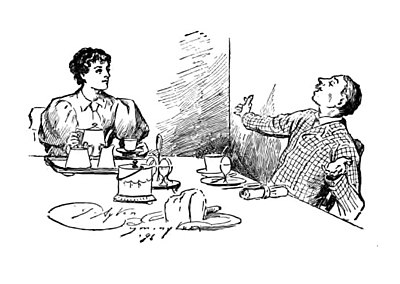
"A draper's assistant isn't a position to be ashamed of," she said, recovering, and not quite understanding yet what this all meant.
"Yes, it is," he said, "for a man, in this country now. To be just another man's hand, as I am. To have to wear what clothes you are told, and go to church to please customers, and work—There's no other kind of men stand such hours. A drunken bricklayer's a king to It."
"But why are you telling me this now?"
"It's important you should know at once."
"But, Mr. Benson—"
"That isn't all. If you don't mind my speaking about myself a bit, there's a few things I'd like to tell you. I can't go on deceiving you. My name's not Benson. Why I told you Benson, I don't know. Except that I'm a kind of fool. Well—I wanted somehow to seem more than I was. My name's Hoopdriver."
"Yes?"
"And that about South Africa—and that lion."
"Well?"
"Lies."
"Lies!"
"And the discovery of diamonds on the ostrich farm. Lies too. And all the reminiscences of the giraffes—lies too. I never rode on no giraffes. I'd be afraid."
He looked at her with a kind of sullen satisfaction. He had eased his conscience, anyhow. She regarded him in infinite perplexity. This was a new side altogether to the man. "But why," she began.
"Why did I tell you such things? I don't know. Silly sort of chap, I expect. I suppose I wanted to impress you. But somehow, now, I want you to know the truth."
Silence. Breakfast untouched. "I thought I'd tell you," said Mr. Hoopdriver. "I suppose it's snobbishness and all that kind of thing, as much as anything. I lay awake pretty near all last night thinking about myself; thinking what a got-up imitation of a man I was, and all that."
"And you haven't any diamond shares, and you are not going into Parliament, and you're not—"
"All Lies," said Hoopdriver, in a sepulchral voice. "Lies from beginning to end. 'Ow I came to tell 'em I don't know."
She stared at him blankly.
"I never set eyes on Africa in my life," said Mr. Hoopdriver, completing the confession. Then he pulled his right hand from his pocket, and with the nonchalance of one to whom the bitterness of death is passed, began to drink his coffee.
"It's a little surprising," began Jessie, vaguely.
"Think it over," said Mr. Hoopdriver. "I'm sorry from the bottom of my heart."
And then breakfast proceeded in silence. Jessie ate very little, and seemed lost in thought. Mr. Hoopdriver was so overcome by contrition and anxiety that he consumed an extraordinarily large breakfast out of pure nervousness, and ate his scrambled eggs for the most part with the spoon that belonged properly to the marmalade. His eyes were gloomily downcast. She glanced at him through her eyelashes. Once or twice she struggled with laughter, once or twice she seemed to be indignant.
"I don't know what to think," she said at last. "I don't know what to make of you—brother Chris. I thought, do you know? that you were perfectly honest. And somehow—"
"Well?"
"I think so still."
"Honest—with all those lies!"
"I wonder."
"I don't," said Mr. Hoopdriver. "I'm fair ashamed of myself. But anyhow—I've stopped deceiving you."
"I thought," said the Young Lady in Grey, "that story of the lion—"
"Lord!" said Mr. Hoopdriver. "Don't remind me of that."
"I thought, somehow, I felt, that the things you said didn't ring quite true." She suddenly broke out in laughter, at the expression of his face. "Of course you are honest," she said. "How could I ever doubt it? As if I had never pretended! I see it all now."
Abruptly she rose, and extended her hand across the breakfast things. He looked at her doubtfully, and saw the dancing friendliness in her eyes. He scarcely understood at first. He rose, holding the marmalade spoon, and took her proffered hand with abject humility. "Lord!" he broke out, "if you aren't enough—but there!"
"I see it all now." A brilliant inspiration had suddenly obscured her humour. She sat down suddenly, and he sat down too. "You did it," she said, "because you wanted to help me. And you thought I was too Conventional to take help from one I might think my social inferior."
"That was partly it," said Mr. Hoopdriver.
"How you misunderstood me!" she said.
"You don't mind?"
"It was noble of you. But I am sorry," she said, "you should think me likely to be ashamed of you because you follow a decent trade."
"I didn't know at first, you see," said Mr. Hoopdriver.
And he submitted meekly to a restoration of his self-respect. He was as useful a citizen as could be,—it was proposed and carried,—and his lying was of the noblest. And so the breakfast concluded much more happily than his brightest expectation, and they rode out of ruddy little Blandford as though no shadow of any sort had come between them.
XXXVI
As they were sitting by the roadside among the pine trees half-way up a stretch of hill between Wimborne and Ringwood, however, Mr. Hoopdriver reopened the question of his worldly position.
"Ju think," he began abruptly, removing a meditative cigarette from his mouth, "that a draper's shop-man is a decent citizen?"
"Why not?"
"When he puts people off with what they don't quite want, for instance?"
"Need he do that?"
"Salesmanship," said Hoopdriver. "Wouldn't get a crib if he didn't.—It's no good your arguing. It's not a particularly honest nor a particularly useful trade; it's not very high up; there's no freedom and no leisure—seven to eight-thirty every day in the week; don't leave much edge to live on, does it?—real workmen laugh at us and educated chaps like bank clerks and solicitors' clerks look down on us. You look respectable outside, and inside you are packed in dormitories like convicts, fed on bread and butter and 
She did not answer. She looked at him with distress in her brown eyes, and he remained gloomily in possession of the field.
Presently he spoke. "I've been thinking," he said, and stopped.
She turned her face, resting her cheek on the palm of her hand. There was a light in her eyes that made the expression of them tender. Mr. Hoopdriver had not looked in her face while he had talked. He had regarded the grass, and pointed his remarks with red-knuckled hands held open and palms upwards. Now they hung limply over his knees.
"Well?" she said.
"I was thinking it this morning," said Mr. Hoopdriver.
"Yes?"
"Of course it's silly."
"Well?"
"It's like this. I'm twenty-three, about. I had my schooling all right to fifteen, say. Well, that leaves me eight years behind.—Is it too late? I wasn't so backward. I did algebra, and Latin up to auxiliary verbs, and French genders. I got a kind of grounding."
"And now you mean, should you go on working?"
"Yes," said Mr. Hoopdriver. "That's it. You can't do much at drapery without capital, you know. But if I could get really educated. . . . I've thought sometimes . . ."
"Why not?" said the Young Lady in Grey.
Mr. Hoopdriver was surprised to see it in that light. "You think? "he said.
"Of course. You are a Man. You are free—" She warmed. "I wish I were you to have the chance of that struggle."
"Am I Man enough?" said Mr. Hoopdriver aloud, but addressing himself. "There's that eight years," he said to her.
"You can make it up. What you call educated men—They're not going on. You can catch them. They are quite satisfied. Playing golf, and thinking of clever things to say to women like my stepmother, and dining out. You're in front of them already in one thing. They think they know everything. You don't. And they know such little things."
"Lord!" said Mr. Hoopdriver. "How you encourage a fellow!"
"If I could only help you," she said, and left an eloquent hiatus. He became pensive again.
"It's pretty evident you don't think much of a draper," he said abruptly.
Another interval. "Hundreds of men," she said, "have come from the very lowest ranks of life. There was Burns, a ploughman; and Hugh Miller, a stonemason; and plenty of others. Dodsley was a footman—"
"But drapers! We're too—sort of shabby genteel to rise. Our coats and cuffs might get crumpled—"
"Wasn't there a Clarke who wrote theology? He was a draper."
"There was one started a sewing cotton, the only one I ever heard tell of."
"Have you ever read 'Hearts Insurgent'?"
"Never," said Mr. Hoopdriver. He did not wait for her context, but suddenly broke out with an account of his literary requirements. "The fact is—I've read precious little. One don't get much of a chance, situated as I am. We have a library at business, and I've gone through that. Most Besant I've read, and a lot of Mrs. Braddon's and Rider Haggard and Marie Corelli—and, well—a Ouida or so. They're good stories, of course, and first-class writers, but they didn't seem to have much to do with me. But there's heaps of books one hears talked about, I haven't read."
"Don't you read any other books but novels?"
"Scarcely ever. One gets tired after business, and you can't get the books. I have been to some extension lectures, of course, '’Lizabethan Dramatists,' it was, but it seemed a little high-flown, you know. And I went and did wood-carving at the same place. But it didn't seem leading nowhere, and I cut my thumb and chucked it."
He made a depressing spectacle, with his face anxious and his hands limp. "It makes me sick," he said, "to think how I've been fooled with. My old schoolmaster ought to have a juiced hiding. He's a thief. He pretended to undertake to make a man of me, and he's stole twenty-three years of my life, filled me up with scraps and sweepings. Here I am! I don't know anything, and I can't do anything, and all the learning time is over."
"Is it?" she said; but he did not seem to hear her.
"My o' people didn't know any better, and went and paid thirty pounds premium—thirty pounds down—to have me made this. The G. V. promised to teach me the trade, and he never taught me anything but to be a Hand. It's the way they do with draper's apprentices. If every swindler was locked up—well, you'd have nowhere to buy tape and cotton. It's all very well to bring up Burns and those chaps, but I'm not that make. Yet I'm not such muck that I might not have been better—with teaching. I wonder what the chaps who sneer and laugh at such as me would be if they'd been fooled about as I've been. At twenty-three—it's a long start."
He looked up with a wintry smile, a sadder and wiser Hoopdriver indeed than him of the glorious imaginings. "It's you done this," he said. "You're real. And it sets me thinking what I really am, and what I might have been. Suppose it was all different—"
"Make it different."
"How?"
"Work. Stop playing at life. Face it like a man."
"Ah!" said Hoopdriver, glancing at her out of the corners of his eyes. "And even then—
"No! It's not much good. I'm beginning too late."
And there, in blankly thoughtful silence, that conversation ended.
IN THE NEW FOREST
XXXVII
At Ringwood they lunched, and Jessie met with a disappointment. There was no letter for her at the post office. Opposite the hotel, The Chequered Career, was a machine shop with a conspicuously second-hand Marlborough Club tandem tricycle displayed in the window, together with the announcement that bicycles and tricycles were on hire within. The establishment was impressed on Mr. Hoopdriver's mind by the proprietor's action in coming across the road and narrowly inspecting their machines. His action revived a number of disagreeable impressions, but, happily, came to nothing. While they were still lunching, a tall clergyman, with a heated face, entered the room and sat down at the table next to theirs. He was in a kind of holiday costume; that is to say, he had a more than usually high collar, fastened behind and rather the worse for the weather, and his long-tail coat had been replaced by a black jacket of quite remarkable brevity. He had faded brown shoes on his feet, his trouser legs were grey with dust, and he wore a hat of piebald straw in the place of the customary soft felt. He was evidently socially inclined.
"A most charming day, sir," he said, in a ringing tenor.
"Charming," said Mr. Hoopdriver, over a portion of pie.
"You are, I perceive, cycling through this delightful country," said the clergyman.
"Touring," explained Mr. Hoopdriver.
"I can imagine that, with a properly oiled machine, there can be no easier nor pleasanter way of seeing the country."
"No," said Mr. Hoopdriver; "it isn't half a bad way of getting about."
"For a young and newly married couple, a tandem bicycle must be, I should imagine, a delightful bond."
"Quite so," said Mr. Hoopdriver, reddening a little.
"Do you ride a tandem?"
"No—we're separate," said Mr. Hoopdriver.
"The motion through the air is indisputably of a very exhilarating description." With that decision, the clergyman turned to give his orders to the attendant, in a firm, authoritative voice, for a cup of tea, two gelatine lozenges, bread and butter, salad, and pie to follow. "The gelatine lozenges I must have. I require them to precipitate the tannin in my tea," he remarked to the room at large, and folding his hands, remained for some time with his chin thereon, staring fixedly at a little picture over Mr. Hoopdriver's head.
"I myself am a cyclist," said the clergyman, descending suddenly upon Mr. Hoopdriver.
"Indeed!" said Mr. Hoopdriver, attacking the moustache. "What machine, may I ask?"
"I have recently become possessed of a tricycle. A bicycle is, I regret to say, considered too—how shall I put it?—flippant by my parishioners. So I have a tricycle. I have just been hauling it hither."
"Hauling!" said Jessie, surprised.
"With a shoe lace. And partly carrying it on my back."
The pause was unexpected. Jessie had some trouble with a crumb. Mr. Hoopdriver's face passed through several phases of surprise. Then he saw the explanation. "Had an accident?"
"I can hardly call it an accident. The wheels suddenly refused to go round. I found myself about five miles from here with an absolutely immobile machine."
"'Ow!" said Mr. Hoopdriver, trying to seem intelligent, and Jessie glanced at this insane person.
"It appears," said the clergyman, satisfied with

the effect he had created, "that my man carefully washed out the bearings with paraffin, and let the machine dry without oiling it again. The consequence was that they became heated to a considerable temperature and jammed. Even at the outset the machine ran stiffly as well as noisily, and I, being inclined to ascribe this stiffness to my own lassitude, merely redoubled my exertions."
"'Ot work all round," said Mr. Hoopdriver.
"You could scarcely put it more appropriately. It is my rule of life to do whatever I find to do with all my might. I believe, indeed, that the bearings became red hot. Finally one of the wheels jammed together. A side wheel it was, so that its stoppage necessitated an inversion of the entire apparatus, an inversion in which I participated."
"Meaning, that you went over?" said Mr. Hoopdriver, suddenly much amused.
"Precisely. And not brooking my defeat, I suffered repeatedly. You may understand, perhaps, a natural impatience. I expostulated—playfully, of course. Happily the road was not overlooked. Finally, the entire apparatus became rigid, and I abandoned the unequal contest. For all practical purposes the tricycle was no better than a heavy chair without castors. It was a case of hauling or carrying."
The clergyman's nutriment appeared in the doorway.
"Five miles," said the clergyman.
He began at once to eat bread and butter vigorously. "Happily," he said, "I am an eupeptic, energetic sort of person—on principle. I would all men were likewise."
"It's the best way," agreed Mr. Hoopdriver, and the conversation gave precedence to bread and butter.
"Gelatine," said the clergyman, presently, stirring his tea thoughtfully, "precipitates the tannin in one's tea and renders it easy of digestion."
"That's a useful sort of thing to know," said Mr. Hoopdriver.
"You are altogether welcome," said the clergyman, biting generously at two pieces of bread and butter folded together.
In the afternoon our two wanderers rode on at an easy pace towards Stoney Cross. Conversation languished, the topic of South Africa being in abeyance. Mr. Hoopdriver was silenced by disagreeable thoughts. He had changed the last sovereign at Ringwood. The fact had come upon him suddenly. Now too late he was reflecting upon his resources. There was twenty pounds or more in the post office savings bank in Putney, but his book was locked up in his box at the Antrobus establishment. Else this infatuated man would certainly have surreptitiously withdrawn the entire sum in order to prolong these journeyings even for a few days. As it was, the shadow of the end fell across his happiness. Strangely enough, in spite of his anxiety and the morning's collapse, he was still in a curious emotional state that was certainly not misery. He was forgetting his imaginings and posings, forgetting himself altogether in his growing appreciation of his companion. The most tangible trouble in his mind was the necessity of breaking the matter to her.
A long stretch up hill tired them long before Stoney Cross was reached, and they dismounted and sat under the shade of a little oak tree. Near the crest the road looped on itself, so that, looking back, it sloped below them up to the right and then came towards them. About them grew a rich heather with stunted oaks on the edge of a deep ditch along the roadside, and this road was sandy; below the steepness of the hill, however, it was grey and barred with shadows, for there the trees clustered thick and tall. Mr. Hoopdriver fumbled clumsily with his cigarettes.
"There's a thing I got to tell you," he said, trying to be perfectly calm.
"Yes?" she said.
"I'd like to jest discuss your plans a bit, y'know."
"I'm very unsettled," said Jessie.
"You are thinking of writing Books?"
"Or doing Journalism, or teaching, or something like that."
"And keeping yourself independent of your stepmother?"
"Yes."
"How long'd it take now, to get anything of that sort to do?"
"I don't know at all. I believe there are a great many women journalists and sanitary inspectors, and black-and-white artists. But I suppose it takes time. Women, you know, edit most papers nowadays, George Egerton says. I ought, I suppose, to communicate with a literary agent."
"Of course," said Hoopdriver, "it's very suitable work. Not being heavy like the drapery."
"There's heavy brain labour, you must remember."
"That wouldn't hurt you," said Mr. Hoopdriver, turning a compliment.
"It's like this," he said, ending a pause. "It's a juiced nuisance alluding to these matters, but—we got very little more money."
He perceived that Jessie started, though he did not look at her. "I was counting, of course, on your friend's writing and your being able to take some action to-day." 'Take some action' was a phrase he had learnt at his last 'swop.'
"Money, " said Jessie. "I didn't think of money."
"Hullo! Here's a tandem bicycle," said Mr. Hoopdriver, abruptly, and pointing with his cigarette.
She looked, and saw two little figures emerging from among the trees at the foot of the slope. The riders were bowed sternly over their work and made a gallant but unsuccessful attempt to take the rise. The machine was evidently too highly geared for hill climbing, and presently the rearmost rider rose on his saddle and hopped off, leaving his companion to any fate he found proper. The foremost rider was a man unused to such machines and apparently undecided how to dismount. He wabbled a few yards up the hill with a long tail of machine wabbling behind him. Finally, he made an attempt to jump off as one does off a single bicycle, hit his boot against the backbone, and collapsed heavily, falling on his shoulder.
She stood up. "Dear me!" she said. "I hope he isn't hurt."
The second rider went to the assistance of the fallen man.
Hoopdriver stood up, too.
The lank, shaky machine was lifted up and wheeled out of the way, and then the fallen rider, being assisted, got up slowly and stood rubbing his arm. No serious injury seemed to be done to the man, and the couple presently turned their attention to the machine by the roadside. They were not in cycling clothes Hoopdriver observed. One wore the grotesque raiment for which the Cockney discovery of the game of golf seems indirectly blamable. Even at this distance the flopping flatness of his cap, the bright brown leather at the top of his calves, and the chequering of his stockings were perceptible. The other, the rear rider, was a slender little man in grey.
"Amatoors," said Mr. Hoopdriver.
Jessie stood staring, and a veil of thought dropped over her eyes. She no longer regarded the two men who were now tinkering at the machine down below there.
"How much have you?" she said.
He thrust his right hand into his pocket and produced six coins, counted them with his left index finger, and held them out to her. "Thirteen four half," said Mr. Hoopdriver. "Every penny."
"I have half a sovereign," she said.
"Our bill wherever we stop—" The hiatus was more eloquent than many words.
"I never thought of money coming in to stop us like this," said Jessie.
"It's a juiced nuisance."
"Money," said Jessie. "Is it possible— Surely! Conventionality! May only people of means—Live their own Lives? I never thought . . ."
Pause.
"Here's some more cyclists coming," said Mr. Hoopdriver.
The two men were both busy with their bicycle still, but now from among the trees emerged the massive bulk of a 'Marlborough Club' tandem, ridden by a slender woman in grey and a burly man in a Norfolk jacket. Following close upon this came a lank black figure in a piebald straw hat, riding a tricycle of antiquated pattern with two large wheels in front. The man in grey remained bowed over the bicycle, with his stomach resting on the saddle, but his companion stood up and addressed some remark to the tricycle riders. Then it seemed as if he pointed up hill to where Mr. Hoopdriver and his companion stood side by side. A still odder thing followed; the lady in grey took out her handkerchief, appeared to wave it for a moment, and then at a hasty motion from her companion the white signal vanished.
"Surely," said Jessie, peering under her hand. "It's never—"
The tandem tricycle began to ascend the hill, quartering elaborately from side to side to ease the ascent. It was evident, from his heaving shoulders and depressed head, that the burly gentleman was exerting himself. The clerical person on the tricycle assumed the shape of a note of interrogation. Then on the heels of this procession came a dogcart driven by a man in a billycock hat and containing a lady in dark green.
"Looks like some sort of excursion," said Hoopdriver.
Jessie did not answer. She was still peering under her hand. "Surely," she said.
The clergyman's efforts were becoming convulsive. With a curious jerking motion, the tricycle he rode twisted round upon itself, and he partly dismounted and partly fell off. He turned his machine up hill again immediately and began to wheel it. Then the burly gentleman dismounted, and with a courtly attentiveness assisted the lady in grey to alight. There was some little difference of opinion as to assistance, she so clearly wished to help push. Finally she gave in, and the burly gentleman began impelling the machine up hill by his own unaided strength. His face made a dot of brilliant colour among the greys and greens at the foot of the hill. The tandem bicycle was now, it seems, repaired, and this joined the tail of the procession, its riders walking behind the dogcart, from which the lady in green and the driver had now descended.
"Mr. Hoopdriver," said Jessie. "Those people—I'm almost sure—"
"Lord!" said Mr. Hoopdriver, reading the rest in her face, and he turned to pick up his machine at once. Then he dropped it and assisted her to mount.
At the sight of Jessie mounting against the sky line the people coming up the hill suddenly became excited and ended Jessie's doubts at once. Two handkerchiefs waved, and some one shouted. The riders of the tandem bicycle began to run it up hill, past the other vehicles. But our young people did not wait for further developments of the pursuit. In another moment they were out of sight, riding hard down a steady incline towards Stoney Cross.
Before they had dropped among the trees out of sight of the hill brow, Jessie looked back and saw the tandem rising over the crest, with its rear rider just tumbling into the saddle. "They're coming," she said, and bent her head over her handles in true professional style.
They whirled down into the valley, over a white bridge, and saw ahead of them a number of shaggy little ponies frisking in the roadway. Involuntarily they slackened. "Shoo!" said Mr. Hoopdriver, and the ponies kicked up their heels derisively. At that Mr. Hoopdriver lost his temper and charged at them, narrowly missed one, and sent them jumping the ditch into the bracken under the trees, leaving the way clear for Jessie.
Then the road rose quietly but persistently; the treadles grew heavy, and Mr. Hoopdriver's breath sounded like a saw. The tandem appeared, making frightful exertions, at the foot, while the chase was still climbing. Then, thank Heaven! a crest and a stretch of up and down road, whose only disadvantage was its pitiless exposure to the afternoon sun. The tandem apparently dismounted at the hill, and did not appear against the hot blue sky until they were already near some trees and a good mile away.
"We're gaining," said Mr. Hoopdriver, with a little Niagara of perspiration dropping from brow to cheek. "That hill—"
But that was their only gleam of success. They were both nearly spent. Hoopdriver, indeed, was quite spent, and only a feeling of shame prolonged the liquidation of his bankrupt physique. From that point the tandem gained upon them steadily. At the Rufus Stone, it was scarcely a hundred yards behind. Then one desperate spurt, and they found themselves upon a steady downhill stretch among thick pine woods. Downhill nothing can beat a highly geared tandem bicycle. Automatically Mr. Hoopdriver put up his feet, and Jessie slackened her pace. In another moment they heard the swish of the fat pneumatics behind them, and the tandem passed Hoopdriver and drew alongside Jessie. Hoopdriver felt a mad impulse to collide with this abominable machine as it passed him. His only consolation was to notice that its riders, riding violently, were quite as dishevelled as himself and smothered in sandy white dust.
Abruptly Jessie stopped and dismounted, and the tandem riders shot panting past them downhill. "Brake!" said Dangle, who was riding behind, and stood up on the pedals. For a moment the velocity of the thing increased, and then they saw the dust fly from the brake, as it came down on the front tire. Dangle's right leg floundered in the air as he came off in the road. The tandem wobbled. "Hold it!" cried Phipps over his shoulder, going on downhill. "I can't get off if you don't hold it." He put on the brake until the machine stopped almost dead, and then feeling unstable began to pedal again. Dangle shouted after him. "Put out your foot, man," said Dangle.
In this way the tandem riders were carried a good hundred yards or more beyond their quarry. Then Phipps realized his possibilities, slacked up with the brake, and let the thing go over sideways, dropping on to his right foot. With his left leg still over the saddle, and still holding the handles, he looked over his shoulder and began addressing uncomplimentary
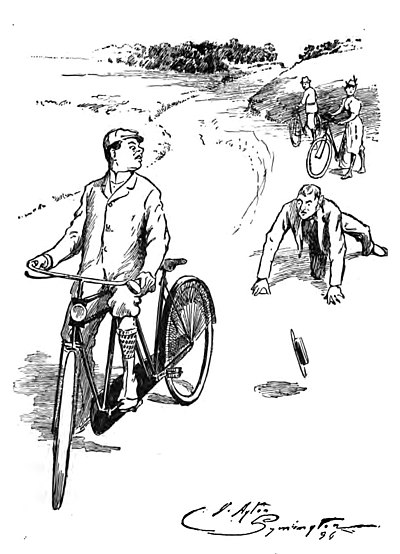
remarks to Dangle. "You only think of yourself," said Phipps, with a florid face.
"They have forgotten us," said Jessie, turning her machine.
"There was a road at the top of the hill—to Lyndhurst," said Hoopdriver, following her example.
"It's no good. There's the money. We must give it up. But let us go back to that hotel at Rufus Stone. I don't see why we should be led captive."
So to the consternation of the tandem riders, Jessie and her companion mounted and rode quietly back up the hill again. As they dismounted at the hotel entrance, the tandem overtook them, and immediately afterwards the dogcart came into view in pursuit. Dangle jumped off.
"Miss Milton, I believe," said Dangle, panting and raising a damp cap from his wet and matted hair.
"I say," said Phipps, receding involuntarily. "Don't go doing it again, Dangle. Help a chap."
"One minute," said Dangle, and ran after his colleague.
Jessie leant her machine against the wall, and went into the hotel entrance. Hoopdriver remained in the hotel entrance, limp but defiant.
AT THE RUFUS STONE
XXXVIII
He folded his arms as Dangle and Phipps returned towards him. Phipps was abashed by his inability to cope with the tandem, which he was now wheeling, but Dangle was inclined to be quarrelsome.
"Miss Milton?" he said briefly.
Mr. Hoopdriver bowed over his folded arms.
"Miss Milton within?" said Dangle.
"And not to be disturved," said Mr. Hoopdriver.
"You are a scoundrel, sir," said Mr. Dangle.
"Et your service," said Mr. Hoopdriver. "She awaits 'er stepmother, sir."
Mr. Dangle hesitated. "She will be here immediately," he said. "Here is her friend, Miss Mergle."
Mr. Hoopdriver unfolded his arms slowly, and, with an air of immense calm, thrust his hands into his breeches pockets. Then with one of those fatal hesitations of his, it occurred to him that this attitude was merely vulgarly defiant; he withdrew both, returned one and pulled at the insufficient moustache with the other. Miss Mergle caught him in confusion. "Is this the man?" she said to Dangle, and forthwith, "How dare you, sir? How dare you face me? That poor girl!"
"You will permit me to observe," began Mr. Hoopdriver, with a splendid drawl, seeing himself, for the first time in all this business, as a romantic villain.
"Ugh," said Miss Mergle, unexpectedly striking him about the midriff with her extended palms, and sending him staggering backward into the hall of the hotel.
"Let me pass!" said Miss Mergle, in towering indignation. "How dare you resist my passage?" and so swept by him and into the dining-room, wherein Jessie had sought refuge.
As Mr. Hoopdriver struggled for equilibrium with the umbrella-stand, Dangle and Phipps, roused from their inertia by Miss Mergle's activity, came in upon her heels, Phipps leading. "How dare you prevent that lady passing?" said Phipps.
Mr. Hoopdriver looked obstinate, and, to Dangle's sense, dangerous, but he made no answer. A waiter in full bloom appeared at the end of the passage, guardant. "It is men of your stamp, sir," said Phipps, "who discredit manhood."
Mr. Hoopdriver thrust his hands into his pockets. "Who the juice are you?" shouted Mr. Hoopdriver, fiercely.
"Who are you, sir?" retorted Phipps. "Who are you? That's the question. What are you, and what are you doing, wandering at large with a young lady under age?"
"Don't speak to him," said Dangle.
"I'm not a-going to tell all my secrets to any one who comes at me," said Hoopdriver. "Not Likely." And added fiercely, "And that I tell you, sir."
He and Phipps stood, legs apart and both looking exceedingly fierce at one another, and Heaven alone knows what might not have happened, if the long clergyman had not appeared in the doorway, heated but deliberate. "Petticoated anachronism," said the long clergyman in the doorway, apparently still suffering from the antiquated prejudice that demanded a third wheel and a black coat from a clerical rider. He looked at Phipps and Hoopdriver for a moment, then extending his hand towards the latter, he waved it up and down three times, saying, "Tchak, tchak, tchak," very deliberately as he did so. Then with a concluding "Ugh!" and a gesture of repugnance he passed on into the dining-room from which the voice of Miss Mergle was distinctly audible remarking that the weather was extremely hot even for the time of year.
This expression of extreme disapprobation had a very demoralizing effect upon Hoopdriver, a demoralization that was immediately completed by the advent of the massive Widgery.
"Is this the man?" said Widgery very grimly, and producing a special voice for the occasion from somewhere deep in his neck.
"Don't hurt him!" said Mrs. Milton, with clasped hands. "However much wrong he has done her—No violence!"
"'Ow many more of you?" said Hoopdriver, at bay before the umbrella stand.
"Where is she? What has he done with her?" said Mrs. Milton.
"I'm not going to stand here and be insulted by a lot of strangers," said Mr. Hoopdriver. "So you needn't think it."
"Please don't worry, Mr. Hoopdriver," said Jessie, suddenly appearing in the door of the dining-room. "I'm here, mother." Her face was white.
Mrs. Milton said something about her child, and made an emotional charge at Jessie. The embrace vanished into the dining-room. Widgery moved as if to follow, and hesitated. "You'd better make yourself scarce," he said to Mr. Hoopdriver.
"I shan't do anything of the kind," said Mr. Hoopdriver, with a catching of the breath. "I'm here defending that young lady."
"You've done her enough mischief, I should think," said Widgery, suddenly walking towards the dining-room, and closing the door behind him, leaving Dangle and Phipps with Hoopdriver.
"Clear!" said Phipps, threateningly.
"I shall go and sit out in the garden," said Mr. Hoopdriver, with dignity. "There I shall remain."
"Don't make a row with him," said Dangle.
And Mr. Hoopdriver retired, unassaulted, in almost sobbing dignity.
XXXIX
So here is the world with us again, and our sentimental excursion is over. In the front of the Rufus Stone Hotel conceive a remarkable collection of wheeled instruments, watched over by Dangle and Phipps in grave and stately attitudes, and by the driver of a stylish dogcart from Ringwood. In the garden behind, in an attitude of nervous prostration, Mr. Hoopdriver was seated on a rustic seat. Through the open window of a private sitting-room came a murmur of voices, as of men and women in conference. Occasionally something that might have been a girlish sob.
"I fail to see what status Widgery has," says Dangle, "thrusting himself in there."
"He takes too much upon himself," said Phipps.
"I've been noticing little things, yesterday and to-day," said Dangle, and stopped.
"They went to the cathedral together in the afternoon."
"Financially it would be a good thing for her, of course," said Dangle, with a gloomy magnanimity. 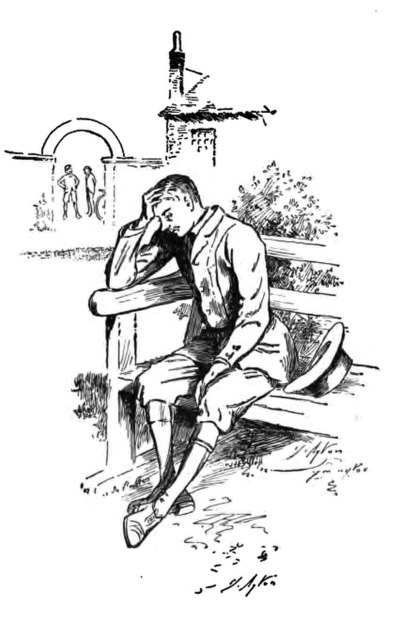
"He's so dull and heavy," said Phipps.
Meanwhile, within, the clergyman had, by promptitude and dexterity, taken the chair and was opening the case against the unfortunate Jessie. I regret to have to say that my heroine had been appalled by the visible array of public opinion against her excursion, to the pitch of tears. She was sitting with flushed cheeks and swimming eyes at the end of the table opposite to the clergyman. She held her handkerchief crumpled up in her extended hand. Mrs. Milton sat as near to her as possible, and occasionally made little dabs with her hand at Jessie's hand, to indicate forgiveness. These advances were not reciprocated, which touched Widgery very much. The lady in green, Miss Mergle (B. A.), sat on the opposite side near the clergyman. She was the strong-minded schoolmistress to whom Jessie had written, and who had immediately precipitated the pursuit upon her. She had picked up the clergyman in Ringwood, and had told him everything forthwith, having met him once at a British Association meeting. He had immediately constituted himself administrator of the entire business. Widgery, having been foiled in an attempt to conduct the proceedings, stood with his legs wide apart in front of the fireplace ornament, and looked profound and sympathetic. Jessie's account of her adventures was a chary one and given amidst frequent interruptions. She surprised herself by skilfully omitting any allusion to the Bechamel episode. She completely exonerated Hoopdriver from the charge of being more than an accessory to her escapade. But public feeling was heavy against Hoopdriver. Her narrative was inaccurate and sketchy, but happily the others were too anxious to pass opinions to pin her down to particulars. At last they had all the facts they would permit.
"My dear young lady," said the clergyman, "I can only ascribe this extravagant and regrettable expedition of yours to the wildest misconceptions of your place in the world and of your duties and responsibilities. Even now, it seems to me, your present emotion is due not so much to a real and sincere penitence for your disobedience and folly as to a positive annoyance at our most fortunate interference—"
"Not that," said Mrs. Milton, in a low tone. "Not that."
"But why did she go off like this?" said Widgery. "That's what I want to know."
Jessie made an attempt to speak, but Mrs. Milton said "Hush!" and the ringing tenor of the clergyman rode triumphantly over the meeting. "I cannot understand this spirit of unrest that has seized upon the more intelligent portion of the feminine community. You had a pleasant home, a most refined and intelligent lady in the position of your mother, to cherish and protect you—"
"If I had a mother," gulped Jessie, succumbing to the obvious snare of self-pity, and sobbing.
"To cherish, protect, and advise you. And you must needs go out of it all alone into a strange world of unknown dangers—"
"I wanted to learn," said Jessie.
"You wanted to learn. May you never have anything to unlearn."
"Ah!" from Mrs. Milton, very sadly.
"It isn't fair for all of you to argue at me at once," submitted Jessie, irrelevantly.
"A world full of unknown dangers," resumed the clergyman. "Your proper place was surely the natural surroundings that are part of you. You have been unduly influenced, it is only too apparent, by a class of literature which, with all due respect to a distinguished authoress that shall be nameless, I must call the New Woman Literature. In that deleterious ingredient of our book boxes—"
"I don't altogether agree with you there," said Miss Mergle, throwing her head back and regarding him firmly through her spectacles, and Mr. Widgery coughed.
"What has all this to do with me?" asked Jessie, availing herself of the interruption.
"The point is," said Mrs. Milton, on her defence, "that in my books—"
"All I want to do," said Jessie, "is to go about freely by myself. Girls do so in America. Why not here?"
"Social conditions are entirely different in America," said Miss Mergle. "Here we respect Class Distinctions."
"It's very unfortunate. What I want to know is, why I cannot go away for a holiday if I want to."
"With a strange young man, socially your inferior," said Widgery, and made her flush by his tone.
"Why not?" she said. "With anybody."
"They don't do that, even in America," said Miss Mergle.
"My dear young lady," said the clergyman, "the most elementary principles of decorum—A day will come when you will better understand how entirely subservient your ideas are to the very fundamentals of our present civilisation, when you will better understand the harrowing anxiety you have given Mrs. Milton by this inexplicable flight of yours. We can only put things down at present, in charity, to your ignorance—"
"You have to consider the general body of opinion, too," said Widgery.
"Precisely," said Miss Mergle. "There is no such thing as conduct in the absolute."
"If once this most unfortunate business gets about," said the clergyman, "it will do you infinite harm."
"But I've done nothing wrong. Why should I be responsible for other people's—"
"The world has no charity," said Mrs. Milton.
"For a girl, " said Jessie. "No."
"Now do let us stop arguing, my dear young lady, and let us listen to reason. Never mind how or why, this conduct of yours will do you infinite harm, if once it is generally known. And not only that, it will cause infinite pain to those who care for you. But if you will return at once to your home, causing it to be understood that you have been with friends for these last few days—"
"Tell lies," said Jessie.
"Certainly not. Most certainly not. But I understand that is how your absence is understood at present, and there is no reason—"
Jessie's grip tightened on her handkerchief. "I won't go back," she said, "to have it as I did before. I want a room of my own, what books I need to read, to be free to go out by myself alone, Teaching—"
"Anything," said Mrs. Milton; "anything in reason."
"But will you keep your promise?" said Jessie.
"Surely you won't dictate to your mother!" said Widgery.
"My stepmother! I don't want to dictate. I want definite promises now."
"This is most unreasonable," said the clergyman.
"Very well," said Jessie, swallowing a sob but with unusual resolution. "Then I won't go back. My life is being frittered away—"
"Let her have her way," said Widgery.
"A room then. All your Men. I'm not to come down and talk away half my days—"
"My dear child, if only to save you," said Mrs. Milton.
"If you don't keep your promise—"
"Then I take it the matter is practically concluded," said the clergyman. "And that you very properly submit to return to your proper home. And now, if I may offer a suggestion, it is that we take tea. Freed of its tannin, nothing, I think, is more refreshing and stimulating."
"There's a train from Lyndhurst at thirteen minutes to six," said Widgery, unfolding a time table. "That gives us about half an hour or three-quarters here—if a conveyance is obtainable, that is."
"A gelatine lozenge dropped into the tea cup precipitates the tannin in the form of tannate of gelatine," said the clergyman to Miss Mergle, in a confidential bray.
Jessie stood up, and saw through the window a depressed head and shoulders over the top of the back of a garden seat. She moved towards the door. "While you have tea, mother," she said, "I must tell Mr. Hoopdriver of our arrangements."
"Don't you think I—" began the clergyman.
"No," said Jessie, very rudely; "I don't."
"But, Jessie, haven't you already—"
"You are already breaking the capitulation," said Jessie.
"Will you want the whole half hour?" said Widgery, at the bell.
"Every minute," said Jessie, in the doorway. "He's behaved very nobly to me."
"There's tea," said Widgery.
"I've had tea."
"He may not have behaved badly," said the clergyman. "But he's certainly an astonishingly weak person to let a wrong-headed young girl—"
Jessie closed the door into the garden.
Meanwhile Mr. Hoopdriver made a sad figure in the sunlight outside. It was over, this wonderful excursion of his, so far as she was concerned, and with the swift blow that separated them, he realised all that those days had done for him. He tried to grasp the bearings of their position. Of course, they would take her away to those social altitudes of hers. She would become an inaccessible young lady again. Would they let him say good-bye to her?
How extraordinary it had all been! He recalled the moment when he had first seen her riding, with the sunlight behind her, along the riverside road; he recalled that wonderful night at Bognor, remembering it as if everything had been done of his own initiative. "Brave, brave!" she had called him. And afterwards, when she came down to him in the morning, kindly, quiet. But ought he to have persuaded her then to return to her home? He remembered some intention of the sort. Now these people snatched her away from him as though he was scarcely fit to live in the same world with her. No more he was! He felt he had presumed upon her worldly ignorance in travelling with her day after day. She was so dainty, so delightful, so serene. He began to recapitulate her expressions, the light of her eyes, the turn of her face . . .
He wasn't good enough to walk in the same road with her. Nobody was. Suppose they let him say good-bye to her; what could he say? That? But they were sure not to let her talk to him alone; her mother would be there as, what was it?—Chaperone. He'd never once had a chance of saying what he felt; indeed, it was only now he was, beginning to realise what he felt. Love! he wouldn't presume. It was worship. If only he could have one more chance. He must have one more chance, somewhere, somehow. Then he would pour out his soul to her—eloquently. He felt eloquently, and words would come. He was dust under her feet . . .
His meditation was interrupted by the click of a door handle, and Jessie appeared in the sunlight under the verandah. "Come away from here," she said to Hoopdriver, as he rose to meet her. "I'm going home with them. We have to say good-bye."
Mr. Hoopdriver winced, opened and shut his mouth, and rose without a word.
XL
At first Jessie Milton and Mr. Hoopdriver walked away from the hotel in silence. He heard a catching in her breath and glanced at her and saw her lips pressed tight and a tear on her cheek. Her face was hot and bright. She was looking straight before her. He could think of nothing to say, and thrust his hands in his pockets and looked away from her intentionally. After a while she began to talk. They dealt disjointedly with scenery first, and then with the means of self-education. She took his address at Antrobus's and promised to send him some books. But even with that it was spiritless, aching talk, Hoopdriver felt, for the fighting mood was over. She seemed, to him, preoccupied with the memories of her late battle, and that appearance hurt him.
"It's the end," he whispered to himself. "It's the end."
They went into a hollow and up a gentle wooded slope, and came at last to a high and open space overlooking a wide expanse of country. There, by a common impulse, they stopped. She looked at her watch—a little ostentatiously. They stared at the billows of forest rolling away beneath them, crest beyond crest, of leafy trees, fading at last into blue.
"The end" ran through his mind, to the exclusion of all speakable thoughts.
"And so," she said, presently, breaking the silence, "it comes to good-bye."
For half a minute he did not answer. Then he gathered his resolution. "There is one thing I must say."
"Well?" she said, surprised and abruptly forgetting the recent argument.
"I ask no return. But—"
Then he stopped. "I won't say it. It's no good. It would be rot from me—now. I wasn't going to say anything. Good-bye."
She looked at him with a startled expression in her eyes. "No," she said. "But don't forget you are going to work. Remember, brother Chris, you are my friend. You will work. You are not a very strong man, you know, now—you will forgive me—nor do you know all you should. But what will you be in six years' time?"
He stared hard in front of him still, and the lines about his weak mouth seemed to strengthen. He knew she understood what he could not say.
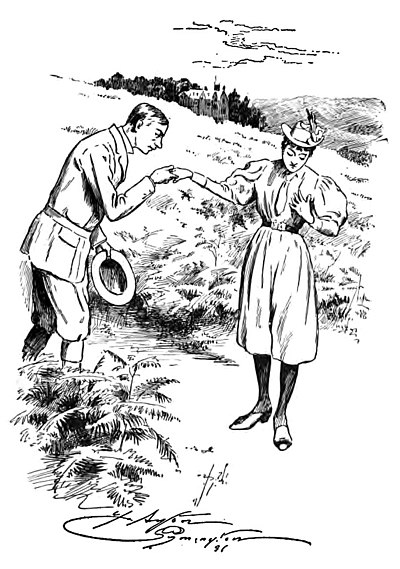
They stood side by side for a moment. Then he said, with a motion of his head, "I won't come back to them. Do you mind? Going back alone?"
She took ten seconds to think. "No," she said, and held out her hand, biting her nether lip. "Good-bye," she whispered.
He turned, with a white face, looked into her eyes, took her hand limply, and then with a sudden impulse, lifted it to his lips. She would have snatched it away, but his grip tightened to her movement. She felt the touch of his lips, and then he had dropped her fingers and turned from her and was striding down the slope. A dozen paces away his foot turned in the lip of a rabbit hole, and he stumbled forward and almost fell. He recovered his balance and went on, not looking back. He never once looked back. She stared at his receding figure until it was small and far below her, and then, the tears running over her eyelids now, turned slowly, and walked with her hands gripped hard together behind her, towards Stoney Cross again.
"I did not know," she whispered to herself. "I did not understand. Even now—No, I do not understand."
THE ENVOY
XLI
So the story ends, dear Reader. Mr. Hoopdriver, sprawling down there among the bracken, must sprawl without our prying, I think, or listening to what chances to his breathing. And of what came of it all, of the six years and afterwards, this is no place to tell. In truth, there is no telling it, for the years have still to run. But if you see how a mere counter-jumper, a cad on castors, and a fool to boot, may come to feel the little insufficiencies of life, and if he has to any extent won your sympathies, my end is attained, (If it is not attained, may Heaven forgive us both!) Nor will we follow this adventurous young lady of ours back to her home at Surbiton, to her new struggle against Widgery and Mrs. Milton combined. For, as she will presently hear, that devoted man has got his reward. For her, also, your sympathies are invited.
The rest of this great holiday, too—five days there are left of it—is beyond the limits of our design.

You see fitfully a slender figure in a dusty brown suit and heather mixture stockings, and brown shoes not intended to be cycled in, flitting Londonward through Hampshire and Berkshire and Surrey, going economically—for excellent reasons. Day by day he goes on, riding fitfully and for the most part through bye-roads, but getting a few miles to the north-eastward every day. He is a narrow-chested person, with a nose hot and tanned at the bridge with unwonted exposure, and brown, red-knuckled fists. A musing expression sits upon the face of this rider, you observe. Sometimes he whistles noiselessly to himself, sometimes he speaks aloud, "a juiced good try, anyhow!" you hear; and sometimes, and that too often for my liking, he looks irritable and hopeless. "I know," he says, "I know. It's over and done. It isn't in me. You ain't man enough, Hoopdriver. Look at yer silly hands! . . . Oh, my God!" and a gust of passion comes upon him and he rides furiously for a space. Sometimes again his face softens. "Anyhow, if I'm not to see her—she's going to lend me books," he thinks, and gets such comfort as he can. Then again; "Books! What's books?" Once or twice triumphant memories of the earlier incidents nerve his face for a while. "I put the ky-bosh on his little game," he remarks. "I did that," and one might

even call him happy in these phases. And, by-the-bye, the machine, you notice, has been enamel-painted grey and carries a sonorous gong.
This figure passes through Basingstoke and Bagshot, Staines, Hampton, and Richmond. At last, in Putney High Street, glowing with the warmth of an August sunset and with all the 'prentice boys busy shutting up shop, and the work girls going home, and the shop folks peeping abroad, and the white 'buses full of late clerks and city folk rumbling home to their dinners, we part from him. He is back. To-morrow, the early rising, the dusting, and drudgery, begin again—but with a difference, with wonderful memories and still more wonderful desires and ambitions replacing those discrepant dreams.
He turns out of the High Street at the corner, dismounts with a sigh, and pushes his machine through the gates of the Antrobus stable yard, as the apprentice with the high collar holds them open. There are words of greeting. "South Coast," you hear; and "splendid weather—splendid." He sighs. "Yes—swapped him off for a couple of sovs. It's a juiced good machine."
The gate closes upon him with a slam, and he vanishes from our ken.
THE END
| This article uses material from the Wikipedia article Metasyntactic variable, which is released under the Creative Commons Attribution-ShareAlike 3.0 Unported License. |