CHAPTER XV
Firm in his intention of bringing his subject to his death by slow degrees, M. Eliphas de la Nox took Theophrastus slowly through the imprisonment, trial, and condemnation of Cartouche. But I omit that part of the narrative of M. Lecamus, since the historians have described that imprisonment and trial at length. I take it up at the point at which Cartouche was on his way to the Torture-chamber that they might force from him the names of his accomplices.
"And now," says M. Lecamus in his narrative, "we were approaching the crucial point of the operation: to kill Cartouche without killing Theophrastus. Simple enough words, but the most difficult operation in Psychic Surgery. Truly M. de la Nox had been right when he said that he was about to tempt Providence. Truly, he had assumed the most appalling responsibility, the risk of killing Theophrastus without killing Cartouche, and consequently of letting that fiend in human form again become reincarnate in some unfortunate contemporary.
"But then it was M. Eliphas de Saint-Elme de Taillebourg de la Nox who had assumed the responsibility, the greatest living expert in Psychical Surgery, the delicacy of whose Astral Scalpel is known to the initiates throughout the world, even to far Thibet. He knew how to move the spirit, quietly and calmly, round its own death, so preparing it for the last moment. He made his dead man live till the very moment at which he made his dead man die!
"He had brought Theophrastus-Cartouche to the hour when his jailors took him from his cell to lead him to the Torture-chamber. His next question was:
"'And where are you now, Cartouche?'
"'I am going down a little staircase at the end of Straw Alley… They are opening a grating… I am in the darkness of the cellars… These cellars frighten me… I know them well… Ah, yes: I was shut up in these cellars in the days of Philippe-le-Bel!'
"M. de la Nox raised his voice in a tone of awful command, and said:
"'Cartouche! You are Cartouche! You are in those cellars by order of the Regent!'
"Then he muttered, 'Philippe-le-Bel! Where in Heaven's name are we going now? We must not stray. We must not! Where are you now, Cartouche?'
"'I am going deeper into the night of the cellars, I am surrounded by guards—many guards. It is too dark to see how many… Ah! I see at the end there, right at the end, a ray which I know well. It is a square ray which the sun has forgotten there since the beginning of the history of France!… My guards are not French Guards, they distrust all the French Guards. My guards are commanded by the military lieutenant of the Châtelet.'
"There was a pause as M. de la Nox let Cartouche continue on his painful way; then he said: 'And where are you now, Cartouche?'
"'I am in the Torture-chamber… About me are men dressed in long robes… Their faces are masked… They are binding me to the stool of Question… They are thick ropes… Well, they need them thick for me… But if they think they're going to get anything out of me, they're wrong—altogether wrong!'
"The face of Theophrastus was set in an expression of stubborn pride, almost ferocious. Slowly it weakened in intensity as we stood waiting and watching him; then suddenly it changed to an expression of pain, and he uttered an ear-splitting yell.
"M. de la Nox and I started back; Marceline uttered a cry.
"Plainly M. de la Nox did not expect that yell, for he said in a tone of surprise, 'Why did you yell like that, Cartouche?'
"'I yell because it's so awful not to be able to denounce my accomplices! Their names are on the tip of my tongue; but they won't come off it! Can't they see that if I don't denounce them, it's because I can't move the tip of my tongue? Why didn't Cartouche move the tip of his tongue? I can't; and it's most unfair!'
"M. de la Nox was silent for a while. There was no reason why he should harrow our sensibilities with the pangs of that old-world ruffian. It was bad enough to see the anguished face of Theophrastus. After a while it grew serene again; and M. de la Nox said:
"'And what are you doing now, Cartouche?'
"'They are leaving me alone,' said Theophrastus. 'Only the doctor and the surgeon are feeling my pulse… They are congratulating themselves on having chosen the torture of the Boot, because it is least dangerous to life, and the least liable to accidents.'
"I observed that he spoke in his ordinary voice, that it was not weakened by the pain he had suffered. It seemed as if he only felt it at the moment of its actual infliction, that he did not feel the after pain.
"There came another long pause; then suddenly Theophrastus uttered another ear-splitting yell.
"'What's the matter now, Cartouche?' said M. de la Nox anxiously.
"'It's the tip of my tongue!' cried Theophrastus furiously.' Can't these silly fools see that the names are on the tip of my tongue, and won't come off it? Why don't the idiots take them off it? Is it my fault that Cartouche did n't split?'
"'But Cartouche was silent: why are you yelling?' said M. de la Nox.
"'They 're torturing Cartouche; but it's Theophrastus Longuet who yells!'
"M. de la Nox seemed thunderstruck by this response. He turned and said to us in a trembling voice: 'Then—then it's he who suffers.'
"It was the truth; one could not doubt it to see the anguish on the contorted face of Theophrastus. It was Cartouche who was tortured and Theophrastus who suffered. That proved the identity of the soul; but it also proved that the pain had not ceased to be effective after two hundred years. That was what dismayed M. de la Nox. It was the first time that a case of this kind had come under his observation during his operations with the Astral Scalpel. The pain of Cartouche found voice through two centuries; this cry of anguish which had not issued from his stubborn lips, had waited two hundred years to burst from the lungs of Theophrastus Longuet!
"M. Eliphas de la Nox buried his head, his luminous head, in his hands and prayed ardently: 'In the beginning you were the Silence! Æon eternal! Source of Æons!…'
"At the end of the prayer he felt Theophrastus' pulse and listened carefully to the beating of his heart. Then he said:
"'M. Longuet is plainly a man of strong constitution, and thoroughly sound. In fact, from that point of view there's scarcely anything to fear. He will bury Cartouche. I think we ought to go through with the operation.'
"I said that I was of his opinion. Marceline hesitated a little, and then bade him continue.
"'And now what are they doing, Cartouche?' said M. de la Nox.
"'They keep asking me those useless questions; but I can't answer,' said Theophrastus impatiently. 'And I keep asking myself what that man in the right-hand corner of the cell is doing. He has his back turned to me; and I can hear a sound of clinking iron… The executioner is at the moment taking it easily. He's leaning against the wall and yawning… There's a lamp on the table which lights up two men who keep on writing and writing. What they're writing I can't conceive, for I haven't said anything—I can't. It's the man in the corner that puzzles me. There's a red light on the wall as if he were between me and a brazier. I wonder what those irons are he's messing about with.'
"'It must be the red-hot irons. They used them,' said M. de la Nox; and he shivered.
"We were silent; and presently there came a series of dreadful, ear-splitting yells from Theophrastus. M. de la Nox turned a very pale and troubled face to us, and declared that he had never come across, or even suspected that one could come across, pain so effective. He had no doubt that it must be owing to the fact that he had never before operated on souls reincarnate after an interval of less than five hundred years; that even those were very rare; and the bulk of his clientele was composed of souls at least two thousand years old. I fancied that he was somewhat out of his depth; and it surprised me beyond words.
"Again Theophrastus yelled; then suddenly Marceline cried:
"'Look! Look, his hair!'
"The most surprising sight met our eyes: the hair of Theophrastus was turning white!
"The whiteness spread over it as smoothly as the edge of the rising tide spreads over the sand, but more slowly. In five minutes all his hair had turned white except one lock on his brow.
"We were silent; and I wiped the perspiration from my face. M. de la Nox was panting; Marceline was sobbing. Somehow that slow whitening of the hair was more painful, more impressively dreadful than those piercing, ear-splitting yells.
"M. de la Nox seemed almost at his wits' end. Twice I saw him open his lips to question Theophrastus; twice he shut them without a word. Then suddenly he stooped down and listened to the beating of Theophrastus' heart. He stood upright again with an air of relief and said:
"'What are you doing now, Cartouche?'
"'Shamming dead. After the red-hot irons and the boiling water they poured into my ears I shammed dead. They have left me... I am slipping the paper I wrote in my cell this morning, with a splinter of wood, and my blood, into the crack in the wall above my head. It tells where I've hid my treasures.'
"He was silent again; and again I saw the face of M. de la Nox grow intent as once more he concentrated all his being on his astral work. How I wished I had attained a height of psychic development which would have enabled me to follow the wonderful, the miraculous movements of his Astral Scalpel.
"It must have been nearly three-quarters of an hour later that he heaved a deep sigh and said, 'Our work is nearly at an end. Where are you now, Cartouche?'
"'I don't know quite what has happened,' said Theophrastus. 'I hid the document; and I have not seen anyone since. When I open my eyes—it is rather an effort—I do not recognise the place to which they have brought me… I'm certainly not in the Torture-chamber, nor in my cell in Montgomery Tower… There's a faint blue light falling through the bars of a grating in front of me… The moon is coming to visit me… The moonlight has descended two or three of the steps which lead up from the grating… I try to move… I can't… I'm a log. My will no longer commands my muscles or limbs… It's as if all relations between my will and my body had ceased… My brain is only master of my sight and understanding. It is no longer master of my actions… My poor limbs! I feel them scattered round about me… I must have reached the point of suffering at which one suffers no more… But where am I?… The moonlight descends two more steps… And again two more steps… Ah! what is that it lights up?… An eye—a big eye… The moonlight moves… A skull… The moonlight moves… A bony hand!… I understand! I understand! They have thrown me into a common grave!… The moonlight moves… There are two legs of a dead man lying across my body!… I recognise those steps now!… And that grating!… I am in the charnel-house of Montfaucon!… I am frightened!
"'When I used to go up the street of the Dead to carouse at the Chopinettes, I often looked through that grating. I looked through it curiously because I saw that one day I should lie in the charnel-house. But never did it occur to me that when a body lay there, it could look out from the other side of the grating! And now my body looks out through it! They have thrown me into the charnel-house because they believed me dead! I am buried alive with the bodies of hanged men! My wretched fate surpasses anything that the imagination of men could invent!
"'The saddest reflections assail me. I ask myself by what trick of Fate I am reduced to such an extremity. I am forced to confess that Fate played no part in the matter. It was my pride, nothing but my accursed pride. I could have quietly remained King of all the robbers, if there had been any living with me. Pretty-Milkmaid was right when she said at the Queen Margot that there was no longer any living with me. I would no longer listen to a word from anyone; and when I called together my Grand Council, I took no notice whatever of the resolutions it passed. I took a delight in playing the despot; and I ended with that mania for cutting up everyone I suspected into little bits. My lieutenants ran greater risks in serving me than in disobeying me. They betrayed me; and it was quite logical. Oh, it's quite time for these reflections, now that I'm in the charnel-house!
"'I'm alive in this charnel-house, alive among the dead; and for the first time in my life I am frightened.'
"Theophrastus was silent for a minute; and we looked at one another with harried eyes. Then in the same mournful, plaintive tones he took up his tale again.
"'It's odd—very odd. Now that I'm on the very boundary of life and death my senses perceive things which they could not perceive when I was in health. My ears hear no more—that boiling water destroyed my hearing—yet they do hear. There is a footfall, a slinking footfall on the steps leading down to the grating… Suddenly the moon ceases to light the charnel-house… Then I see between me and the moon on the steps of the charnel-house, a man! a living man!… Maybe I am saved! I wanted to cry aloud with joy; and perhaps I should have cried aloud, if the horror of what I feel, of what I know, had not sealed my lips. I feel, I know that this man has come to rob me of my hand… I read it, clearly, in his brain. A lady of the Court has sent him for the charm—the charm to keep her husband's love—the hand of a murderer—the hand of Cartouche!
"'I read it in his brain as clearly as if I read it written… He is lighting a lantern… He has unlocked the grating and entered the charnel-house… He has found my body, and is stooping over it… He has taken my left hand in his left hand, and his knife gleams in the light of the lantern… He is cutting through my wrist… I do not feel the blade in my wrist; I see it… Ah! I begin to feel the knife!… Oh! My wrist! My wrist!… It is nearly severed… Ah! Ah! Ah!… It is severed!
"'What is this… The man howls… He is dancing about among the dead… I see! I see… My hand has come away in the left hand of the man who howls, but by a last miracle of the last life in my wrist, as it was severed, my hand gripped the hand of the man who howls!… Ha! Ha! he can't get rid of it!… It's gripped him!… How it grips him!… He is dragging at it with his right hand!… He can't stir it!… Ah, it isn't easy to rid oneself of a dead man's last grip!… He is out of the charnel-house, howling!… He bounds up the steps, howling!… As he goes, howling, he is waving, like a madman, in the moonlight, my gripping hand!'
"The voice of Theophrastus died faintly away; and I heard the teeth of M. de la Nox chatter. Then he whispered:
"'Where are you now, Cartouche?'
"'I am entering the radiant darkness of death!'
CHAPTER XVI
"As soon as Theophrastus had uttered the words: 'I am entering the radiant darkness of death,' M. Eliphas de Saint-Elme de Taillebourg de la Nox raised his right hand above his head with a splendid gesture, then bent over the face of my friend, breathed upon his eyelids, and said:
"'Theophrastus Longuet, awake!'
"Theophrastus did not awake. His eyelids remained closed, and his stillness appeared to us stiller than ever. And now that he spoke no more, now that his lips were closed as tightly as his eyelids, it suddenly seemed to us, stricken with a horrible dread, that he had followed Cartouche into the radiant darkness of death.
"His corpse-like pallor, his hair grown suddenly white, showed him to us terribly old, old with the age suddenly acquired in the depths of the tomb.

"Theophrastus Longuet, awake!"
"'Theophrastus Longuet, awake! Awake! Theophrastus Longuet, awake!'
"Theophrastus did not awake; and our hearts sank and sank; then, at the very moment at which we abandoned hope of his ever awaking, he uttered an appalling groan, opened his eyes, and said quietly:
"'Good-morning. Cartouche is dead,'
"M. de la Nox gasped and said, 'Thank God, the operation has succeeded!'
"Then he began his prayer again: 'In the beginning thou wert the Silence! Æon eternal! Source of Æons!…' Marceline and I were shaking the hands of Theophrastus, and laughing hysterically. In all conscience, the operation had been severe; but now that it was successful we congratulated Theophrastus warmly. We congratulated him on having escaped from his terrible plight at the cost of a bottle of hair-dye. It was not much to pay for the death of Cartouche.
"Then we bade him get up and come with us. We were in a hurry to get out of the house in Huchette Street. It seemed to us as if we had been in it a good deal more than two hundred years.
"'Come along, dear! Come along!' said Marceline.
"'Speak louder,' said Theophrastus, 'I don't know what's the matter with my ears. I seem to be very deaf; and then I can't move.'
"'You must be a little dazed, dear,' said Marceline. 'And considering the time you've been stretched on this camp-bed without stirring, it isn't to be wondered at. But make an effort and come along.'
"'Speak louder, I tell you!' said Theophrastus impatiently. 'I can move my arms, but I can't move my legs. I want to move them, but they don't stir; and then there's a pricking in my feet.'
"'It's pins and needles, dear. Bend your toes back quickly. I want to get home. We've had nothing to eat since this morning, and I'm dreadfully hungry,' said Marceline.
"'I don't know whether I've got any toes,' said Theophrastus sadly.
"'Come on. It's time we were going,' said I.
"'Undoubtedly; but you'll have to carry me, for my legs are in such a state…'
"M. de la Nox uttered a deep groan. He had turned back the socks of Theophrastus and seen his ankles. They were swollen and scarred and bleeding. In half a minute we had slit up the legs of his trousers and pants with a pair of scissors. What a dreadful sight met our eyes! The legs of Theophrastus were the legs of a man who has suffered the torture of the Boot!
"M. de la Nox groaned again, and with his eyes full of tears, he said: 'Incredible! incredible! Who could have believed that pain would be so effective at the end of two hundred years?'
"'This phenomenon is analogous to the stigmata of the Saints,' I said, suddenly realising its scientifically psychic significance.
"But Marceline burst into tears and flung herself upon the unhappy Theophrastus.
"I shook my fist in the face of Destiny, and hurried out to fetch a cab.
"When I returned, Marceline was still weeping; Theophrastus was still examining his legs with extreme curiosity and inquiring how it was that he could not move them, and how they came to be in this extraordinary condition.
"M. Eliphas de Saint-Elme de Taillebourg de la Nox did not answer; he was kneeling, with his face buried in his hands, sobbing in utter despair.
"He said, or rather sobbed, in a lamentable voice: 'My Beloved! My Beloved! I believed that I was thy son, O My Beloved! I took my shadow for thy light! O My Beloved! Thou hast humbled my pride; I am only a little bit of the Night, at the bottom of the obscure Abyss, I, the Man of Light. And the Night does not will! And I have willed, I: the Night! I am only a dark son of the Silence, Æon, Source of Æons! And I have wished to speak! Ah, Life! Life! To know Life! To possess Life! To equal Life!… Temptation! Vertigo of the eternal Abyss! Mystery of the Ternary! Three! Yes; the three worlds are one! And the world is three! It was the truth at Tyre, at Memphis! At Babylon! One! Two! Three! Active, Passive, and Reactive! One and One make two! Two is neuter! But! But! But, O My Beloved! One and Two make Twelve. One is God! Two is matter! Put matter beside God! Pythagoras has said it, and you have Twelve. That means Union!… That means? That means? Who then here below has dared to pronounce the words: That means?'
"Then he sobbed in the most heart-rending fashion, while Theophrastus on his camp-bed said:
"'I should like very much to get out of this.'"
CHAPTER XVII
The unlucky Theophrastus was more than six weeks recovering from his Astral operation. M. Lecamus describes his illness in a somewhat long-winded fashion. Little by little he began to recover the use of his legs; but it seemed unlikely that his hearing would ever quite recover from the boiling water which had deafened Cartouche two hundred years before; at intervals he was for a few moments stone deaf. During all this time he made no allusion to the Past; I do not speak of that wretched past, bounded in the minds of all of us by the few years which have elapsed since our last terrestrial birth; he made no allusion to his eighteenth-century past. This fact assured Marceline, M. Lecamus, and M. Eliphas de Saint-Elme de Taillebourg de la Nox, who was a frequent visitor at the sick-bed, that Cartouche was indeed dead; and M. de la Nox was often heard to thank Æon, Source of Æons, for this happy event.
Theophrastus, as his legs healed, had serious thoughts of returning to business. He had retired young, at the age of forty-one, owing to his invention of a superior rubber stamp which had ousted the rubber stamps of rival manufacturers from the market. His mind was full of yet another innovation which would revolutionise the whole Rubber-stamp Industry. There could be no stronger symptom of a complete cure, no stronger proof that the operation had not weakened his mind. And when he began to get about again, Mme. Longuet found that he had become so natural that she, and M. Lecamus along with her, believed that their misfortunes had at last tired out Destiny.
Theophrastus would never have his Black Feather again: it had been extirpated for the rest of time.
However, by the instructions of M. Eliphas de Saint-Elme de Taillebourg de la Nox, they kept a careful watch on him. It was his habit to rise at an early hour, and after having breakfasted on a cup of chocolate and buttered toast, go for a stroll on the outer Boulevard. He was trying his legs. He began to find in them their pristine elasticity.
He looked into the shops; he watched with a Parisian's interest the moving panorama of the streets. M. Lecamus, who followed him, observed nothing abnormal in his actions; and in his reports to M. de la Nox he only laid stress on a single fact, truly unimportant, a somewhat prolonged halt before a butcher's stall. If this halt had not been a daily habit, even Adolphe, on the look-out as he was, would have paid no attention to it. Theophrastus, his hands behind his back playing with his green umbrella, would gaze with satisfaction at the red meat. He often had a talk with the butcher, a big, square-shouldered, cheery soul, always ready with some simple joke. One day Adolphe found that Theophrastus was prolonging his halt unduly. He walked up to the stall and found him engaged, with the butcher, in adorning the fresh meat with paper frills. It was a harmless occupation; and so M. de la Nox thought, for there is a note of his on the margin of Adolphe's report: "He can look at the red meat on the butcher's stall. It is just as well to let him 'see red' at times. It is the end of the Psychic crisis, and hurts no one."
Now this butcher, M. Houdry, was famous in his district for the whiteness and delicacy of his veal. His customers often wondered where the calves of M. Houdry were fed. It was a mystery which was making his fortune. In the course of time, Theophrastus won his heart and was admitted to his confidence. The secret of his success lay, not in the fact that his calves were specially fed, but in the fact that he killed them himself and in his method of killing them: he used to slice off their heads with a single stroke of a great cutlass.
As their intimacy increased, Theophrastus was admitted to witness the operation; and he spent many a happy hour in the slaughter-house of the butcher, observing him kill and cut up the calves which were bringing him wealth and fame.
Theophrastus was exceedingly interested in the whole process. He learnt the names of the different instruments with enthusiasm, and was presently allowed to help with the simpler parts of the process. It was a privilege. He came to feel even more than M. Houdry's scorn for the methods of ordinary butchers.
But every day as he left the stall he made the same little joke. He said:
"You kill a calf every day. You must be careful, my dear M. Houdry; or you will find that it will end in the calves getting to know about it."
One day he said, "Look at the calf's eyes, M. Houdry! Look at his eyes!"
"Well, what about them?" said M. Houdry.
"Look how they're looking at you!"
"But they're dead," said M. Houdry, somewhat puzzled.
"And you're not afraid of the eyes of a dead calf which look at you?" said Theophrastus. "I congratulate you on your courage!"
M. Houdry went on with his work, thinking that his pupil had certainly some queer fancies.
When he began to deal with the calf's ears, Theophrastus cried, with angelic delight: "The ears? I understand all about ears! Leave them to me!" And he bought the calf's head.
M. Houdry wished to have it sent to his house, but Theophrastus would not let it out of his hands. He disposed it carefully in the bottom of his green umbrella.
As he went out of the slaughter-house he said: "Au revoir, M. Houdry, I am taking my calf's head away with me; but I have left you the eyes. I should not like the eyes of a calf to look at me as those eyes looked at you just now. The eyes of a dead calf—a nasty thing—very nasty. You laugh, M. Houdry? Well, well, it's your business… My congratulations on your courage. But all the same it will end in the calves getting to know about it!"
He returned home; and when he showed Marceline and Adolphe his calf's head in his green umbrella, they smiled at one another.
"He is beginning to take pleasure in things," said Marceline.
"An innocent amusement," said Adolphe indulgently.
CHAPTER XVIII
It was the habit of the three friends to play a game of dominoes in the evening after dinner. M. Lecamus, who was a Norman, took a delight in using terms racy of the soil. When he set down the Double-six, he would cry: "Now for the double-nigger!" When he put down a Five, he would cry: "The pup! That bites!" When he put down a One, he would cry: "The maggot! Bait!" The Three drew from him this phrase: "If you've the pluck, down with the pig's-tail!" He called the Two "The beggar!" The unfortunate Four was blasted by the name of "The whelp!" and he could not put down a Blank without announcing: "The washerwoman!"
Marceline took the greatest delight in these exclamations, and she was always ready to play dominoes. Theophrastus generally lost; and it was a pleasure to see him lose, for at this game he had displayed the most disagreeable nature in the world. Whenever he lost, he sulked.
One evening Theophrastus had, as usual, lost; and with an angry frown on his brow, he had stopped playing, and buried himself in an evening paper. He was very fond of the political notes, and his opinions were limited. They were bounded on the north by "The Despotism of Tyrants," and on the south by "The Socialist Utopia." Between the Socialist Utopia and the Despotism of Tyrants, he understood everything, he declared, except that one should attack the army. He often said, "The army must not be touched!" He was a worthy soul.
That evening he read the Political Notes without, as usual, commenting aloud on them, because he was sulking. And then his eyes were caught by this headline:
CARTOUCHE IS NOT DEAD.
He could not refrain from smiling, so absurd did this hypothesis seem to him. Then he ran his eyes over the first lines of the article, and let escape him the word "Strange!…" and then the word "Odd…" and then the word "Amazing…" But without any particular display of emotion. Then he decided that it was time to stop sulking, and said:
"You have n't read this article entitled: 'Cartouche is not dead,' Adolphe. It's a strange and amazing article."
Marceline and Adolphe started violently and looked at one another in dismay. Theophrastus read:
"Is Cartouche, then, not dead? For some days the police, with the greatest mystery which we however have penetrated, have been solely occupied with a series of strange crimes of which they have been forced to conceal the most curious side from the public. These crimes and the manner in which their author escapes from the Police at the very moment at which they believe they have caught him, recall point by point the methods of the celebrated Cartouche. If it were not a question of an affair as reprehensible as a series of crimes, one could even admire the art with which the model is imitated. As an official of the Prefecture of Police, whose name we do not give since he insisted on secrecy, said to us yesterday, 'He's the very spit of Cartouche!' So much so that the detectives no longer call the mysterious robber, on the track of whom they sometimes find themselves, anything but Cartouche! Moreover the authorities, with great secrecy but with considerable intelligence—for once we find no difficulty in admitting it—have placed in the hands of three of them a history of Cartouche edited by the Librarians of the National Library. They have decided, quite subtly, that the history of Cartouche should be useful to them, not only in the matter in hand, which consists in their preventing to-day the criminal eccentricities of the new Cartouche and in arresting the new Cartouche himself, but also that his story ought to form a part of the general instruction of all detectives. Indeed a rumour has come to our ears that M. Lepine, the Prefect of Police, has ordered several of the evening courses at the Prefecture to be devoted to the authentic history of the illustrious robber."
"What do you think of that?" said Theophrastus with an air of amiable indulgence. "It's a regular farce. The journalists are queer beggars to try to stuff us with all this rubbish."
Neither Adolphe nor Marceline smiled. In a somewhat shaky voice Marceline bade him go on reading.
"The first crime of the new Cartouche, the crime at least with which the Police was first called on to occupy itself, does not present that aspect of horror which we find in some of the others. It is a romantic crime. Let us say at once that all the crimes of which we have cognisance and which are attributed to the new Cartouche, have been committed during the last fortnight and always between eleven o'clock at night and four in the morning."
Madame Longuet started up, her face as white as a sheet. Since the Astral operation, Theophrastus had been sleeping in the bedroom by himself, while she had slept in a small bed in the study. M. Lecamus caught her wrist and swiftly drew her back into her seat. His eyes bade her be silent.
Theophrastus paused in his reading and said, "What on earth do they mean by their new Cartouche? Myself, I only know the old one!… Well, let's hear about the romantic crime…"
He read on, growing calmer and calmer at every line:
"A lady, young and charming, and very well known in Paris, where her Salon is filled by all those who occupy themselves gracefully with Spiritualism—the affair is, after all, somewhat compromising, therefore we do not publish her name—was in the middle of her toilet about one o'clock in the morning, preparing to enjoy her well-earned repose after a somewhat exhausting conference with the most illustrious of the Pneumatics, when suddenly her window, which opens on to a balcony, was flung open violently, and a man of little more than middle height, still young, and extremely vigorous (this detail is in the police report), but with his hair entirely white, sprang into the room. He had in his hand a shining, nickel-plated revolver.
"'Do not be frightened, madame,' he said to the terrified lady. 'I am not going to harm you. Regard me as your most humble servant. My name is Louis-Dominique Cartouche; and my only ambition is to sup with you. By the throttle of Madame Phalaris! I've got a devil of a twist on me!' And he laughed.
"Mme. de B… (we will call her Mme. de B…) thought she had to do with a madman. But it was only a man resolved to sup with her, since, he said, he had been for a long time fascinated by her grace and charm. Yet this man was far more dangerous than a madman. For it was necessary to give way to him, owing to his nickel-plated revolver.
"'You are going to ring for your servants, and order them to bring an excellent supper,' said the man coolly. 'Do not give them any explanation which might cause me trouble. If you do, you're a dead woman.'
"Mme. de B… is a lady of courage. She rose at once to the occasion, rang for her maid, ordered supper to be brought to her boudoir, and a quarter of an hour later she and the man with the white hair were facing one another at table, the best friends in the world. We need hardly say that the man with the white hair made no haste over that delightful meal; and it was after two o'clock when he climbed down from the balcony. It was perhaps not unnatural that the beautiful Mme. de B… should not have informed the police of the adventure. It was necessity that compelled her to the avowal; for a few days later a Commissary of Police called on her, and informed her that the ring, containing a magnificent diamond, which she wore on the third finger of her right hand was the property of Mlle. Emilienne de Besançon; that that lady had seen it on her finger at a charity bazaar the day before; that Mme. de B… was doubtless ignorant whose property it was; doubtless it had been given to her. Mme. de B… was beyond words surprised and annoyed. She told the story of the balcony, the unknown, and the supper; and said that in bidding her good-bye he had forced the ring on her, saying that he had had it from a lady of whom he had been very fond, Mme. de Phalaris, but who had died a long while ago. It was impossible to suspect Mme. de B… She furnished a proof: the shining, nickel-plated revolver, which the unknown had left on a small table in the boudoir. At the same time she begged the Commissary of Police to take away a hundred bottles of champagne of the finest brands, which the unknown had sent to her the day after that extraordinary night, on the pretext that the supper had been excellent, but the champagne alone had left something to be desired. She feared lest, like the ring, the champagne should have been stolen.
"This adventure, which is the least of those we have to relate, is a faithful reproduction of an affair which took place on the night of July 13, 1721, at the house of Mme. la Maréchale de Boufflers. That lady also was at her toilet. The young man arrived by the balcony; he had not a shining, nickel-plated revolver in his hand, but he carried six English pistols in his belt. After having introduced himself as Louis-Dominique Cartouche, he demanded supper. And the widow of Louis-François, Duke de Boufflers, Peer and Marshal of France, the hero of Lille and Malplaquet, supped with Cartouche, and did not hurry over the supper.
"Cartouche only complained of the champagne; and next morning Mme. de Boufflers received a hundred bottles. He had had them taken from the cellars of a great financier by his butler Patapon.
"A few days later one of the bands of Cartouche stopped a carriage in the street. Cartouche looked in through the window and scanned the faces. It was Mme. la Maréchale de Boufflers.
"He turned to his men and said in ringing tones, 'Let Mme. la Maréchale de Boufflers pass freely to-night and always.'
"He bowed low to Mme. la Maréchale, after having slipped on her finger a magnificent diamond which he had previously stolen from Mme. de Phalaris. Mme. de Phalaris never saw it again!
"And now let us pass on to the crime in Bac Street."
CHAPTER XIX
Marceline had risen and gone to her bedroom as much to hide her emotion as to ascertain whether the nickel-plated revolver was still in its drawer. When she came back into the dining-room, Theophrastus asked her what was the matter with her. Marceline replied that the revolver was no longer in its drawer. Theophrastus begged her to compose herself, and declared, in a tone which admitted of no contradiction, that since the revolver was not in its drawer, it must be somewhere else, and it was a matter of no importance whatever.
"We are now going to accompany this newspaper man to the crime in Bac Street," he went on. "His comments on the story of Mme. de B…, who must of course be Mme. de Bithyinie, the lady of your Pneumatic Club who is such an intimate friend of M. de la Box, show him to be a well-informed man. I am pleased to see that he does not follow those idiots of historians who try to make scandal out of my supper with Mme. la Maréchale de Boufflers, forgetting that in 1721 she was more than sixty years of age. It's a mistake that I propose to set right. My reputation might suffer from it. She was a witty and delightful talker; but I should never have dreamed, for a moment, of making love to a woman of sixty!"
As he said this, Theophrastus raised the index finger of his right hand, and waved it in the air with an authoritative gesture; and it was not Marceline or Adolphe who would have dared to contradict him.
He took up the evening paper again.
"The story of the Bac Street crime is simpler and more rapid in movement," he read. "A few days after the adventure of Mme. de B… the Prefect of Police received the following note: 'If you have the pluck, come and find me. I am always at Bernard's, at the café in Bac Street.' It was signed: 'Cartouche.' The Prefect pricked up his ears and laid his plans. The same evening at a quarter to twelve, half a dozen police officers dashed into the café in Bac Street. They were at once hammered with a chair by a man of extraordinary strength, still young, but with quite white hair. Three men were stretched out on the floor, and the other three had barely time to drag the three bodies of their wounded companions into the street, to save them from being burnt alive, for the man with the white hair set fire to the first storey. Then he made his escape over the roofs, springing from one roof to another over a little court, narrow indeed, but forming a kind of well more than fifty feet deep, deep enough in fact to break his neck ten times over."
"I like that," said Theophrastus, breaking off and smiling pleasantly. "Three men on the floor! I was n't nearly so lucky in Bac Street the other century; for I left there nine of my lieutenants, who were arrested in spite of the massacre of the police. I thought all was lost; but one must never despair of Providence."
He took up the paper again, amid the terrified silence of M. Lecamus and Marceline, and read on:
"The new Cartouche" ("What idiots they are to keep calling him 'the new Cartouche'!") "has been also at his games in Guénégaud Street. There is in it a narrow passage crossed by a plank. Some days ago, there was found under this plank the body of a student at the Polytechnic School, M. de Bardinoldi, the mystery of whose death has so puzzled the press. What the police has confided to no one is the fact, that, pinned to the jacket of the student, was a little card on which was written in pencil: 'We shall meet again in the other world, M. de Traneuse.' There can be no doubt that this was a crime of the new Cartouche for the old one" ("One must be as stupid as a journalist," cried Theophrastus, "to suppose that there are two Cartouches!") "for the old one did in fact murder an engineer officer named M. de Traneuse on this very spot. Cartouche killed him with a blow on the back of the head with his cane; and the student had the back of his skull fractured by a blow from some blunt object."
Theophrastus stopped reading and delivered himself of some comments.
"They say to-day, 'blunt object.' Blunt object! It sounds well! Blunt object pleases me… You are pulling a mug," he said to Marceline and Adolphe. "And you're holding on to one another as if you expected some catastrophe. It's silly to lose your hair about a few practical jokes. I profit by the occasion, my dear Adolphe, to explain to you the pleasure I take in frequenting Guénégaud Street. This business of M. de Traneuse was the origin of one of the best tricks I ever played on M. d'Argenson's police officers. After the execution of M. de Traneuse, who had permitted himself to make some extremely disagreeable remarks about me, I was pursued by two patrols of the watch, who surrounded me and rendered resistance impossible. But they did not know that I was Cartouche, and contented themselves with conducting me to Fort-L'Eveque, the least severe prison in Paris, where they shut up debtors, disorderly actors, and people who had not paid fines. It was only on the 10th of January that they knew that they had captured Cartouche; but on the evening of the 9th Cartouche had escaped and resumed the direction of his Police. It was time, for everything was topsy-turvy in the streets of Paris. My dear Marceline, and you too, Adolphe, you look as if you were going to a funeral. And yet this article does n't lack a certain salt. I thought at first it was a scribbler's joke, but I see that it is quite serious. It is really: take it from me. And wait for the story of the calf! We have only got to the affair of Petits-Augustins Street… Listen."
Theophrastus raised the evening paper again, adjusted his gold-rimmed spectacles on his nose, and went on:
"The most incredible thing in this extraordinary story is that several times during the last week the police have been on the very point of catching the modern Cartouche, and that he has always escaped by the chimney, just like the other. History teaches us that that was the practice of the real Cartouche. On the 11th of June, 1721, he had formed the plan of robbing Desmarets House, Petits-Augustins Street. It was one of his men, the Ratlet, who had suggested the coup to him. But the Police had their eye on Cartouche and the Ratlet; and no sooner were they in Desmarets House than the archers rushed to the spot, and the house was surrounded. Cartouche had the doors of the rooms quietly locked and the lights put out. He undressed himself, climbed up the chimney, descended by another chimney into the kitchen, where he found a scullion. He killed the scullion, dressed himself in his clothes, and walked out of the house, shooting down with his pistols two archers, who asked him where Cartouche was. Well, what will you say when we tell you that yesterday our Cartouche, having been tracked to a confectioner's in the Augustins Quarter, escaped by the chimney, after having put on over his own clothes, which doubtless he desired to keep clean, the over-alls of the confectioner, which were found on the roof? As for the confectioner he was found, half cooked, in his own oven. But before putting him into it, Cartouche had taken the precaution of previously assassinating him."
Here Theophrastus once more broke off his reading.
"Previously!" he cried. "Previously! These journalists are marvellous!… I had previously assassinated him!… But why have you gone into the corner? Am I frightening you? Come, come, my dear Marceline; come, Adolphe: a little coolness. You 'll want it for the story of the calf!"
"Never," says Theophrastus in his memoirs, which from this epoch become deeply tinged with a vast melancholy, "never before had either my wife or M. Lecamus worn such expressions at the reading of a mere newspaper article. But if we let ourselves be frightened by everything the newspapers tell us, we should be for ever on the rack. The journalists describe the events of the day with a particularly surprising power of imagination in the matter of crime. They must have their daily blood. It is indeed laughable. A knife-thrust more or less costs them nothing; and they only make me shrug my shoulders. The knife-thrusts of these gentlemen do not trouble my digestion in the slightest; and, I repeat, I shrug my shoulders at them.
"When I came to the place in the article at which Cartouche put the baker's man in the oven, my wife groaned as heavily as if that baker's man had been her brother; and leaving her chair, she shrank back little by little into the left-hand corner of the dining-room, nearest the hall. M. Lecamus was in a position quite as ridiculous. He had retired to the right-hand corner of the dining-room, nearest the hall. They were staring at me as if they were staring at a phenomenon at a fair, an eater of live rabbits, or something of that kind. I was displeased; I did not conceal from them my opinion that such childish behaviour was unworthy of two reasonable beings; and with some severity I begged them to return to their places by my side. But they did not do so. Then I started on the story of 'The Calf's Revenge.'
"I read:
"'M. Houdry is a butcher on the outer Boulevard. His specialty is veal; and people come from all parts of the district to purchase it. His renown is explained by a fact so exceptional that we should have refused to believe it, except for the repeated declarations of the Commissary of Police, M. Mifroid, who held the first inquiry into the circumstances of the crime. It is well known that the Paris butchers receive their meat from public slaughter-houses, and are forbidden to have slaughter-houses of their own. But every day M. Houdry killed a calf at home!'
"'That's quite right,' I said. 'M. Houdry explained it to me several times; and I was rather surprised at the confidence he showed in me when he told me about his mysterious slaughter-house. Why should he have revealed to me a fact which was known only to his wife, his assistant, a foundling whom he reckoned as one of the family, and to his brother-in-law who every night brought the calf? Why? There is no telling. Perhaps it was stronger than he! You know well that one never escapes one's destiny. I used to say to him: "Take care! It will end by the calves getting to know about it."'
"I went on with my reading:
"'This calf was brought to him in silence every night by his brother-in-law; and since the little back-yard in which his slaughter-house is situated looks out on some waste land behind, no one ever saw a live calf at M. Houdry's house. M. Houdry attached so much importance to killing his calves himself because his veal owed its excellence to his manner of killing it.'
"'As a matter of fact,' I broke off to say, 'he used to cut off their heads at a single blow, with a big cutlass.'
"'Early yesterday morning M. Houdry shut himself up as usual in his slaughter-house, with his calf. His assistant helped him tie up the calf. As a rule, M. Houdry took from twenty-five to thirty minutes preparing his veal for the stall. Thirty-five minutes passed; and the double doors of the slaughter-house did not open. Sometimes M. Houdry called his assistant to help him finish the work. That morning he did not call him. Forty minutes passed. Then Mme. Houdry, the butcher's wife, came to the back door and said to the assistant: "What's your master doing this morning? He's a long time over his work."
"‘"Yes; much longer than usual," said the assistant.
"'Then she called, "Houdry! Houdry!" There was no answer; and she walked across the back-yard, and opened the doors of the slaughter-house. At once the calf ran out and began to dance gracefully round her. (Dear! dear! I begin to dread some great misfortune!) She looked at the calf with some surprise, for at that hour the calf should have been veal. Then she opened the door wider, and called to her husband. He did not answer; she turned towards his assistant and said:
"‘"Your master is n't here. Are you sure he has n't gone out?"
"‘"Quite sure, Mum. I 've been in the back-yard all the time. I expect he's hiding behind the door to jump out and give you a fright, Mum. You know what a joker the master is. But all the same, he'd much better be hiding the calf. If anybody sees it, he 'll get into trouble."
"'So saying, he sprang at the head of the calf and slipped a halter over it.
"‘"Houdry! Houdry!" cried his wife. "You 're hiding to give me a fright! Don't be silly!"
"'There was no answer; and she went into the slaughter-house. Then she screamed; she had found M. Houdry. He was not hiding at all.
"'He was laid out, in neat joints of veal, on the table.'
"'I told him so,' said I. 'I told him so more than once. My presentiments always come true. I expected some great misfortune! And here it is! Every day, again and again, I told M. Houdry to look out: that one does not kill so many calves without the calves getting to know about it. But he always laughed at me. Yet the Theory of Chances always confronts us. It confronted him. He took no notice of it. He took no notice of anything: neither of the way the calf looked at him, nor of the Theory of Chances. But I said to him: "My dear M. Houdry, if a butcher can kill more than a thousand calves in Paris, when it is forbidden by the law, there will certainly be found one calf to kill the butcher!" And here you are! The calf has cut up the butcher! Well, well, it's nobody's fault… Let us continue this interesting article.'
"'Mme. Houdry screamed and fainted. The butcher boy also screamed and fainted—he was a foundling. A few minutes later the drama was discovered. One can imagine the emotion of the neighbourhood…' (There was reason for it. Poor M. Houdry: he was a fine fellow. And now they will have to try the calf. The calf will be a great success in the dock. It's a strange, fantastic, inexorable, and courageous calf!)
"The journalist was not of the opinion that the calf had cut up the butcher. And once more he dragged in the name of Cartouche. (Poor old Cartouche!) Once more I shrugged my shoulders. Then, raising my eyes above the top of the paper, I looked into the two corners of the drawing-room for those two foolish creatures who had so childishly retired to them—my wife and M. Lecamus. I looked in vain. They had disappeared. I called to them loudly. They did not answer. I hunted through the flat without finding them. Then I tried to open the door on to the landing; but it would not open. They had locked me in.
"That did not trouble me at all. When I am locked in, I go out by the chimneys, if they are big enough; if they are too small, I leave by the window. But my drawing-room chimney is a monumental chimney; there is not another like it in Gerando Street; and I climbed up it with the same ease with which I had climbed down the chimney of M. Houdry on the very morning on which the calf cut up that excellent but unfortunate man! I soon came out on to the roof into a very cold and rainy night which filled me with a profound sadness."
CHAPTER XX
That profound sadness was destined to affect seriously the future of Theophrastus. As he made his way over the roofs of Gerando Street, it increased to such a paralysing intensity that presently he sat down on the edge of a roof, with his legs dangling over the street, and plunged into the bitterest reflections. The result of this unwise action was that he caught a severe cold.
As he sat reflecting, he slowly came to himself, his modern self. During the reading of the article which narrated the crimes of the new Cartouche, he had displayed a carelessness airy to the point of callousness. Now the sense of his responsibility, especially in the matter of cutting up the butcher Houdry, weighed on him more and more heavily. The memory of many midnight outings, by way of the chimney he had just climbed, came into his mind; and several sanguinary crimes filled his blinking eyes with the too tardy tears of an ineffectual remorse.
So, in spite of all the suffering he had endured, in spite of all the passionate prayers of M. de la Nox to Æon, Source of Æons, Cartouche was not dead; the Black Feather ever sprouted afresh. This very night, as on so many other nights of crime, he was out on the roofs of Paris with his familiar spirit and his Black Feather. He wept. He cursed that mysterious and irresistible force which, from the depth of the centuries, bade him slay. He cursed the gesture which slays. He thought of his wife and his friend. He recalled with bitter regret the hours of happiness passed with those dear ones. He forgave them their terror and their flight. He resolved never again henceforth to trouble their peaceful hours with his red vagaries.
"Let us vanish!" said he. "Let us hide our shame and our original obliquity in the heart of the desert! They will forget me!… I shall forget myself! Let us profit by these moments of reason in which my brain, for the while free from the Past, discusses, weighs, deduces, and forms conclusions in the Present. It is no longer Cartouche who speaks. To-night it is Theophrastus who wills! Theophrastus who cries to Cartouche: 'Let us fly! let us fly! Since I love Marceline, let us fly! Since I love Adolphe, let us fly! One day they will be happy without thee; with thee there is no longer any happiness!… Farewell! Farewell, Marceline, beloved wife! Farewell, Adolphe, dear friend and comforter!… Farewell! Theophrastus bids you farewell!'"
He wept and wept. Then he said aloud:
"Come along, Cartouche."
He plunged into the night, springing from gutter to gutter, crawling from roof to roof, sliding from the tops of walls with the ease, the balance, and the sureness of a somnambulist.
•••••••
And now, who is this man who, with bowed head and stooping back, his hands in his pockets, wanders like Fortune's step-son through the bitter wind and the rain that falls all the dreary way? He moves along the road which runs beside the railway, a road dismally straight, bordered by dismal little stunted trees, the dismal ornaments of the departmental road, the road which runs beside the railway. Whence does this man, or rather this shadow of a man, this sad shadow of a man, with his hands in his pockets, come? On his right and on his left stretches the plain, without an undulation, without the bulge of a hill, without the hollow of a river—stretches grey and gloomy under the grey and gloomy sky.
Now and again along the railway, so painfully straight, trains pass,—slow trains, express trains, freight trains. While they pass the railway snores; then it is silent, and one hears, borne on the wind, the ting-ting-ting-ting of the little electric bell in the little railway station in front. But what little railway station? There is one in front; there is one behind. They are three miles apart; and between them the double line of rails runs as straight as a die. Between the two railway stations there are no viaducts, no tunnel, no bridge, not even a level-crossing. I dwell on these details on account of the strange behaviour of the express train.
That sad shadow of a man is Theophrastus. He has resolved to fly, to fly no matter where, from his wife—poor dear, unfortunate, heroic fellow! After a night passed on the roofs of Paris, not knowing whither to direct his steps, yet not wishing to stay them, he went into a railway station—what railway station? Shall we ever know?—And without a ticket he got on a train, and without a ticket somewhere he got off it and came out of another railway station. It may be that in this evasion of the duties of the passenger his Black Feather stood him in good stead.
Behold him then on the road… At the entrance to a village… On the road which runs beside the railway.
Whom does he perceive on the threshold of a cottage at the entrance to the village?… The Signora Petito herself!
It was the first time the Signora Petito had seen M. Longuet since he clipped her husband's ears. She fell into a fury. She ran down to the garden gate; and her anger found vent not only in abuse, but in the most imprudent revelations. Had Signor Petito heard what his angry Regina said, he would have smacked her for her incredible folly. After abusing Theophrastus for his barbarity to Signor Petito, she told him with vindictive triumph that her husband had found the treasures of the Chopinettes, and that those treasures were the richest in the world, treasures worth far more than a couple of ears, were they as big as the ears of Signor Petito. "They are quits!"
In the course of this outburst, Theophrastus with considerable difficulty interjected a few words; but he was not at all disturbed by it. Indeed he was grateful to the fury of Signora Petito for having given him such important information. He said grimly:
"I shall find my treasures, for I shall find Signor Petito."
The Signora Petito burst into a satanic laugh, and cried:
"Signor Petito is in the train!"
"In what train?"
"In the train which is going to pass under your nose."
"What is the train which is going to pass under my nose?"
"The train which is carrying my husband beyond the frontier! Get into it, M. Longuet! Get into it if you want to speak to Signor Petito. But you'd better make haste, for it passes in less than an hour, and you can't buy a ticket for it at any of these little stations. It does n't stop at them!"
She laughed an even more satanic laugh, so satanic that Theophrastus longed for the moments when he was deaf. He raised his hat, and went quickly down the road which runs beside the railway. When he was alone, between the little trees and the telegraph posts, he said to himself:
"Come, come! I must ask news of my treasures of Signor Petito himself… But how the deuce am I to do it? He is in the train which is going to pass under my nose."
At this point it is necessary to give a map:
Station ADCStation B
¤•|¤
It is unnecessary to give the names of the stations, for the demonstration is practically geometrical, and to geometry letters are more appropriate.
Let us go to station A. The signal-man of station A hears the ting! of the bell which announces that the express he is expecting has passed station B, and is on that section of the block-system which begins at station A and ends at station B. The express goes from B to A. It is on the line B A. That is clear. The signal at A announces the train by lowering its little red arm with a ting!
The signal-man at station A waits for the train, and waits for the train, and waits for the train! It ought to be there. It is a train which goes sixty miles an hour, and, if it is late, it goes seventy or eighty. The distance between station A and station B is at the most three miles and a furlong. Three minutes and a half is the longest an express takes to do the distance. The signal-man, frightened to death at not seeing the train appear, shouts to the station-master that the train ought to have gone through! The station-master dashes to the telegraph, and telegraphs station B: "Train signalled not arrived!" Station B answers: "Joker!" Station A: "It's serious. What are we to do? Horrible anxiety." Station B: "Notify Jericho!" Station A: "There must have been an accident! We are hurrying along the line! Come and meet us!" Station B: "What can have happened? We are coming."
Then the station-master, the porters, and the ticket-clerks of stations A and B hurry along the line, the staff of station A going towards station B, the staff of station B going towards station A. They hurry along, in the full light of day, in the middle of a perfectly flat plain, a plain without a river, without ridge, and without hollow. They hurry along the line, and meet one another between A and B… But they do not meet the train!
The station-master of station A (I say particularly of station A), who suffered from heart disease, fell down dead.
CHAPTER XXI
Let us state this geometrical problem in the simplest words: an express train has to cover the ground between two little stations three miles apart. It is announced at the second when it passes the first; and yet they wait for it at the second in vain. They hurry from both stations down the line to find the wreck; but they do not so much as find the train, an express train in which there are perhaps a hundred passengers.
That the station-master of A should have fallen down dead at the shock of this unheard-of, bewildering, stupefying, absurd, diabolical, and yet how simple (as we shall learn later) disappearance of the train, is not greatly to be wondered at. The minds of all of them were shaken by the occurrence. The station-master of B was not in a much better condition than his colleague. Everyone present uttered incoherent cries. They kept calling the train, as if the train could have answered! They did not hear it, and on that flat plain they did not see it! The ticket-clerk of station A knelt down beside the body of his chief, and presently said, "I am quite sure he is dead!" The rest gathered round the body of the dead man; and then, tearing up two of the little trees from the side of the road which runs beside the railway, they laid him on them. Carrying the body on this rude litter, they returned towards station A. We must bear in mind that the express had passed station B, and that no one had seen it reach station A.
But they had not yet reached station A when, on the line, on the line along which they had just come, they perceived a railway-carriage, or rather a railway-carriage and a guard's-van! They greeted the sight in their excitable French way with the howls of madmen. Where did this end of a train come from? And what had become of the beginning of the train, that is to say, of the engine, the tender, the dining-car, and the three corridor carriages?
Look at the plan. C marks the point on the line at which the staffs of stations A and B met, when they were hunting for the train. It is also the point at which the station-master of A fell down dead. The two staffs then, in a body, were bringing back the dead station-master towards A, when at the point D, a point they had passed a few minutes before, and at which they had seen nothing, they find a railway-carriage and a guard's-van.
These people greeted this sight with the cries of madmen; and then they perceived an odd-looking head looking out of one of the windows of the railway-carriage. It waggled. This head had no ears; and the earless man had his head out of the carriage window. They shouted to him. From the moment they caught sight of him they asked him what had happened. But the man did not answer. The odd thing was that his head waggled from left to right, as if it were moved by the wind which was blowing at the time with some force. It was a head with crinkly hair. It was bent downwards; and the cravat round a high collar, very white on that grey day, was untied and streaming in the wind.
At last when they came quite near (they moved slowly owing to the fact that they were carrying the station-master) they saw clearly the shocking reality. The man not only had his head out of the window, he had also got it caught in the window. The unfortunate wretch must have opened the window and stuck his head out while the train was in motion; and the window must have been jerked up violently and cut his head half off! On seeing this, the two staffs howled afresh; then they set down the body of the station-master, ran round the guard's-van, in which there was nobody, and opening a door on the other side of the carriage, they found that it was empty, except for the man whose head was caught in the window, and that his body, inside the carriage, was stripped of every rag of clothing.
The news of these fantastic horrors at once spread throughout the district. An enormous crowd thronged the platforms of station A all the rest of the day. The chief officials of the line came from Paris. Not only were they unable to explain, on that day and the days following, the death of the man who had had his head out of the carriage window, but they were still unable to find either the train or the passengers. They talked of nothing but this strange affair at the funeral of the station-master of A, which was celebrated with great solemnity, and also throughout Europe and America.
CHAPTER XXIII
So far I have only given the simplest plan of the line that I might get the basis of the affair as clear as possible. That plan is not quite complete, for though there was only this one line joining the stations A and B there was a short side-line, H I, which led to a sand-pit which had supplied a glass-factory. But since the glass-factory had failed, they no longer worked the sand-pit; and the side-line was practically abandoned. Here is the complete plan:
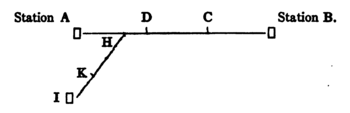
It will naturally be supposed that this side-line leading to the sand-pit is going to provide the explanation, the quite simple explanation of the disappearance of the express. But if the matter had been as simple as the side-line would appear to make it, I should hardly have omitted it from the first map. I could have said at once: "It is quite clear that, owing to a train of circumstances which it remains to determine, the express, instead of continuing to follow the line B A, must have turned off up the side-line H I, and buried itself in the vast mass of loose sand at the sand-pit I. Rushing along at a speed of over sixty miles an hour, it evidently plunged into the mass of sand, which covered it up; and that is the stupid but actual reason of its disappearance."
But, to say nothing of the fact that this does not explain the presence, at the point D, of the guard's-van and railway-carriage, out of the window of which Signor Petito had stuck his head, this explanation could not have failed to occur to the alert intelligence of the engineers of the company. Moreover, there were points and a switch at the point H; this switch, in accordance with the rules, was padlocked; and the key had been taken away.
I indeed attached no importance to the fact that the padlock was locked; for, it seemed to me quite probable that the key had been left in the padlock, which had actually been the case, and that Theophrastus, who had good reasons for stopping the train in order to join Signor Petito, had profited by the presence of that key, to shift the points. It was only a matter of thrusting over the lever of the switch; and that would explain why the train was not seen by the signal-man at A, since, instead of continuing along the line B A, it had turned off up H I towards the sand-pit. I told myself all this; and if it had explained anything, I should have stated it at once, and instead of giving two maps I should have given merely the latter with the side-line H I on it.
That I have not done so is owing to the fact that the side-line H I explains nothing. I also believed at first that it was going to make the disappearance of the express clear to us, but as a matter of fact it complicates the catastrophe instead of explaining it; for here is the story, the true story; and that too continues to explain nothing at all.
Wandering along the road which runs beside the railway, Theophrastus had noticed the little side-line, and seen that the key had been left in the padlock of the switch. This fact, which had been of no importance to him before his brief but stormy interview with Signora Petito, assumed an enormous importance when he resolved to join, at any cost, Signor Petito, who was in the train which was about to pass under his nose. M. Longuet said to himself: "I cannot board the express, rushing between the two stations A and B, in the usual way. But there is a little side-line H I, the key is in the padlock of the switch; I have only to turn the lever, and the express will dash up H I. Since it is broad daylight the engine-driver will see what has happened, he will stop the train, and I shall take advantage of its stopping to board it."
Nothing could be more simple; and Theophrastus did it. He dragged over the lever of the switch, walked up the side-line, and waited for the express.
Theophrastus, hidden behind a tree that none of the officials on the express might see him, awaited its coming at the point K, that is to say, rather more than half-way up the side-line, that is to say, on this side of the sand-pit I. He waited for the express coming from H, with his eyes on the track. If, as everyone must have been supposing ever since I mentioned the sand-pit, the train coming from H had buried itself in the sand at I, Theophrastus, who was at K, between H and I, must have seen it. But Theophrastus waited for the train and waited for the train and waited for the train. He waited for it as the signal-man at station A had waited for it; and he no more saw the express than did the signal-man at A and the rest of the officials of the line.
The express had disappeared for M. Longuet as it had disappeared for the rest of the world.
So much so that, tired of waiting, M. Longuet walked down as far as H to see what was happening. There he saw the staff of A, which was hurrying towards B in its search for the express. He asked himself sadly what could have become of the express; and finding no answer to the question, he walked up H I, and when he arrived at K, which he had just left, he found the empty guard's-van and the railway-carriage which a few minutes later the two staffs were to find at D!
Once more he swore by the throttle of Mme. Phalaris, and buried his brow in his hands, asking himself how that guard's-van and that carriage came to be there, since the express itself had not come. It had not come, since he, Theophrastus, had not quitted the track.
Suddenly he saw the head of a man waggling out of the window of the railway-carriage; and since this head had no ears, he recognised Signor Petito.
He sprang up into the railway-carriage, and without troubling to let down the window and release the head of the unfortunate expert in handwriting, he stripped him of his clothes, and proceeded to put them on. Theophrastus, who knew himself to be tracked by the police and in whom the astuteness of Cartouche sprang to life again, was disguising himself. When he was dressed, he made a bundle of his own clothes, and descended from the carriage. He felt in Signor Petito's pockets, took out his pocket-book, sat down on the embankment, and plunged into the study of the papers it contained, hunting for the traces of his treasures. But Signor Petito had carried to the tomb the secret of the treasures of the Chopinettes; never again were the Gall, the Cock, the Chopinettes, or the treasures to be discussed: with the result that Signora Petito, who learnt a few minutes later of the extraordinary death of her husband, presently went mad, and was confined in a lunatic asylum for six months.
But we are only concerned with the misfortune of Theophrastus, which so surpasses all other human misfortunes, and which is so hard to believe that we need all the assistance that Science can give us to credit it wholly. I cannot believe that the minds of my readers are so base, or their imaginations so poor, that the matter of the treasures could be of any genuine interest to them, when they are confronted by this phenomenon, of such surpassing interest, the soul of Theophrastus.
Presently that unfortunate man, on failing to find anything of interest to him in the papers of Signor Petito, heaved a deep sigh. He raised his head; and lo! the guard's-van and the railway-carriage of Signor Petito had disappeared!
CHAPTER XXIII
Theophrastus, though he had with good reason made up his mind never again to be astonished by anything, was nevertheless astonished by the disappearance of the railway-carriage, with the earless head of Signor Petito waggling in the wind. With a melancholy air he walked down the little side-line, asking himself whether he ought to be more astonished by the disappearance of the carriage than by its sudden appearance. In truth, the suppression of the express was troubling his spirit deeply.
It seems to me that I, who know the secrets of the sandalwood box, have no right to give the explanation of this suppression before the hour at which Theophrastus learnt it himself, from a quite commonplace observation which the Commissary of Police, M. Mifroid, an earnest student of Logic from his earliest years, made to him in the Catacombs of Paris. At the same time, it is only fair to say that all the points in the problem are already in the possession of the reader, who can solve it himself, if indeed he has not already done so, without further delay. Theophrastus then, in a state of prostration, walked down the side-line, arrived at the bifurcation, examined the switch, thrust back the lever which he had thrust over, locked the padlock, and carried away, once and for all, the key which had been so carelessly left in it a few days before. He performed this action because he felt that it was only right; and he restored the switch to its place, because he felt that his reason could not stand another disappearance of the express.
Still melancholy, he reached the deserted station A. All the rest of the staff was absent on the search for the express; only the signal-man was on the look-out. Theophrastus questioned the signal-man, who could only say, as he pointed to the red arm of the signal:
"The express is signalled, but it does not come!"
"Was it really signalled from the last station?" said Theophrastus.
"Yes, sir, the station-master and all the staff of the last station saw the express go through it. They telegraphed it to us. Besides, sir, look at my little red arm! Look at my little red arm! And it is quite impossible that there should have been a wreck between the last station and this one. There is no bridge, sir, no viaduct, no works of art. Besides, just now I climbed to the top of that ladder against the big tank there. From it you can see the whole line right to the other station. I saw our people down the line, gesticulating, but I did not see the express!"
"Strange—very strange," said Theophrastus mournfully.
"Strange is n't the word for it! Look at my little red arm!"
"Inexplicable!" said Theophrastus gloomily.
"The most inexplicable thing in the world!" cried the signal-man.
"Not so: there is one thing even more inexplicable than an express which disappears with its engine and passengers without anyone being able to tell what has become of it," said Theophrastus in the same gloomy tone.
"What on earth's that?" said the signal-man, opening his astonished eyes wider than ever.
"Why, a railway-carriage without an engine which suddenly appears without one's being able to tell where it comes from."
"What?" cried the signal-man.
"And which disappeared as suddenly as it appeared… You have n't by any chance seen a railway-carriage with a man looking out of the window pass this way?"
"You 're laughing at me, sir!" said the signal-man with some heat. "You 're exaggerating! Just because you don't believe the story of the express which has been signalled and does not come! But look, sir, look! Look at my little red arm!"
M. Longuet replied: "If you have n't seen the express, no more have I!"
He shrugged his shoulders bitterly and left the station. An idea had occurred to him: his misfortune was so utter and so irremediable that he was resolved to die… for others.
With a little astuteness the thing is practicable, even easy. Since he is dressed in the clothes of Signor Petito, nothing prevents him leaving his own clothes on the bank of the first river he comes to. This simple proceeding will constitute a formal act of suicide. Behold Marceline and Adolphe once more at peace!
On the bank of what river did M. Longuet lay his clothes? How did he re-enter Paris? These are matters of such little importance that he makes no mention of them in his memoirs. There is only one thing that is really important, the explanation of the disappearance of the express.
In the dull November sunset a workman was bricking up a hole in the roadway of a Paris square in the ancient Quarter d'Enfer. As he filled it he was singing the Internationale, the hymn of the advanced Labour Parties throughout the world.
This workman, a bricklayer, was with his comrades engaged in assisting in that perpetual occupation of modern municipalities, getting the streets up; and the street was up.
The municipal engineers had been making a new sewer through the Quarter d'Enfer with a patient disregard of the fact that under that quarter the Catacombs spread their innumerable tunnels. It was but natural that the bottom of the end of the excavation, in which they were laying the new sewer, should have fallen out, and that they should have been obliged to rest the pipes on railway sleepers cut in half. They were, however, at the end of their task: the hole at the bottom of the excavation, which ran right down to a passage of the Catacombs, had been nearly bricked up; and the aperture which remained could not have been much more than three feet across. As the bricklayer bricked it up, he sang the Internationale.
At the same hour, a few yards down the side of the square, M. Mifroid stood before the counter of a shop at which they sold electric lamps, and was buying half a dozen of them for his men. Each lamp was guaranteed to give forty-eight hours' light, though they were not much larger than cigar-cases. His lamps had been packed up; and he had just put his fingers through the loop of the string of the packet, when a little way down the counter he perceived a man, still young but with quite white hair, slipping several examples of these electric lamps into his pocket without paying for them. They would doubtless be quite as useful to a thief as a policeman. M. Mifroid, with his usual courage, sprang towards the man, crying, "It's Cartouche!"
He had recognised him owing to the fact that since the Calf's Revenge every Commissary of Police in Paris carried a portrait of the new Cartouche in his pocket. They owed them to Mme. Longuet herself and M. Lecamus, who had fled from the article in the evening paper to the nearest police-station, since they felt themselves bound, in the interests of humanity, to inform the police, somewhat tardily, of the bicentenary mental condition of Theophrastus.
Therefore M. Mifroid, who had had the further advantage of a passing acquaintance with Theophrastus in his home, recognised him at once.
Theophrastus, who had for some nights known the intentions of the police, when he saw M. Mifroid and heard his cry, said to himself, "It's time I was off!"
He bolted out of the shop; and the Commissary of Police bolted after him.
To return to our bricklayer, he sang the Internationale all the time. He was alone, because his comrades had gone round the corner to refresh themselves. He was at the chorus of the song; and it was the seventy-ninth time he had sung it since two o'clock in the afternoon. He raised his head towards Heaven and roared:
"Cellalutte finale
Groupppons-nous etddemain…"
With his head turned to Heaven he did not see two shadows flying headlong, which, one after the other, fell through the hole; their cries were drowned in the volume of sound which poured from his lungs. They were the shadows of Theophrastus and of M. Mifroid pursuing him through the dusk. In their careless haste they fell clean through the street which was up. The bricklayer turned his head a little to the right and roared enthusiastically:
"L'lnterrrnationaaaaleu
Sera le genrrhummain!…"
And he finished bricking up the hole. Singing the Internationale, he had performed the symbolic act of interring a policeman and a thief.
CHAPTER XXIV
"When one comes to oneself in the depth of the Catacombs," says Commissary Mifroid in the admirable report of the matter which he drew up, "the first thought which steals into one's mind is a fearful one: the fear of being old-fashioned. I mean by that a sudden anxiety lest one should find oneself reproducing all the ridiculous behaviour of which writers of romance and melodrama never fail to make their unfortunate heroes guilty when they find themselves immured in caves, grottoes, excavations, caverns, or tombs.
"At the moment of my fall, even while I was so rapidly covering the space which separated me from the soil of the Catacombs, my presence of mind did not forsake me. I was aware that I was falling into those thousand-year-old subways which interlace their innumerable and capricious windings under the soil of Paris. The next thing I was aware of was a slight and painful numbness which followed my recovery from the insensibility into which I had been plunged by the inevitable shock. I was, then, in the Catacombs. At once I said to myself, 'Above all things I must not be old-fashioned.'
"It would have been old-fashioned, for example, to utter cries of despair, to appeal to Providence, or to strike my brow against the wall of the passage. It would have been old-fashioned to find at the bottom of my pocket a bar of chocolate and at once divide it into eight pieces which would have represented assured sustenance for eight days. It would have been equally old-fashioned to find a candle-end in my pocket—a place in which no rational human being ever keeps candle-ends—and five or six matches, and so create the harrowing problem whether one ought to let the candle burn once it was lighted, or blow it out and rekindle it at the cost of another match, a problem which often interferes with the digestions of whole families who read romances.
"I had nothing in my pocket. I assured myself of the fact with extreme satisfaction; and in the darkness of the Catacombs I slapped my pockets, repeating: 'Nothing! Nothing! Nothing!'
"At the same moment it occurred to me that it would be quite up-to-date for a man in my situation to illuminate without further delay the opaque darkness which weighed so heavily on my eyes and tired them, with a sudden and radiant electric star. Had I not, before falling into this hole, bought half a dozen electric lamps of the latest pattern? The parcel must have accompanied me in my fall. Without stirring I groped about and laid my hand on it. By great good luck the lamps were unbroken; I took one of them and pressed the button. The excavation was lighted by a fairy glow; and I could not refrain from smiling at the unfortunate wretch who, shut up in some cavern, invariably crawls along, holding his breath, behind a miserable little flame which presently he hurriedly blows out.
"I rose to my feet, and examined the ceiling. I had known that the streets were up, and that the work was nearly finished. I was the less surprised therefore, on looking up through the hole through which I had fallen, to see no spark of daylight, and to realise that it had been quite bricked up. Now several yards of earth separated me from living creatures, without the slightest possibility of my boring through them, even if the ceiling had not been far too high for me to reach. I satisfied myself of this without any feeling of annoyance; then, having turned my electric ray on the floor, I perceived a body.
"It was the body of M. Theophrastus Longuet, the body of the new Cartouche. I examined it and perceived that it showed no signs of any serious injury. The man must be stunned, as I had been myself; and doubtless he would presently recover. I called to mind the fact that M. Lecamus had introduced me to his friend one day in the Champs-Elysées; and here I was face to face with him as one of the most abandoned of assassins.
"Even as this flashed into my mind, M. Longuet heaved a deep sigh, and stretched out his arms. He complained of pains about his body, bade me good-evening, and asked me where we were. I told him. He did not appear utterly dismayed by the information, but drawing a pocket-book from his pocket, he traced some lines which looked like a plan, showed them to me, and said:
"'My dear M. Mifroid, we are in the depths of the Catacombs. It's an extraordinary event; and how we are to get out I do not know. But the matter which fills my mind at this moment is really far more interesting, believe me, than falling into the Catacombs. I beg you to glance at this little plan.'
"He handed me the leaf from his pocket-book, on which I saw the following:
"He sneezed twice.
"'Oh, you have a cold,' said I, taking the paper.
"'Yes; I have had a bad cold since taking a somewhat long stroll one rainy night on the roofs of Gerando Street,' he said.
"I advised him not to neglect it. I must say that this quiet and natural conversation between two men in the depths of the Catacombs, a few minutes after their recovery from such an unexpected fall, gave me infinite pleasure. Having considered the lines on the paper, I asked the explanation of them; and M. Longuet told me the story of the disappearance of an express train and of the reappearance of a railway-carriage, which was by far the most fantastic I had ever heard. This man had desired to make an express disappear between A and B by sending it up a side-line H I, by shifting the points, and he had waited for it at K. But the train had neither appeared at A nor at K, that is to say, either to him or to anyone else. Next a railway-carriage had appeared to him at K; and presently that railway-carriage itself had disappeared. I could well have believed that this man, considering his past (the past of Cartouche!) and the story which he now told me, was mad, if he had not expressed himself so logically, and given me the most exact material details about the points, the switch, and all the facts of the case.
"Moreover, it is a matter of common experience that a madman always understands everything. But this man wanted to understand. I begged him to repeat the story. He said nothing. Twice I reiterated the request and still he said nothing. I was about to lose patience, when, grasping the fact that I had asked him something, he told me that now and then he was deaf for a few minutes.
"Since he had recovered his hearing, we returned to the problem of the express. He assured me that he would rather die ten times in the depths of the Catacombs than come out of them once without knowing what had become of this express. 'I do not wish,' he added, 'to lose the most precious thing in the world: my Reason.'
"'And when did this happen?' said I. 'For, as a matter of fact, I have heard nothing of the disappearance of an express; and it ought to be generally known.'
"'It must be known by now,' he, said in a very melancholy tone. 'It only happened a few hours before our fall into the Catacombs.'
"I examined the paper once more for quite five minutes. I reflected deeply, asked for certain complementary details, and then burst out laughing: though in truth it was not a laughable matter, for the catastrophe was truly appalling. What made me laugh was the seeming difficulty of the problem and the delight of having solved it in five minutes.
"'You believe yourself a rational human being,' I cried, 'because you have Reason! But you 're exactly like ninety-nine people out of a hundred, you don't know how to make use of it. You talk of Reason; but what use is Reason in a brain which does not know by which end to take hold of it? It's a wonderful instrument in the hands of a doll! Don't turn away your head in that sulky way, M. Longuet. I tell you: you don't know by which end to take hold of your Reason! Come, M. Longuet: let us reason with this paper in our hands.'
"He tried, the duffer! He said: 'There were five men at A, and five men at B. The five men at B saw the train pass; the five men at A did not see it. I—I was at K; and I am sure that it did not pass at K… consequently…'
"'Consequently?… Consequently, there's no longer any express? Consequently your express has vanished—melted—flown away? Hey, presto: vanish express! You think perhaps that the express is in the English Channel! You see clearly, M. Longuet, that if you have Reason, you don't know how to use it. Allow me to tell you that you took hold of your Reason by the wrong end! The wrong end is that which begins by saying, 'We did not see the express,' and which ends by saying, 'Then there is no longer any express!' But I am going to show you how to take hold of your Reason by the right end. It is this: the truth is that the express exists, and that it exists between the points B, where it was seen to pass, A, where it was not seen to pass, and I, where it could not pass. Since we are in a plain, your express is between A, B and I. That is certain…'
"'But!'
"'Hush! Be quiet! And since we are in a plain, and in that plain there is an immense mass of loose sand, the only place in which the train could have disappeared is in that mass of sand: that is the eternal truth!'…
"'I swear it didn't! I was at K waiting for the express; and I did not quit the line H I.'
"'By the immortal Masterpieces of the Italian Renaissance I command you not to let go of the right end of your Reason which I have put into your hand. We are discussing at this moment what is; we are not yet at the how. It is owing to the fact that you began with the how that you have not been able to reach what is. The express is in I, since it cannot be anywhere else. I am sure that the five men could not have seen it pass B, as they assert, unless it had passed. I am as certain that five men could not have been unable to see it at A if it had passed A; and since the line A B was examined and found not to contain the express, it must be that it turned off up the line H I. There we are, then, with the train on the line H I.'
"'But I was there too,' cried Theophrastus, 'and I swear to you that it wasn't!'
"'Dear! Dear! Do hold on to the right end of your Reason! You were at K; the express passed K; it must pass K; it must go and plunge into I, since it cannot be anywhere else. By a necessary chance, while the beginning of the train is engulfed in the mass of sand (I take it for granted that the line H I is too short for the engine-driver, having perceived the error of direction half-way up it, to have had the time to ward off the catastrophe), the couplings of the last carriage broke, and the carriage and the guard's-van began to descend the line which was on a slope since it went to this mass of sand. There, after having gone down the line to H and back up it to K, you saw the carriage and Signor Petito at the window. (Probably Signor Petito opened the window with the intention of jumping out, at the moment he grasped the imminent catastrophe, and as it happened the shock of it shut his head in the window.)'
"'That I understand; but what I don't understand…'
"'Let us first consider what we do understand: that is the right end of Reason. We will next consider what we do not understand. No one is found in the guard's-van. The shock undoubtedly hurled the guard into the sand. All that is certain. Now, after having stripped Signor Petito of his clothes, you sat down on the embankment and read his papers. When you raised your head, the railway-carriage was no longer there. Well, since there was a slope and since there was a wind, which waggled the head of M. Petito at the window, the carriage, after having glided down to H, found itself once more on the line A B a little higher up than H on the side of B, where the staff of the station have by now certainly found it. Do you understand now? Do you understand everything, except that you have n't seen the train pass K? Since everything is thus explained, it must be that that was how things happened. Now I only seek how you were not able to see the train pass K. That which it is impossible to explain in the case of five persons at A or at B may very well be explained in the case of one at K.'
"'I am waiting,' said M. Longuet.
"I chuckled—and truly there was reason to chuckle—and went on, 'There are moments when you are deaf, M. Longuet?'
"'There certainly are,' said M. Longuet.
"'Suppose you were deaf during the moment you were waiting for the train at K, then you would not have heard it.'
"'No, but I should have seen it.'
"We have already arrived at the fact that you did not hear it. That is a considerable advance! God bless you, M. Longuet! God bless you!' (M. Longuet was sneezing.)
"M. Longuet thanked me for my pious wish, and since he continued to sneeze, I took out my watch from his pocket (he had already stolen it from me), and I said to him: 'Do you know, M. Longuet, how long a single one of your sneezes lasts, that is to say, how long you remain with your head bent while you sneeze?… Three seconds!… That is to say a second and two-fifths longer than is required to fail to see an express with four carriages pass in front of you, which is going sixty miles an hour. M. Longuet, the express has disappeared, or rather seemed to disappear, because you were deaf and had a cold!'
"M. Longuet threw up his arms wildly towards the ceiling of the Catacombs.
CHAPTER XXV
"When M. Longuet had recovered from the emotion with which my explanation of the disappearance of the express had filled him, he embraced me and handed me a revolver which he had found in the pocket of Signor Petito. He did not wish to keep it on him. He was desirous that I should be able, at need, to defend myself against the eccentricities of which he feared, on grounds based, alas! on a too real experience, the dangerous return. For the same reason he entrusted to me a large knife which had also come from the pocket of Signor Petito.
"We laughed; and then we set ourselves to consider our situation seriously. M. Longuet went on emptying his pockets; and there came out of them seven little electric lamps similar to those I had myself bought before falling into this hole. He congratulated himself, saying that his instinct had been right in urging him to take plenty of them, for, adding my six to his seven, we now had thirteen lamps, guaranteed to give forty-eight hours' light each, which gave us six hundred and twenty-four hours of consecutive light. He added that since we should not need light for the ten hours a day, afternoon—he was an advocate of the restful siesta—and night, during which we should sleep, we had light for forty-four days eight hours.
"I said to him: 'You are altogether too old-fashioned, M. Longuet. Cartouche immured in the Catacombs would have done exactly the same with electric lamps as you are doing. But I, M. Longuet, I take your seven lamps and add three of mine to them; and this is what I do with them!'
"I threw them carelessly down against the foot of the wall.
"'There is no point in dragging about these impedimenta,' I said. 'Are you hungry, M. Longuet?'
"'Very, M. Mifroid.'
"'How long do you think you could be hungry?'
"Since he did not seem to understand, I explained that I meant to ask him how long he thought he could remain so hungry without eating.
"'I am pretty sure,' said he, 'that if I had to stay forty-eight hours as hungry as this…'
"'Let us suppose that you stayed as hungry as this for seven days,' I interrupted. 'Three lamps would be quite sufficient for us, for at the end of those three lamps we should have no need of light!'
"He had understood. But he smiled amiably, groped about, produced from the floor a good-sized parcel, and said:
"'But you see, M. Mifroid, I need not endure this hunger a moment longer than I need. I have here a ham which weighs ten pounds, or a hundred and sixty ounces. I am assured that if a man chews it in the manner invented by M. Fletcher of the United States, he can live for an unlimited period on four ounces of ham a day, and retain the full possession of his faculties and muscular power. We have therefore food for one man for forty days, food for two for twenty days. And then'—he paused, and a singular light came into his eyes—'I think, M. Mifroid, that then—at the end of that twenty days, one of us will Fletcherise the other!'
"'Nothing, M. Longuet, nothing would induce me to preserve my life by the degrading practice of cannibalism!' I said warmly.
"'It is a sentiment which does you much honour, M. Mifroid,' said M. Longuet. 'But there is no need, and indeed it would be impossible, that we should both become cannibals.'
"I was extremely disgusted, naturally, that M. Longuet should have been guilty of such an egregiously old-fashioned act as to be unable even to make an unexpected visit to the Catacombs, through a hole in the street, without bringing a ham with him; but I picked up the other ten electric lamps. I did not let my natural annoyance find vent in words; I only said to him, 'How on earth do you come to be walking about Paris with a ten-pound ham?'
"'I am going to write my memoirs,' said M. Longuet. 'And since quiet is necessary to the writing of one's memoirs, and I feared that you gentlemen of the Police would do your best to rob me of that peace, if I gave you the chance, I was going to shut myself in a little hiding-place I know of with this ham, these electric lamps, and some more necessary provisions which I had not yet bought, in order to write uninterrupted. The paper and pens I have already purchased; and they are in my hiding-place.'
"The excuse was valid, and there was nothing to be said. I set off down the passage.
"'Where are you going?' he said.
"'It does not matter where,' said I. 'But it is necessary to go anywhere rather than stay here, since here there is no hope. We will consider our course as we walk. Our only safety is in walking; and in walking for twenty days without taking any bearings we have every chance of arriving somewhere.'
"'But why without taking our bearings?' he asked.
"'Because,' I replied, 'I have remarked that in all the stories of the Catacombs it is always those bearings which have been the ruin of the unfortunate people who have got lost. They mixed up their bearings, were reduced to utter confusion, and fell into the exhaustion of despair. In our situation we must avoid every cause for despair. You are not in despair by any chance, M. Longuet?'
"'Not at all, M. Mifroid; I am only hungry. And I don't mind saying that if I were less hungry in your delightful society I should have no regrets whatever for the roofs of Gerando Street.'
"'We will eat presently, M. Longuet,' I said. 'An ounce of ham shall be our evening meal.'
"M. Longuet smiled hungrily; then he said, 'Perhaps it would blunt the edge of my appetite a little if you were to tell me something about these Catacombs.'
"'I think I ought to begin by giving you a general notion of the Catacombs,' I said. 'Then you would better understand why it is absolutely necessary to walk for a long time before getting out of them.'
"The road we followed was a long passage of from fifteen to twenty feet high. Its walls were very dry; and the electric light showed us a stone free from any parasitic vegetation, free even from any mouldiness. It was a sight which caused me some disquiet, for if we were to subsist for twenty days on a diet of salt ham, without any vegetable food, I feared that we might fall a prey to scurvy. My mind was at ease about the matter of drink; for I knew that in the Catacombs there were little streams of running water; and we had only to walk far enough to come across them.
"M. Longuet could not reconcile himself to the idea that we were walking without caring where we were going. I thought it wise to make him understand the necessity of not caring where we were going. I told him, as was the truth, that during the laying of the sewer the engineers, having descended into the Catacombs through the hole, had tried in vain to find their way about them and a way out. They had had to give it up, and to content themselves with building three pillars to prop up the roof, along the top of which their sewer ran, with materials let down through the hole by which we had so hastily descended, and which had been so definitely and unfortunately bricked up over our heads.
"Not to discourage him, I informed him that to my certain knowledge we could reckon on at least three hundred and ten miles[1] of Catacombs, and that there was no reason that there should not be more. It was evident that if I did not at once make clear to him the difficulty of getting out, he would have yielded to despair at the end of a couple of days' journey.
"'Bear in mind then,' I said, 'that they hollowed this soil from the third to the seventeenth century! Yes; for fourteen hundred years man has raised from under the soil the materials which were necessary for building on the top of it! So much so that from time to time, since there is too much on the top, and in places nothing at all beneath, the things on top have returned beneath whence they came.'
"Since we found ourselves under the ancient Quarter d'Enfer, I recalled to his memory that in 1777 a house in d'Enfer Street was in that way engulfed. It was precipitated a hundred and twelve feet below the pavement of its own courtyard. Some months later, in 1778, seven persons were killed in a similar landslip, in the district of Menilmontant. I quoted several examples of a later date, laying stress on the loss of life.
"He understood me and said, 'In fact, it's often more dangerous to walk about on the top than underneath.'
"I had gained his attention, and finding him so cheerful and interested, forgetting all about his hunger, I profited by it to quicken our steps; and I chanted the most spirited chorus I could remember. He took it up and we sang together:
'Step out! Step out, boys, with a will!
The road is hard and hot;
There's an inn beyond the hill
And good liquor in a pot!'
"That's the song that makes you step out!
"When we were tired of singing (one soon grows tired of singing in the Catacombs because the voice does not carry), M. Longuet asked me a hundred questions. He asked me how many feet of soil there were between us and the surface; and I told him that according to the last report it varied between eleven and two hundred and sixty feet.
"'Sometimes,' I said, 'the crust of earth is so thin that it is necessary to prolong the foundations of public buildings to the bottom of the Catacombs. Therefore in the course of our peregrinations there is a chance of our coming across the pillars of Saint-Sulpice, of Saint-Etienne-du-Mont, of the Panthéon, of the Val-de-Grâce, and of the Odéon. These buildings are, so to speak, raised on subterranean piles.'
"'Subterranean piles!' he cried joyfully. 'Is there really a chance that in the course of our peregrinations we shall come across subterranean piles?'
"Then he returned to his fixed idea:
"'And in the course of our peregrinations is there any chance of our coming across a way out? Are there many ways out of the Catacombs?' he said wistfully.
"'Plenty,' said I. 'In the first place, there are exits in the Quarter—"
"'So much the better!' he interrupted.
"'And others which are unknown, openings by which no one ever enters, but which none the less exist: in the cellars of the Panthéon, in those of Henri IV College, the Observatory, Saint-Sulpice Seminary, the Midi Hospital, some houses in d'Enfer, Vaugirard, Tombe-Issoire Streets; at Passy, Chaillot, Saint-Maur, Charenton, and Gentilly… More than sixty…'
"'That's good!'
"'It would have been better,' I replied, 'if Colbert had not on July 11, 1678—'
"'Wonderful!' interrupted M. Longuet. 'You have as fine a memory as M. Lecamus!'
"'It need n't astonish you, M. Longuet. I was formerly secretary of the Commissary of the district; and it pleased me to take an interest in the Catacombs, as it has since pleased me to practise the violin and sculpture. You have not got beyond the old-fashioned Commissary of Police, my dear M. Longuet.'
"He did not reply to that; he said, 'You were saying that Colbert on July 11, 1678—'
"'In order to put a stop to the cupidity of the builders, issued an order to close the openings into the Catacombs before Paris was quite undermined. That ordinance of Colbert's has, so to speak, walled us up.'
"At this moment we were passing a pillar. I examined the structure and said: 'Here is a pillar which was built by the architects of Louis XVI in 1778, in the course of the consolidation."
"'That poor Louis XVI!' said M. Longuet. 'He would have done much better to consolidate the monarchy.'
"'That would have been to consolidate a Catacomb,' said I felicitously, though I believe that the word Catacombs is only used in the plural.
"M. Longuet had taken the lamp from me, and without ceasing he turned its ray from right to left as though he were seeking something. I asked him the reason of this action which began to tire my eyes.
"'I'm looking for corpses,' he said.
"'Corpses?'
"'Skeletons. I have always been told that the walls of the Catacombs are lined with skeletons.'
"'Oh, that macabre tapestry, my friend (I already addressed him as 'my friend' because I was so pleased with his serenity in such serious circumstances), that macabre tapestry is barely three quarters of a mile long. That three quarters of a mile is very properly called the Ossuary, because skulls, ribs, shin-bones, thigh-bones, collar-bones, shoulder-bones and breast-bones form its sole decoration. But what a decoration! It's a decoration composed of three million and fifty thousand skeletons, which have been taken from the cemeteries of Saint-Médard, Cluny, Saint-Landry, the Carmelites, the Benedictines, and the Innocents. All the bones, well sorted, arranged, classified, and ticketed, form along the walls of the passages, roses, parallelograms, triangles, rectangles, spirals and many other figures of a marvellous exactitude. Let us desire, my friend, to reach this domain of death. It will mean life! For I do not know a spot in Paris more agreeably frequented. You only meet there engaged couples, couples in the middle of their honeymoon, lovers, and, in fact, all the happy people. But we are not there yet. What is three quarters of a mile of bones out of three hundred and ten miles of Catacombs?'
"'Not much,' he said with a deep sigh. 'How many miles do you think we have gone, M. Mifroid?'
"I begged him not to waste time in calculations which must be entirely futile; then, to cheer him up, I told him the story of the janitor and of the four soldiers. The first was very short: there was once a janitor of the Catacombs who lost his way in them; they found his body a week later. The second tells of four soldiers of the Val-de-Grâce who, by the help of a rope, descended a well two hundred feet deep. They were in the Catacombs. Since they did not reappear, they let down drummers who made all the noise they could with their drums. But since in the Catacombs sound does not carry, no one answered the roll-call. They searched for them. At the end of forty-eight hours they found them dying in a cul-de-sac.
"'They had no moral force,' said Theophrastus.
"'They were idiots,' said I. 'When one is stupid enough to lose one's way in the Catacombs, one is unworthy of pity, I will go so far as to say, of interest.'
"Thereupon he asked me how I should myself escape losing my way in the Catacombs. Since we reached a place where another passage crossed the one we were in, I could answer without delay. I said:
"'Here are two passages, which are you going to take?'
"One of them ran directly away from our starting-point; the other almost certainly returned to it. Since it was our purpose to get away from our starting-point, M. Longuet pointed to the first.
"'I was sure of it!' I exclaimed. 'Are you quite ignorant of the experimental method? The experimental method in the depths of the Catacombs has demonstrated for centuries that every individual who believes that he is returning to his starting-point (at the entrance to the Catacombs) is moving away from it. Therefore the logical thing to do to get away from one's starting-point is necessarily to take the road which seems to bring you back to it!'
"We turned down the passage by which we appeared to be retracing our steps. In that way we were sure that we were not journeying in vain.
"My two stories had carried us over another mile; then M. Longuet said: 'I must really have my supper.'
"We had our supper, an ounce of ham each. There was some difficulty in judging how much an ounce was; but we did the best we could. He instructed me in the method of eating one's food discovered by M. Fletcher of the United States. We divided either ounce into four mouthfuls, not that they were by any means mouthfuls; and we chewed each patiently till we had extracted from it the last vestige of flavour. I could well believe him when he assured me that in this way we obtained from it the whole of the nourishment it contained. For my part, I should have been delighted to extract the last vestige of flavour from fifty more such mouthfuls.
"After this meagre, but doubtless exceedingly nourishing supper, we continued our journey. We went another four miles, when I confessed that I began to feel tired. I was somewhat surprised to find a manufacturer of rubber stamps, a sedentary pursuit, like M. Longuet to be endowed with such untiring vigour. On learning from my watch, which he still carried, because he said he found it a comfort to carry somebody else's watch, that it was eleven o'clock, I suggested that we should go to sleep.
"His fixed idea, that we should find an exit from the Catacombs, led him to display some reluctance. But I pointed out to him the extreme improbability of finding an exit in the first twenty miles of three hundred and ten; and we composed ourselves to rest.
- ↑ These are the official figures.
CHAPTER XXVI
"We awoke the next morning with the appetites of youth. In the middle of our exiguous breakfast it occurred to me that we were behaving in an extremely old-fashioned way. The heroes of Romance invariably divide their bar of chocolate into a number of pieces. We, with our ham, were showing ourselves as commonplace as they. I imparted these reflections to M. Longuet, and suggested that instead of making our hundred and fifty-eight ounces of ham last for twenty days, we should eat ten ounces each a day, and be content to let them last eight.
"M. Longuet objected firmly. He said:
"'In the first place the admirable discovery of M. Fletcher of the United States has proved that such a quantity of food is unnecessary for the sustenance of the human being.' (I learned later that this was a misstatement.) 'In the second place, it is our duty as French citizens to postpone the degrading practice of cannibalism to the last possible moment.'
"He spoke with a vigorous emphasis there was no gainsaying. I admired his strength of character, and was silent.
"Immediately after breakfast we resumed our journey.
"In about half an hour M. Longuet complained of thirst; and I explained to him that in our circumstances all complaints were utterly futile: a statement which, for all its undeniable logic, seemed to afford him very little comfort. But fortunately at the end of another hour our ears were greeted by the agreeable sound of rippling water; and presently the ray of our electric lamp gleamed on a little stream which ran from some subterranean spring across the passage. M. Longuet flung himself down and began to drink. I hesitated, for it appeared to me, as a logician, that since we could not carry water along with us, to drink would only make us thirsty. Then I reflected that we should find other springs, and presently followed his example.
"We went on our way; and presently M. Longuet inquired of me whether there was no nourishment of any kind in the Catacombs on which we might sustain life when we had exhausted the resources of ham and the survivor of cannibalism. Fortunately I had visited the laboratory of the Catacombs of M. Milne-Edwards; and I could entertain him with an account of the fauna and flora of these caverns, on which he would be able, at need, to keep himself alive. I am bound to say that, contrary to my usual habit, I took great pleasure in this conversation about edible things. I felt indeed that such a subject was extremely old-fashioned; doubtless my pleasure in it arose from the exiguity of my breakfast.
"'My dear friend,' I said, 'it is always possible not to die of hunger, even if you never get out of the Catacombs. The flora, the cryptogamic vegetation, the mushrooms, in a word, of the Catacombs, will not suffice, I fear, to keep you alive. But fortunately wherever you find water in these caverns, you find food. You can always become an ichthyophagus."
"'What on earth is that?' he said suspiciously.
"'An ichthyophagus is a fish-eater.'
"'Ah!' he exclaimed with an immense satisfaction, 'there are fish in the waters of the Catacombs! I am very fond of fish!' He paused; then he added in a musing tone, 'After all, it is better to be an ichthyophagus than a cannibal.'
"'They are not large fish; but certain streams contain incalculable quantities of them.'
"'Really? Incalculable quantities?... Incalculable?... How large are they?' he said with great animation.
"'Oh, they are of different sizes. Generally they are small. But they are not at all disagreeable to eat. I was told about them when I went down to visit the Fountain of the Samaritan, a very pretty, good-sized spring in the Ossuary.'
"'Is it far from here?' he said eagerly.
"'I cannot tell you at the moment. All I know is that this fountain was built in 1810 by M. Héricourt de Thury, Engineer of Subterranean Passages. As a matter of fact, this fountain is frequented by copepodes (Cyclops Fimbriatus)...'
"'Ah! Copepodes! Are they fishes?'
"'Yes; and they present modifications of tissue and coloration peculiar to themselves. They have a beautiful red eye.'
"'What? One eye?'
"'Yes; that is why they are called cyclops. But you need not be astonished that this fish has only one eye, for the Asellus Aquaticus, which also lives in the running streams of the Catacombs, a little aquatic isopode, as its name indicates, often has no eyes at all.'
"'Impossible!' cried M. Longuet. 'How do they see?'
"'They have no need to see, since they live in darkness. Nature is perfect. She is perfect in giving eyes to those who need them; she is perfect in taking away eyes from those who do not need them.'
"M. Longuet appeared to reflect a little; then he said: 'Then, if we continued to live in the Catacombs, we should end by no longer having eyes?'
"'Evidently: we should begin by losing the use of our sight and then our sight itself. Our descendants would soon lose their eyes altogether.'
"'Our descendants!' he cried.
"We laughed at this little slip; and then he pressed me to continue my description of the fishes of the Catacombs.
"I discussed at length the modification of organs, their excessive development or their atrophy, according to the environment in which the species lives. I described the different kinds of fishes also at length.
"But at last he said: 'All this about their organs is very interesting. But how do you catch them?'
"'I can only tell you that the Catacombs which contain all these millions of bones cannot offer us a single maggot in the way of bait.'
"'No matter,' said Theophrastus. 'There are more ways of killing a dog than hanging him. An angler has more than one trick in his basket; and the Asellus Aquaticus had better look out.'
"That day and the days which followed it were very much alike. Whenever we came to a stream we stopped and drank. Always M. Longuet wanted to stop and fish. This was not wholly hunger; the sportsman's ardour burned in his soul. But I represented to him that, for anything we knew, we had the whole three hundred and ten miles of Catacombs to traverse before we came to the exit, and that it was our first duty to walk and walk. We might have fallen into them at the furthest end.
"By eleven o'clock, not only the sustaining but also the satisfying effect of the ounce of ham appeared to be exhausted; we were not only extremely hungry, but we were moving at a much slower pace. I represented to M. Longuet that it would be wise to have our déjeuner at once. But his dreadful middle-class instincts were too strong for us. He had the habit of a regular life so ingrained in him that he would not hear of déjeuner before noon. Also I marvelled at his power of endurance: I had never suspected that the manufacture of rubber stamps could endow a man with those muscles of steel. None the less we talked very little between eleven and noon.
"That ounce of ham was one of the most delicious meals I have ever eaten. M. Longuet, who seemed in the course of our conversation to have caught some of my scientific spirit, timed the meal by my watch. It was a source of great satisfaction to him that he took from nine to eleven seconds longer over each mouthful than I did. After it we proceeded on our way with renewed vigour; and since I found that he was of the truly receptive type of mind, I found our conversation very enjoyable.
"The afternoon was exactly like the morning. We walked, conversing about a dozen different subjects. The next morning was exactly like the last afternoon; and the days which followed were exactly like one another. The second and third days were the least comfortable. On those days the satisfying effects of our ounces of ham appeared to exhaust themselves more quickly. But after the third day I began to realise the great value of the discovery of M. Fletcher of the United States. Our appetites had become quite normal; an ounce of ham blunted them till the next meal. We were losing weight indeed, especially M. Longuet, whose waistcoat hung somewhat limply down in front. But the muscles of our legs appeared to have grown stronger; and undoubtedly our intellects had grown quicker and more alert. When we had exhausted my subjects, I learned from M. Longuet the process of making rubber stamps, with a thoroughness which fits me to embark at any moment on that career. I found that he was even quicker to acquire the knowledge which goes to the making of an able Commissary of Police.
"It would indeed have been a very pleasant walking tour, thanks to that unlikeness of our natures which produces the most harmonious companionship, had it not been for the monotony of the scenery through which our way lay. The subterranean passages, illumined by our lamps, were sometimes vast, sometimes narrow, sometimes rounded like the naves of the cathedrals, sometimes square, angular, and mean, like the corridors of workhouses. But they presented no spectacle of great variety. When he had said, 'Look, stone! Look, clay! Look, sand!' we had said everything, because we had seen everything.
"It was on the afternoon of the fourteenth day that M. Longuet embarked on a subject of conversation extremely distasteful to me, the edible qualities of the human body. I tried gently to divert him from it; but it appeared to have become one of his fixed ideas; and he harped on it for two very tedious hours. That evening I halted for supper on the banks of a stream, nearly eighteen inches wide, which ran across the passage we were in; and after supper I suggested that, before retiring for the night, he should for once glut his sportsman's ardour.
"Though indeed he had no hooks, he fell to his angling with the liveliest eagerness. We turned the light of our lamp on to the waters of the stream, and presently out of the hole in the wall from which it issued, there came swimming a little fish. Then we found that hooks were unnecessary in the sport of the Catacombs. Owing to the fact that the little fish had no eyes, M. Longuet was able to lay his hand on the bed of the stream, which was, perhaps, at that point three inches deep, and when the little fish came swimming over it, to jerk up his hand and fling it on the bank. We examined his catch in the light of our lamp; but I was unable to say whether it was an Asellus Aquaticus or a Cyclops Fimbriatus.
"In the course of the next quarter of an hour we caught three more of these little fishes (they were nearly four inches long); then, at the sight of fresh fish, a wolfish gleam came into M. Longuet's eyes; and he suggested that we should repeat the supper we had only just finished. After his distasteful conversation of the afternoon, I made no objection. But with his ineradicable middle-class instinct he complained that we had no means of cooking our catch. I explained to him that our early ancestors, the cave-men, probably ate most of their food raw, and whatever else we were, we were, at the moment, undoubtedly cave-men. With this new intellectual alertness, acquired by following the method of M. Fletcher of the United States, he saw my point. We cleaned the fish with the knife of Signor Petito and ate them. They were delicious.
"But, as I should have foreseen, so much rich food coming suddenly after the rational diet on which we had subsisted during the last fortnight was too much for us, and for several hours we suffered the most acute pangs of indigestion. Moreover, with the greedy haste of gourmands, we had not timed ourselves over the meal, and had eaten the fish far too quickly. However, no experience is wasted on a rational man; and I realised that one Asellus Aquaticus, after ham, is enough for the logical Fletcherite.
"After the passing of our indigestion, we slept soundly; and the next morning we resumed our journey entirely free from any anxiety: it might take us six months, or it might take us a year, but sooner or later we should find the Ossuary and the exit from the Catacombs, sustained in our task by the Asellus Aquaticus. Indeed it was extremely improbable that it would take us more than a few days longer, for since I had never missed a chance of taking a passage which appeared to lead back to our starting-point, we must necessarily have drawn further and further from it.
"This expectation was realised sooner than I expected, for on the night of the seventeenth day, just as, at the close of a very interesting discussion on the neglect of the logical faculty by the great majority of men, we had turned our thoughts to supper and sleep, we were suddenly confronted by two skeletons.
"They were fastened against the wall on either side, and an arm of either, like the arm of a finger-post, pointed down the passage ahead.
CHAPTER XXVII
"With a simultaneous cry of pleasure we quickened our steps, and presently we found ourselves between most interesting geometrical and ornamental figures composed entirely of bones.
"I took off my hat to those bones, with a sense of profound relief and gratitude. My stay in the Catacombs had been far from unpleasant, since I had passed the time in the company of such an agreeable and sympathetic companion; but I was glad that it had come to an end. I had had enough of it—possibly the monotony of the scenery had tired me of it. I had fallen into the way of instructing Theophrastus; and at once I taught him to distinguish between the tibia, the cubitus, and the femur. A knowledge of anatomy harms no one. But I was sorry to observe that he listened to me with an air of gloom. He did not seem to share my joy at reaching our journey's end.
"We had walked briskly for more than half an hour; and now and again I had paused to point out to Theophrastus some unusually artistic arrangement of the bones, when suddenly we came upon a lighted candle in the left eye of a skull. I concluded that we had at last reached the realm of the living. Then we came upon candles upon candles in the eyes of skulls, and then chandeliers full of twinkling candles. Then we heard voices: the babbling tinkling laughter of women. We were reaching the end of our journey.
"The first twentieth-century words we heard were:
"'Well, dear boy, this function is n't gay. I prefer the Bullier…'
"'Thank goodness, I'm only eighteen years old—a good long way from replacing these tibias!'
"We came into a big cavern to find ourselves in the middle of a fête. No one paid any attention to us; they took us for guests.
"All along those funereal walls were ranged rows of chairs. The light was bright, the candles and the chandeliers of skulls gleamed. At the end of the cavern was a platform covered with lines of music-stands. The musicians were just coming on to the platform. The audience was taking possession of the chairs; people were arguing and joking about the macabre decoration of the walls.
"All the cafés of the Abyss, all the artistico-mystico-macabre scenes in which life is laughed at and death jeered at, all those boxes of the Butte, in which skulls grin from the walls, and skeletons rattle on the floor, all the funereal carnival of Montmartre were surpassed.
"We had before us fifty musicians of the Opera, of Lamoureux, and of Colonne, who had come down into the Kingdom of Bones to serenade the Dead. And under the vaults of the Catacombs, among their avenues and crossways, where stretch the tragic walls covered with the bony wrecks of men, the funeral march of Chopin raised its lamentation before an audience of æsthetes, of artists, of Bulgarians, of Moldo-Wallachians, of frequenters of first-nights, of M. Mifroid, and M. Theophrastus Longuet, who sleeps peacefully on his chair as he always does at the theatre.
"'Perfect, that first violin! Perfect!' I said under my breath. (I am a connoisseur.)
"What gave me the greatest delight was the exquisite fashion in which the orchestra rendered the adagio of the third symphony of Beethoven. Finally we had 'The Dance Macabre' of Saint-Saëns. Then I tapped Theophrastus on the shoulder and said that it was time we went home. The concert after three weeks of the Catacombs had done me a world of good.
"We walked briskly, and ten minutes later we found ourselves on the surface of the earth. I breathed a deep sigh of satisfaction: with the exception of the ham, there had been nothing old-fashioned about our three weeks' journey through the Catacombs.
"'I told you that we should get out!' I said. 'My wife will indeed be pleased to see me!'
"'So much the better for you and for her,' said Theophrastus gloomily.
"'I should never have believed that the Catacombs were so pleasant,' said I.
"'Neither should I,' said Theophrastus gloomily.
"We walked on for a few minutes in silence. It was so pleasant to be walking under the open sky and the stars instead of under a roof in electric light, that I did not hurry to take a cab.
"Then Theophrastus said, 'What are you waiting for?'
"What am I waiting for? I'm not waiting for anything or anyone. I am being waited for. And I'm sure that Mme. Mifroid must be in a terrible state of anxiety.'
"'But why don't you arrest me? When I asked what were you waiting for, I meant what are you waiting for to arrest me?'
"'No, M. Longuet, no. I shan't arrest you… It was my mission to arrest Cartouche. But Cartouche no longer exists! There is only M. Longuet; and M. Longuet is my friend!'
"The eyes of Theophrastus filled with tears.
"'I have a strong feeling that I'm cured… if only I could be sure of it.'
"'What would you do if you were?' said I.
"'I should go back to my wife, my dear Marceline,' he said wistfully.
"'Well, you must go back to your wife, M. Longuet; you certainly must.'
"'You advise me to?'
"'Of course I do.'
"'No, M. Mifroid, no. She no longer expects me. Before falling through that hole in d'Enfer Street, I was careful to leave my clothes on the bank of a river. She believes me dead—drowned. She must be plunged in profound despair. My only satisfaction is that my dear friend, M. Lecamus, whom you know, has done everything possible for her in her affliction.'
"'That makes it all the more necessary for you to go back to her,' I said.
"'I will,' said Theophrastus; and his face brightened.
"We were shaking hands with one another, with the reluctance to separate of bosom friends; and indeed our sojourn in the Catacombs had made us bosom friends, when suddenly Theophrastus smote his brow and said:
"'I must tell you a story of your youth!'
"Now, if anyone, at such a time, with Mme. Mifroid in such a state of anxiety, had said to me, 'I must tell you a story of my youth,' I should have made some excuse and fled. But he said, 'I must tell you a story of your youth.' It was extremely curious; I stopped and listened; and this was what he told me:
"'The incident took place in this spot, the Buci Cross-roads,' said Theophrastus.
"'Was I very young?' I asked, smiling.
"'Well, you must have been between fifty and fifty-five.'
"I gave a little jump. I am not quite forty. And you can understand my astonishment when M. Longuet spoke of an incident of my youth when I was between fifty and fifty-five. But he paid no heed to my movement, and went on:
"'At that time you had a greyish beard, cut into two long broad points which flowed gracefully down to your belt; and you were mounted—I can see it now—on a fine Spanish horse.'
"'Really? I was mounted on a Spanish horse?' (I have never been mounted on anything but a bicycle.)
"'A Spanish horse, which you gave to one of your archers to hold.'
"'Ah, I was in command of archers, was I?'
"'Yes, of twenty mounted archers, and a hundred archers on foot. All this troop had come from the Palais de Justice; and when it reached the Buci Cross-roads, you dismounted, because you were thirsty, and wished before the ceremony to get outside a pint at the tavern kept by the Smacker.'
"'And for what ceremony had I come from the Palais de Justice with my hundred and twenty archers?' said I, wishing to humour him, for I only wanted to get home.
"'It was the matter of summoning me by Public Proclamation for the murder of the workman Mondelot. Therefore on that day, March 28, 1721, the Clerks of Court, trumpeters, drummers, archers on horseback, and archers on foot, issued from the Palais de Justice in an imposing procession, and after having made the proclamation first in the Court de May, where everything passed quietly, and then again in Croix-Rouge Place, they came back here to the Buci Cross-roads. You had drunk your pint, M. Mifroid, and were mounting your Spanish horse, when this remarkable incident took place. The Clerk of Court read very solemnly: 'In the name of the King, through the Lords of Parliament, the said Louis-Dominique Cartouche…' when a voice, cried: 'Present! Here's Cartouche! Who wants Cartouche?'… On the instant the Clerks of Court, archers on foot, and archers on horseback, drummers and trumpeters, the whole procession broke up and fled in every direction…. Yes; there did not remain a single person at the Buci Cross-roads, not a single person except myself and the Spanish horse, after I cried:
"'Here's Cartouche!'
"Phenomenon more curious than all curious phenomena in the depths of the Catacombs!… M. Longuet had no sooner said, 'Here's Cartouche!' than I started to fly from the Buci Cross-roads as fast as my legs could carry me, as if the fear of Cartouche had dwelt in the calves of the police at the Buci Cross-roads for nearly two hundred years!"
CHAPTER XXVIII
At his point I leave the report of the Commissary of Police, M. Mifroid. The conclusion of it indeed is filled with the most profound and philosophic reflections on the effect of companionship in misfortune on the human heart; but they are not relevant to the story of Theophrastus.
When the noise of the flying feet of M. Mifroid no longer came echoing down the empty street, the heart of that unfortunate man filled with the deepest melancholy. Here was that accursed Black Feather again! Behold him in the flickering light of a street lamp. He shakes his head. Ah! with what a lamentable air does he shake his miserable and dolorous head! Of what is he dreaming, unhappy wretch, that again and again he shakes his luckless head? Doubtless the idea he had had of going back to disturb the peace of his dear Marceline no longer appears to him reasonable. Plainly he rejects it, for his heavy, lagging feet do not carry him towards the heights of Gerando Street.
Some minutes later, he finds himself in Saint-Andrew-des-Arts Place, and plunges into the dark passage of Suger Street. He rings at a door. The door opens. In the passage a man in a blouse, with a paper cap on his head and a lantern in his hand, asks him what he wants.
"Good-evening, Ambrose. You are still awake, are you—as late as this?" said Theophrastus. "It's me. Oh, a lot of things have happened since I last saw you!"
It was true. A lot of things had happened to M. Longuet since he had last seen Ambrose, for he had not seen him since the day on which he had learned from him the date of the water-mark on the document found in the cellars of the Conciergerie.
"Come in, and make yourself at home," said Ambrose.
"I will tell you all about it to-morrow," said Theophrastus. "But to-night I want to sleep."
Ambrose took him up to bed, and he slept the dreamless sleep of a little child.
During the next few days Ambrose tried to induce Theophrastus to speak; but, oddly enough, he preserved a complete silence. He spent his time writing and writing. Once or twice he went out at night. Once Ambrose asked him where he was going.
"A Commissary of Police, M. Mifroid, is writing an account of a journey we took together," said Theophrastus. "And I am going to ask him for a copy of it."
I am inclined to believe that one of these nights he must also have returned to the flat in Gerando Street, by his favourite chimney, and taken away from it the report, which M. Lecamus had written for the Pneumatic Club, of the operation of M. Eliphas de Saint-Elme de Taillebourg de la Nox. Also on one of those nights he must have acquired the sandalwood box inlaid with steel; and since Ambrose believes that he had but little money, it is not improbable that when he acquired it he had his Black Feather.
One evening he came downstairs carrying a box, the sandalwood box, under his arm; and with an air of gloomy satisfaction, he said to Ambrose, "I have finished my literary labours; and I think I will go and see my wife."
"I did not like to speak to you about her," said Ambrose quickly. "Your gloom and your inexplicable behaviour made me afraid that you had some domestic difficulties."
"She is as fond of me as ever!" cried Theophrastus with some heat.
As he left the house, Ambrose said to him, "Be sure you remember me very kindly to Marceline."
Theophrastus said that he would; but to himself he said:
"Marceline will never see me; she must never see me. Not even the Catacombs have torn out my fatal Black Feather. I must not trouble her peace. She shall never see me. But I—I wish to see her once again, from afar, to see if she is happy."
He sobbed in the street.
•••••••
It is nine o'clock at night, a dark winter's night. Theophrastus mounts the slope at the top of which rise the walls of Azure Waves Villa. With a trembling hand he draws back the bolt of the little door of the garden behind the house. He crosses the garden gently, noiselessly, one hand pressed against his heart, which is beating even more furiously than on the night of the purring of the little violet cat—his good heart, his great heart, still overflowing with love for the wife he wishes to see happy.
There is a light in the drawing-room; and the window is a few inches open, for the night is muggy. You advance slowly, noiselessly to a screening shrub, set down the sandalwood box, and peer through the leafless branches into the cosy drawing-room.
Ah! what have you seen in the drawing-room?… Why that deep groan? Why do you tear the white locks from your brow?… What have you seen?… After all, does it matter what you have seen, since you are dead? Did you not wish to see your wife happy? Well, you see her happy!
She and M. Lecamus are sitting on the sofa. They are holding one another's hand; they are gazing at one another with the eyes of lovers. He kisses her, with respect but with devotion. He is consoling her for the loss of you. You wished it. How can he better console her than by replacing you?
Theophrastus, the gentle, kind-hearted manufacturer of rubber stamps, perceives this. He drops on his knees on the cold, wet grass, weeping tears of bitter resignation. He is reconciling himself to the necessity of the cruel fact that they are sitting in his comfortable drawing-room, and he is kneeling on his cold, wet grass. He is almost reconciled to it; but not quite. What is that that is thrusting, thrusting forth? The upward thrust of the Past—the Black Feather!
The tears are drying in the eyes of Theophrastus. His eyes are gleaming through the dim winter night with an evil gleam. He springs to his feet; he grinds his teeth; he cries hoarsely:
"By the throttle of Madame Phalaris!"
The Past has him in its grip; he is racked by the pangs of the old-time jealousy, and the pangs of the new. In three seconds he is through the window and in the drawing-room. Wild screams of terror greet his entrance; but in ten seconds more M. Lecamus lies senseless in the big easy-chair, bound hand and foot with the bell-rope. When he recovers his senses, the hand of the clock has moved on ten minutes. Torn by fears and suspense, he listens with all his ears. He hears faint movements on the floor above. The minutes pass; twenty minutes pass. Then there is a sound of heavy footsteps on the stairs. Theophrastus enters, once more a changed Theophrastus: his eyes no longer gleam with an evil light; they are full of unshed tears. His face is working with intense emotion; and on his shoulder is a portmanteau.
What does that portmanteau contain?
Theophrastus, his face working with intense emotion, crosses the room to his old friend. He wrings his hand, wrings it for the last time; and in a broken voice, a voice full of tears, he says:
"Good-bye, Adolphe! Good-bye, dear friend, for ever! I am going to the Seine near the Town Hall Bridge. I have to leave this portmanteau. And then I go into eternal exile!"
He loosed his grip of his friend's hand and, his face still working with intense emotion, he went through the window, bearing the portmanteau with astonishing ease.
M. Lecamus has never seen him again; he has never seen Marceline again; he has never seen the portmanteau again. Does the unhappy Theophrastus, luckless exile from the Paris he loves, wander through the far East or the far West? Does he in the old eighteenth-century fashion police Bagdad, or does he build up a rubber stamp business in Chicago?
| This article uses material from the Wikipedia article Metasyntactic variable, which is released under the Creative Commons Attribution-ShareAlike 3.0 Unported License. |